

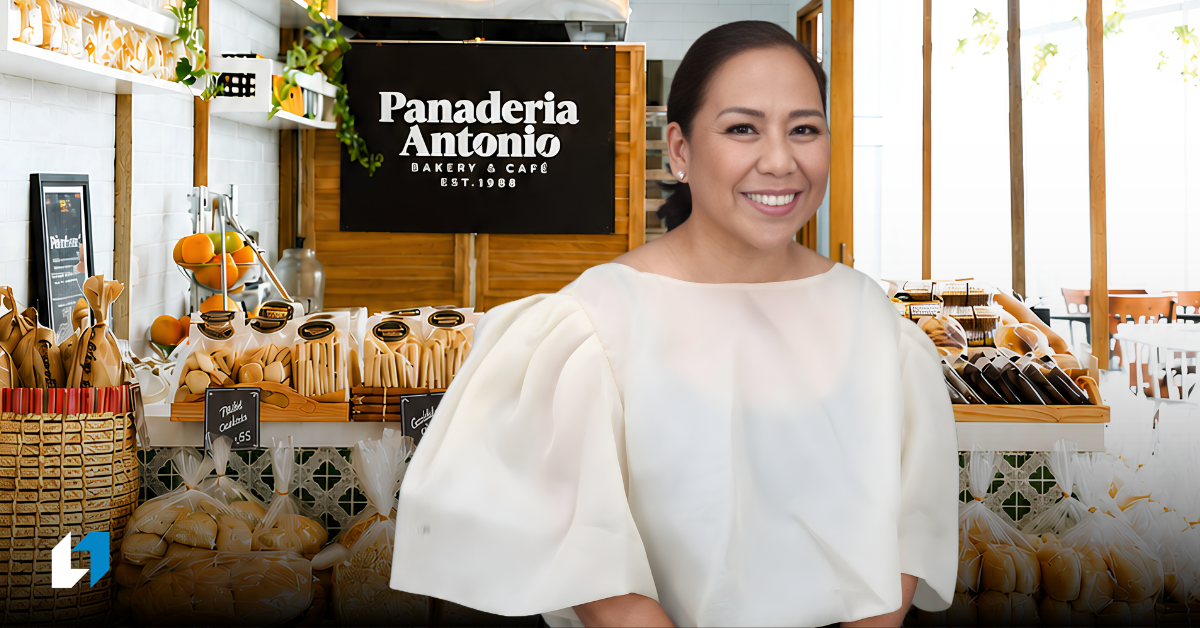
When Kamela Seen and her husband accepted their first mall opportunity in Dagupan, it looked like a breakthrough. After years of surviving through catering and informal work, they were finally being offered a proper retail space. The catch was that the opportunity came with limitations they would only fully understand once operations began.
“At that time, tamang tama nagkaroon kami ng offer sa isang mall,” Seen recalls. The space was small—just 25 square meters—and located near the entrance of a supermarket inside a lifestyle center. The proposal was straightforward: open a bakery. Given her husband’s background, it seemed like a natural fit. “Kasi yung family ng husband ko owns the oldest bakery in our town, yung Sanitary Bakery,” she explains. The mall owner even encouraged them to sell pandesal, reassuring them that bread would work in that location.
They named the bakery Panaderia Antonio and took the offer, knowing full well that they were stepping into unfamiliar territory. What they did not have—critically—was a production area. The retail space could sell bread, but it could not make it.
Instead, they relied on borrowed infrastructure. Seen explains that her in-laws allowed them to use their bakery’s production area after hours. “Pinahiram lang kami ng in-laws ko ng production area nila after nila mag-produce,” she says. That meant their schedule was dictated by someone else’s operations. “Kung ang time nila is from 3:00 a.m. to 3:00 p.m., kami naman yung next gagamit.”
This arrangement shaped their daily reality. Production began when others finished. Timing was tight, fatigue was constant, and there was little room for error. Any delay upstream affected their ability to supply the store. Still, Seen accepted the setup because it was the only way forward. Building their own production space was financially impossible at the time.
Funding the bakery itself was another challenge. Capital was limited, and traditional financing options were scarce. Eventually, they secured a loan through a rural bank connection. “Yung funding namin noong time na yun,” Seen says, “yung Dad ko may friend na isang rural bank sa amin, nagkaroon kami ng chance na magloan kahit medyo mataas ang interest rate.” The terms were far from ideal, but waiting for better conditions was not an option. Survival had already taught her that momentum mattered.
The first year was about endurance rather than growth. They focused on keeping the bakery running, paying loan obligations, and managing costs carefully. The location helped—being at the supermarket entrance gave them foot traffic—but margins remained thin. Despite steady sales, the business did not immediately generate meaningful financial relief.
Still, the bakery proved viable enough to attract attention. After the first year of operations, another opportunity emerged. “After ng first year ng operations namin,” Seen recalls, “in-offeran kami ulit ng second store sa Urdaneta.” The location was an hour away from Dagupan, adding logistical complexity. Shortly after, a third opportunity came up—a standalone branch on land owned by her grandmother.
On paper, this looked like progress. Three locations suggested scale. In reality, the same constraints followed them. Production was still borrowed. Financing was still tight. Operations became more complicated, not more efficient. “So okay lang, nagsu-survive naman kami,” Seen says, “pero kahit tatlo na sya hindi ganon kabilis ang turnover financially.” Revenue circulated, but it did not accumulate. “Parang umiikot lang,” she adds.
That realization forced Seen to confront a hard truth. Expansion alone was not solving their problems. More stores meant more overhead, more coordination, and more pressure—without a corresponding increase in financial stability. The bakery business was working operationally, but it was not working strategically.
Looking back, Seen sees this phase as essential training. Running a retail operation without owning production taught her discipline. Managing high-interest debt sharpened her financial instincts. Being dependent on borrowed infrastructure exposed the fragility of growth built on constraints rather than control.
This period also clarified what she did not want long-term. She did not want a business where margins were constantly squeezed by inputs she could not fully manage. She did not want growth that looked impressive from the outside but felt stagnant from the inside. Most importantly, she realized that sustainability required something more than footprint.
Panaderia Antonio taught Kamela Seen a lesson that many entrepreneurs learn too late: having a store is not the same as owning the engine behind it. By building a bakery with borrowed production space and expensive financing, she learned how fragile growth can be when infrastructure is not under your control. That realization did not end her entrepreneurial journey—it redirected it. The pressure of operating within tight constraints eventually pushed her toward a more differentiated, product-led path, setting the stage for what would come next.
This article includes quotes from an interview originally published by Esquire Philippines, authored by Henry Ong.

