

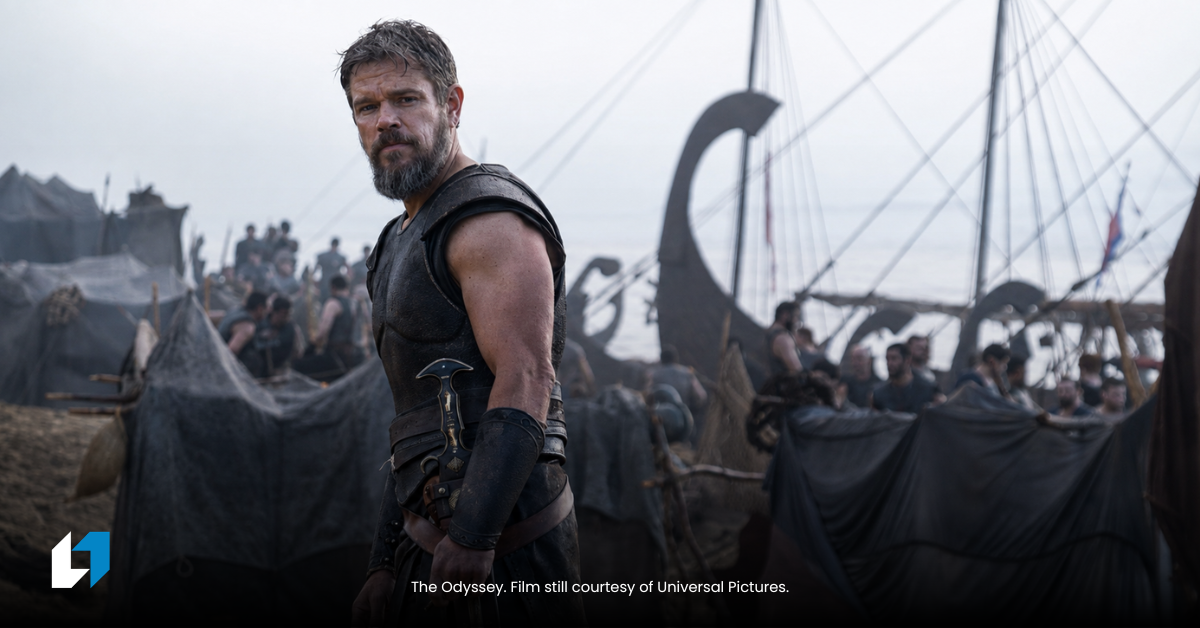
Christopher Nolan’s The Odyssey has introduced a new generation to one of the oldest survival stories ever told.
The film, which opened in cinemas on July 17, follows Odysseus, the king of Ithaca, as he attempts to return home after the Trojan War. His journey takes 10 years and exposes him to storms, monsters, temptation, betrayal and repeated losses.
The story has also become a major commercial success. The Odyssey generated about $264 million worldwide during its opening weekend, the strongest global debut of Nolan’s career. The film was the first feature shot entirely with IMAX film cameras, which helped turn the ancient story into a modern cinematic event.
Beyond its action and spectacle, the film offers useful lessons about investing, particularly for Filipinos who have had to navigate years of volatile stock prices, high inflation, changing interest rates and a weak peso.
Anyone who has invested in the Philippine Stock Exchange knows that building wealth rarely follows a straight line. The PSEi can rally sharply one year and struggle the next. Property prices can stagnate. Interest rates can change. A promising stock can suddenly disappoint.
Odysseus’ journey offers a useful analogy. The destination may appear clear at the beginning, but reaching it requires discipline when circumstances change.
The investors who succeed are not always those who move fastest or earn the highest return in a single year. They are often the ones who remain financially strong enough to survive the entire journey.
Here are five investment lessons from The Odyssey.
1. Start With a Clear Destination
Odysseus faces countless distractions and dangers, but his objective remains unchanged: he wants to return to Ithaca. This destination gives meaning to every decision he makes.
Filipino investors also need to know where they are going before deciding where to place their money. An investment portfolio intended for retirement 20 years from now may look very different from one meant to fund a condominium down payment or a child’s college tuition within the next three years.
The objective determines the appropriate combination of return, risk and liquidity.
Someone saving for a near-term obligation may prefer time deposits, money market funds or short-term fixed-income instruments. A younger investor with a longer horizon may be able to allocate more to equities, including Philippine stocks, global funds or other growth assets.
Without a clear destination, investors can become overly influenced by short-term market movements.
A sudden rally in the PSE may tempt them to buy a stock they do not understand. A sharp correction may cause them to sell a fundamentally sound company because they never established how long they intended to hold it.
A financial goal provides direction during periods of uncertainty. Before investing, an individual should define the amount required, the expected time horizon and the level of loss that can be tolerated. These factors can help determine whether the portfolio should favor equities, bonds, cash, property or a combination of assets.
The clearer the destination, the easier it becomes to distinguish a temporary setback from a genuine threat to the plan.
2. Survival Is More Important Than Winning Every Battle
Odysseus does not complete his journey because he defeats every opponent. He succeeds because he survives.
This may be the most important lesson for investors, especially in a market as volatile as the Philippines. Capital must remain intact long enough to benefit from future opportunities and the power of compounding.
An investor who pursues maximum returns without regard for risk can suffer a loss so severe that recovery becomes extremely difficult. A 50-percent decline requires a 100-percent gain merely to return to the original amount.
Philippine investors have seen how quickly fortunes can change. A stock that appears unstoppable during a bull market can lose much of its value once sentiment turns, earnings disappoint or debt becomes a concern.
Excessive leverage creates an even greater threat to survival. Borrowed money can increase gains when prices rise, but it can also force an investor to sell precisely when prices collapse.
Concentrated portfolios carry a similar danger. It is not unusual for local investors to place a large portion of their portfolio in only one or two favorite stocks. That strategy can produce exceptional gains when the companies perform well, but a single corporate problem can also destroy years of accumulated wealth.
Diversification may not produce the most exciting result during a speculative boom. Its purpose is to prevent one mistake from ending the entire journey.
An investor can diversify across Philippine equities, fixed income, cash, property and even overseas investments rather than depend entirely on a single company or market.
Investors should therefore ask not only how much they can earn, but also how much they could lose and whether they could continue investing after that loss. Wealth creation begins with capital preservation.
3. Resist the Siren Call of Easy Profits
Among the most famous threats in The Odyssey are the Sirens, whose irresistible songs lure sailors toward destruction.
Odysseus knows that willpower alone may not be enough. He orders his men to block their ears and tie him to the ship’s mast before they pass the danger.
Financial markets have their own siren calls. Filipino investors encounter them through guaranteed investment schemes, supposed insider tips, speculative stocks, cryptocurrencies and social media personalities who promise unusually high returns with little risk.
They become especially persuasive during bull markets when friends, colleagues and online traders appear to be making easy money.
Greed often becomes strongest after prices have already risen sharply.
At that point, investors may abandon valuation, ignore financial statements and convince themselves that prices will continue rising simply because they have already risen.
The temptation can be even stronger in smaller Philippine stocks where a sudden surge in price or volume can create the impression that someone knows something the public does not.
Like Odysseus, investors need protection before temptation appears.
This may include limits on how much can be placed in speculative stocks, predetermined buying prices and rules against borrowing money for high-risk trades.
Investors should also learn to examine earnings, cash flow, debt and valuation rather than rely entirely on rumors or price momentum.
A written investment plan can serve as the equivalent of Odysseus’ mast. It reminds investors why they bought an asset, what could invalidate the original thesis and how much exposure they are willing to accept.
Discipline is easier to maintain when the rules are established before excitement takes control.
4. Adapt to Changing Conditions Without Losing the Goal
Odysseus cannot control the sea, the weather or the creatures he encounters. He survives because he changes his tactics while keeping his final destination intact.
Filipino investors operate under similar conditions. They cannot control inflation, Bangko Sentral ng Pilipinas interest-rate decisions, movements in the peso, oil prices, geopolitical conflicts or government policies.
A weakening peso can increase the cost of imports. Higher interest rates can hurt property companies and highly leveraged businesses. Higher oil prices can pressure consumer spending and corporate margins.
These conditions can change the outlook for individual investments even when an investor’s long-term financial objective remains the same.
A long-term strategy therefore cannot mean refusing to change. Investors may need to rebalance when equities become too large a percentage of their portfolios. They may need to reduce exposure to a company whose earnings have deteriorated or hold more cash when their personal financial circumstances change.
However, adaptation should not become constant reaction.
The Philippine stock market can move sharply on foreign fund flows, political developments or temporary shifts in sentiment. Investors who change strategy after every market decline or news report may repeatedly sell low and buy high.
The key is to separate a change in market price from a change in investment value.
A blue-chip stock may decline because foreign investors are leaving emerging markets even though the company continues to generate cash, pay dividends and expand its business. In that case, a lower price may eventually create an opportunity.
The situation is different when debt becomes unsustainable, management loses credibility or the company’s core business suffers permanent deterioration.
Successful investing requires flexibility in execution but consistency in purpose. The route may change. The destination should not.
5. Patience Is an Active Investment Skill
Odysseus’ journey home lasts 10 years. Progress is slow, uncertain and often difficult to recognize. There are moments when he appears close to his goal, only to be pushed farther away.
Building wealth in the Philippines can feel the same. There are periods when the PSE remains weak for years, property prices barely move or investment returns fail to keep pace with expectations. Investors may begin to wonder whether they would have been better off keeping everything in cash.
But compounding rarely produces dramatic results during the early years. An investor who places ₱100,000 in an investment that earns an average return of 8 percent annually would have about ₱216,000 after 10 years, assuming returns are reinvested. After 20 years, the amount would rise to approximately ₱466,000.
The result becomes more powerful when the investor continues adding money every month or every year.
This is particularly important for Filipino workers who may not begin with millions of pesos. Wealth can still accumulate through regular contributions to stocks, UITFs, mutual funds, bonds or other suitable investments.
Yet investors often interrupt compounding because they become impatient.
They abandon a sound strategy after a weak year, chase the stock that recently produced the highest return or withdraw money intended for a long-term goal.
Patience does not mean holding every investment forever. A company can deteriorate, a valuation can become excessive and new information can invalidate the original thesis. Patient investors still monitor their holdings and make decisions when the facts change.
The difference is that they do not mistake temporary discomfort for permanent failure.
Patience is not passive. It requires the ability to tolerate uncertainty while continuing to evaluate whether the investment remains capable of reaching the objective.
Wealth Is a Journey of Survival
The Odyssey endures because its themes remain familiar despite the age of the story.
Odysseus must manage fear, pride, temptation and uncertainty before he can reach home. Filipino investors face the same emotional pressures whenever the PSE falls, inflation rises or another promising investment suddenly becomes popular.
They become fearful when markets fall, greedy when prices rise and impatient when wealth takes longer to accumulate than expected.
The greatest threat may not come from the market itself. It may come from the decisions investors make when those emotions become strongest.
A successful investment journey therefore requires more than intelligence or the ability to identify the next promising stock on the PSE.
It requires a clear destination, protection against catastrophic loss, resistance to easy profits, flexibility when conditions change and patience when progress appears slow.
Odysseus does not reach Ithaca because the journey becomes easy. He reaches it because he continues despite the obstacles.
Filipino investors who want to survive the long journey to wealth must learn the same lesson. The objective is not to avoid every market correction, economic slowdown or financial mistake. It is to remain financially strong enough to reach the destination.

