

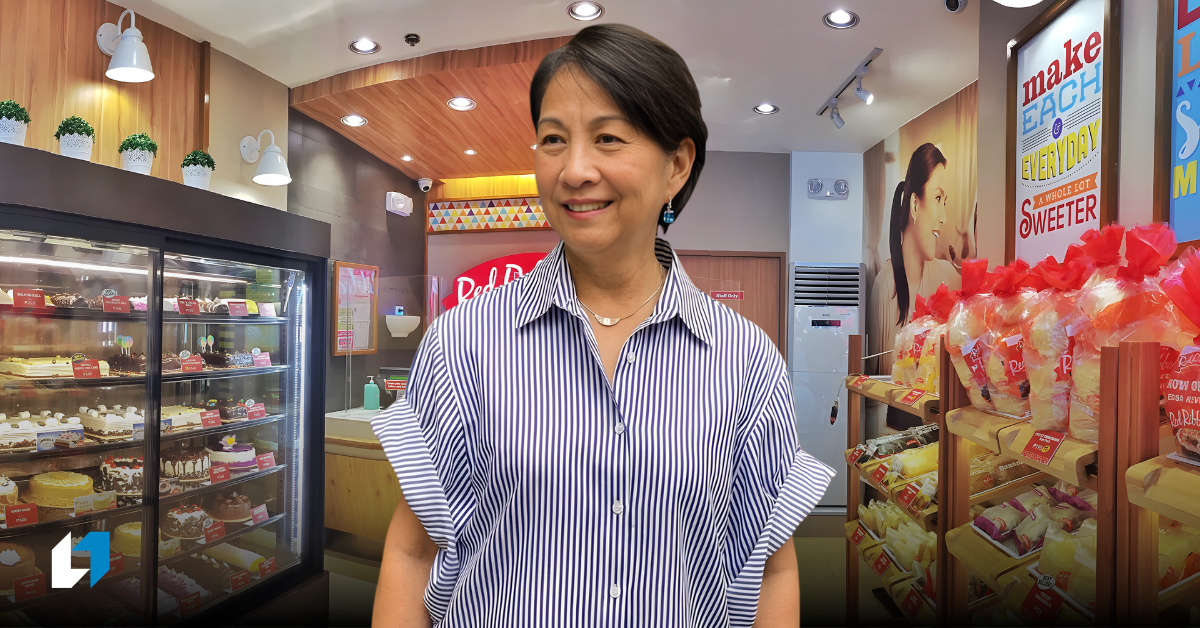
When Tessie Moran opened the first Red Ribbon store, her life was already in transition. She was starting a business for the first time while preparing to become a mother, with no clear boundary between personal life and work. The store blessing took place in March, and she was due to give birth just a few months later. Even so, the pace never slowed.
Moran recalls that she was pregnant with her son, Philip, who would later become co-founder and president of Caramia, when the business officially began. “I was pregnant with Philip. I was due to deliver him in June,” she says. Despite the physical strain, she continued baking daily and fulfilling large orders. “The blessing of the store was in March, and I had an order, and I was preparing my order for a big mango cake while I was already in labor,” she adds, underscoring how fully intertwined her personal and professional lives were at the start.
In its earliest days, Red Ribbon was not yet a focused cake brand. Moran sold whatever customers were willing to buy and whatever helped keep the business going. Alongside cakes, the menu included palabok, dinuguan, and baked macaroni—items that often sold faster than desserts at the time. “We would also sell orders like palabok, dinuguan, and baked macaroni,” she says. “I think those were the ones selling more at that time kasi yun ang pinupuntahan.” The approach was practical rather than strategic, shaped by demand rather than branding.
The first year was physically and emotionally demanding. Moran was adjusting to motherhood while running daily operations with very limited help. “The first year was a very busy year because I already had a baby and I was baking,” she says. She relied on a small group of helpers who were also learning on the job. “I only had helpers who would assist me who eventually learned na lang.” With no established systems in place, most of the responsibility fell on her. “It was a lot of work, but I was young,” she says. “The first year was a struggle, but because of the demand and good feedback, it was encouraging.”
Family support played a crucial role in helping her sustain that intensity. Moran credits her mother and sister for helping her manage operations at a time when doing everything alone would have been overwhelming. “The support of my mom and my sister was very helpful because it was not easy running the operations with helpers alone,” she says. Their involvement allowed her to keep going during the most demanding phase of the business.
As Red Ribbon gained traction, Moran began focusing on areas beyond baking. She spent significant time researching packaging and sourcing materials, understanding that presentation mattered just as much as taste. “Aside from researching products, I was also researching packaging,” she explains. Certain cakes required specific containers, while others needed carefully designed boxes. Together with her sister, she regularly went to Quiapo and Divisoria to source cake pans, boxes, and supplies. “We would buy the pans, the packaging, the boxes, lahat yan,” she says. “Quiapo and Divisoria were our destinations.”
One milestone that stayed with her was purchasing her first Hobart mixer. Moran recalls the excitement vividly. “I remember buying my first Hobart mixer,” she says. “It’s probably the same feeling you get when you buy a nice car. I was so excited, I couldn’t sleep.” For her, the mixer symbolized progress and confidence. “I even carried it with me,” she adds. “It was like having my first BMW.”
Expansion followed gradually. The second store opened in Pasig in 1981, offering the same cakes that had already gained popularity in Quezon City. Production still happened at home. “By the third store, Tessie was making all the cakes in our apartment,” her husband Danny recalls, “so we had to deliver everything from the apartment to the store—naka-jeep lang.” Growth came organically, driven by customer demand rather than aggressive expansion.
Tessie Moran’s early journey shows that entrepreneurship often begins in imperfect conditions—when responsibilities collide and certainty is in short supply. By building Red Ribbon while becoming a mother, she learned that progress does not wait for ideal timing. It rewards persistence, adaptability, and the willingness to stay hands-on when systems do not yet exist. Those formative years, shaped by hard work and family support, laid the foundation not only for Red Ribbon’s success but also for the discipline that would later define Caramia.
This article includes quotes from an interview originally published by Esquire Philippines, authored by Henry Ong.

