

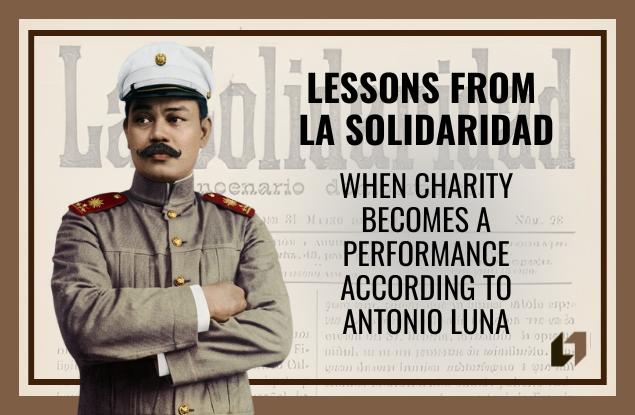
More than a century before social media turned charity into something people often share publicly, Filipino intellectual Antonio Luna had already noticed something about human nature: generosity is sometimes driven not only by compassion, but also by the desire to be seen as compassionate.
In 1891, writing under the pen name Taga-Ilog, Luna published an essay titled “Of the Present” in the reformist newspaper La Solidaridad. The essay explored how societies respond to suffering and why people are often moved to give.
When Disaster Awakens Compassion
At first glance, Luna’s reflections appear to celebrate the power of charity. When disasters strike, he observed, communities often mobilize quickly to help those who suffer. Wealthy citizens, ordinary workers, and members of the aristocracy all contribute what they can. “The rich as well as the poor, the aristocracy as well as the common people… render help to alleviate such disasters,” he wrote.
To Luna, these moments revealed something admirable about human nature. Tragedy can awaken a powerful sense of solidarity, prompting people to donate money, clothing, food, and labor to help others rebuild their lives. Compassion spreads quickly, almost like an electrical current running through society.
Yet Luna also noticed a curious contradiction. The same crowds capable of deep sympathy could also be entertained by spectacles of cruelty. He pointed to the popularity of bullfights, where audiences gathered eagerly to watch violence in the arena. “The masses become frenzied with joy upon seeing blood spilling from horses sacrificed at the bullfight,” he wrote.
For Luna, this contrast revealed something important about human psychology. Emotions are powerful but inconsistent. People who cheer scenes of violence can, in another moment, feel deeply moved by suffering.
When Charity Becomes a Public Display
The essay becomes even more interesting when Luna describes charity campaigns taking place in the streets of Madrid. Citizens donated clothing and personal belongings to help victims of disasters. Some gestures were clearly heartfelt. Luna recounts one striking moment when a woman removed her own shawl and offered it to the relief effort.
“There goes my shawl,” she exclaimed, before adding, “Wait until I remove my petticoat; I have nothing else.”
Scenes like this demonstrated genuine sacrifice. But Luna also observed that public charity sometimes took on another dimension. Fundraising events, speeches, and campaigns could turn generosity into a form of spectacle.
Giving, in these settings, was not only about helping others. It could also become a way to display virtue, reputation, or social standing.
Luna suggested that charitable movements sometimes succeed by touching what he called “the wound which is called vanity.” When people’s pride or desire for recognition is engaged, generosity can flow quickly.
That observation did not mean Luna dismissed charity itself. Rather, he was acknowledging a simple reality: human motivations are rarely pure. People give for many reasons—empathy, guilt, faith, social pressure, or the wish to be admired.
The Difference Between Public Charity and Real Generosity
For Luna, the most meaningful acts of generosity are those that do not seek recognition. “Charity work is that which unfolds by impulses from within, in silence and obscurity,” he wrote.
More than 130 years later, Luna’s insight still feels remarkably relevant. Today, charitable campaigns can spread instantly through digital platforms. Online fundraising drives and disaster relief efforts mobilize millions of donors within hours.
At the same time, acts of generosity are often shared publicly through social media posts, campaigns, and viral stories. Many of these efforts are sincere and beneficial. Yet Luna’s observation still holds: the desire to help others can sometimes blend with the desire to be seen helping.
In the end, Luna’s essay offers a simple but enduring reminder. Compassion is real, and people are capable of remarkable generosity. But the motivations behind charitable acts are often complex.
As Luna understood more than a century ago, the true measure of generosity may not lie in how visible it is—but in how sincerely it is given.

