

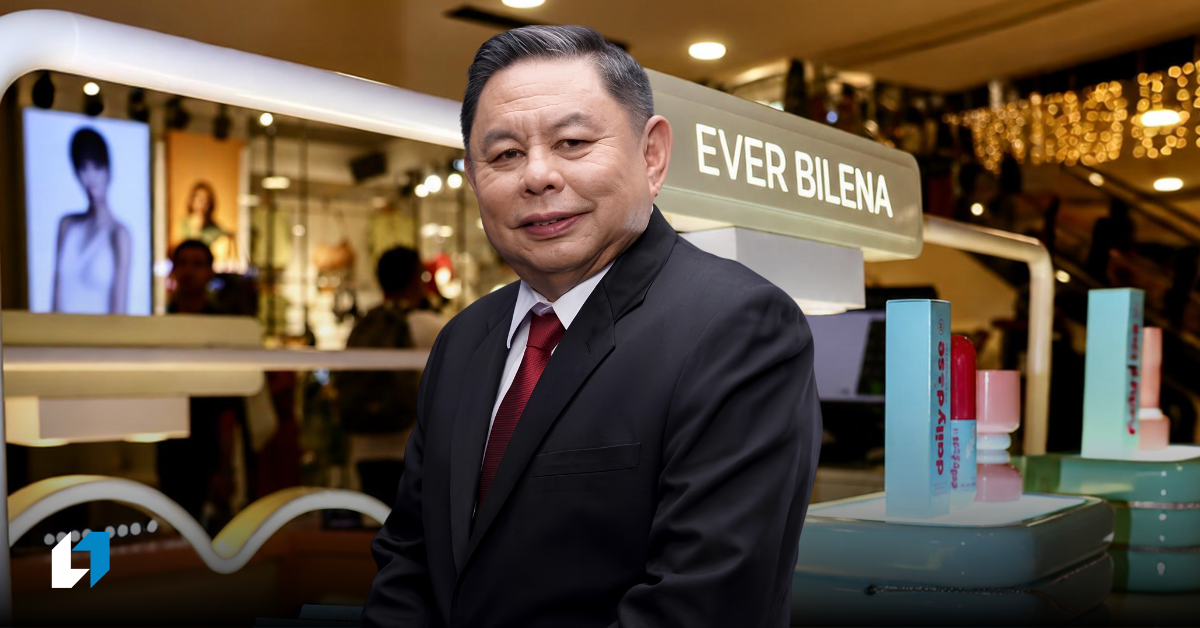
After years of watching a family business collapse and experiencing the instability of trading different products, Dioceldo Sy reached a moment of clarity. Hustling had kept him alive, but it had not given him direction. What he wanted next was not just income—it was control.
“Then after two years, I said, why should I sell all these things?” Sy recalls. That question marked the end of his Divisoria phase. The answer came naturally. “So I realized I should go back to the industry that I know, which is cosmetics.”
Unlike trading random goods, cosmetics was familiar territory. It was the industry he had grown up observing and later worked in hands-on. But starting again meant beginning from zero—without a factory, without products, and without partners.
To move forward, Sy had to find a supplier. At the time, there was no internet, no email, and no shortcuts. “I went to the consul office of Taiwan,” he says. The process was manual and deliberate. “Nag-research ako ng mga 20 to 30 companies.”
Communication required patience. “Nagpadala ako ng sulat kasi wala namang fax noon, di ba?” There were no guarantees. “And then hinintay ko lang na may mag-reply.” Most did not. But one did. “May isang nag-reply, ito nga si Ever Bilena.”
What made the connection remarkable was how aligned both sides were. “Sabi nya, ‘We’re looking also for a distributor.’” Sy had been searching for a supplier, and the supplier was searching for someone like him. “So parang nagtagpo lang kami,” he says.
With a potential partner in place, the next decision was product selection. Timing mattered. “At that time, ang hot item was nail polish,” Sy explains. He knew he needed something with high demand and manageable complexity. “Sabi ko I need nail polish.” The response was immediate. “Sabi nya, ‘We do have nail polish.’”
The conversation itself required effort. “Long distance call pa nun,” Sy recalls. Eventually, he traveled. “Tapos lumipad ako. Yun ang first trip ko to Taiwan.” It was more than a sourcing trip—it was a commitment.
When discussions turned to payment terms, the risk became real. “Nag-usap kami tapos, so pwedeng LC.” Letters of credit came with a cost. “Eh LC nun mabigat din kasi 25 percent deposit dati.”
At that point, Sy had to decide how much he believed in the idea. He did not seek investors. He did not hedge. He used his own money. “Yung puhunan ko kinuha ko sa savings ko na naipon from 1976 to 1983.” The amount represented years of work. “Meron ako naipon mga P150,000.”
That was everything he had. “Yan ang lahat ng pera ko,” he says. There was no fallback plan. “All-in ako.” The risk was absolute. “Lahat ng savings ko tinaya ko.”
With that decision, Ever Bilena began—not as a brand vision or expansion plan, but as a single-product bet. “So, I started with nail polish,” Sy says. There were no elaborate launches or marketing campaigns. What mattered was getting the product in, getting it sold, and seeing if the market responded.
Starting with nail polish was intentional. It was affordable, fast-moving, and repeatable—exactly the opposite of the unstable trading Sy had just left behind. It allowed him to test demand without overextending. More importantly, it placed him back in control of supply, pricing, and inventory.
This phase represented a shift in how Sy approached business. Instead of reacting to market swings, he committed to a focused product within an industry he understood deeply. The risk was concentrated, but so was the learning.
Looking back, the decision to go all-in was not reckless—it was informed by years of exposure, failure, and observation. Sy had seen what happened when businesses lacked control, when supply dictated income, and when effort failed to compound. This time, he chose ownership over hustle.
Ever Bilena did not start with certainty. It started with conviction—and the willingness to risk everything on a product and a partnership he believed in.
Ever Bilena was born not from abundance, but from a calculated leap. By putting all his savings into a single product sourced through a painstaking process, Dioceldo Sy shifted from survival mode to builder mode. His story shows that entrepreneurship often begins not when risk disappears, but when experience makes the risk worth taking. For Sy, going all-in was not about bravado—it was about finally backing something he could control.
This article includes quotes from an interview originally published by Esquire Philippines, authored by Henry Ong.

