

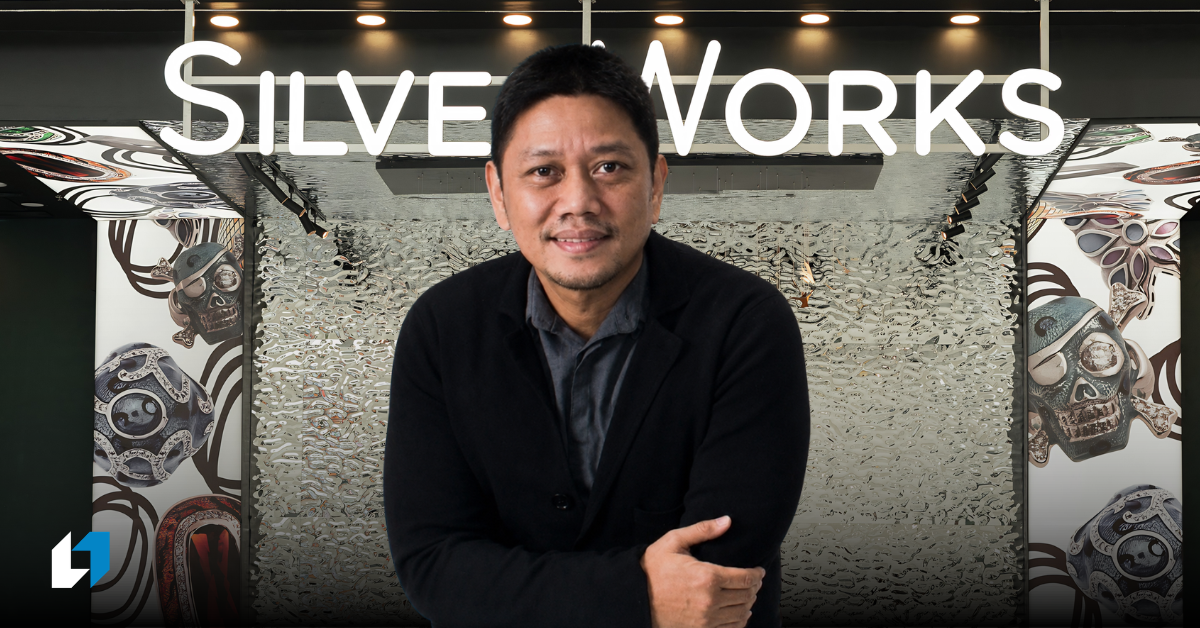
Long before Louie Gutierrez built SilverWorks into one of the Philippines’ best-known jewelry retail chains, his family had already been in the jewelry business for generations.
“I’m actually a third-generation jeweler,” Gutierrez says.
The story began with his grandfather, who started the family’s jewelry trade long before modern shopping malls or large retail chains existed.
“The jewelry business was started by my lolo in 1926.”
At a time when retail infrastructure was still limited, his grandfather relied on a more personal approach to selling. Rather than waiting for customers to visit a store, he traveled directly to them.
“My grandfather was a traveling salesman selling jewelry to women in the Visayas.”
This early method of selling reflects how many Filipino businesses originally operated: through personal relationships, mobility, and direct trust with customers. Traveling salesmen played an important role in reaching communities that had little access to formal retail establishments.
As the business grew, Gutierrez’s grandfather developed a strategy that allowed the enterprise to expand across different locations while keeping it within the family.
“He eventually had ten children,” Gutierrez recalls. “To grow the business, he assigned each of them their own area.”
Instead of centralizing the operation, the elder Ocampo decentralized it by territory. Each child received a location where they could start their own jewelry operation under the family’s entrepreneurial tradition.
“So merong Fernando, Pampanga; may Angeles; may Quezon City,” Gutierrez explains.
This territorial approach created multiple branches of the family business across different regions. In effect, it functioned as an early form of decentralized expansion—similar to how modern companies create regional operations or franchise networks.
For Gutierrez’s parents, the territory assigned to them was Olongapo.
“As for my parents, they were newly married in 1957, and the area given to them by my lolo was Olongapo.”
That city would play a crucial role in shaping the next stage of the family’s jewelry business.
“That’s where I was born—batang Gapo ako,” Gutierrez says.
During those years, Olongapo was a vibrant commercial center because of the presence of the U.S. Naval Base. The unique local economy created a steady demand for consumer goods, including jewelry.
“Most of my parents’ customers were Americans and their girlfriends,” he recalls.
The store’s operating hours reflected the lifestyle of the area.
“We stayed open until midnight because when the girls got out of the clubs, they would come straight to us to buy jewelry.”
Customers would often arrive with their American partners and make purchases late at night.
“They would bring their boyfriends and ask them to buy jewelry. That’s really how the business began for our branch of the family in Olongapo.”
The household itself revolved around the business. Like many traditional family enterprises, the store and the home existed in the same building.
“We lived in a shop house,” Gutierrez says. “The store was on the ground floor, and we lived on the second and third floors.”
Growing up in that environment meant that business education happened naturally.
“As kids, we would hang out in the store,” he recalls. “Sometimes we would even count diamonds.”
This kind of early exposure often plays a significant role in shaping the entrepreneurial instincts of the next generation. Children raised inside family businesses absorb operational knowledge informally—through observation, repetition, and participation.
The division of roles between his parents also shaped how Gutierrez understood business.
“My mom was the real negosyante in the family,” he explains. “My dad was an architect, so he brought the art, while my mom handled the business.”
That balance between creativity and commerce became an important influence on how he later approached the jewelry trade.
“That combination of art and commerce—that’s how I was raised.”
Over time, the family operation expanded beyond jewelry. As the business grew, the stores began offering a wider variety of merchandise.
“Eventually, as the business expanded, it became a department store,” Gutierrez says.
The enterprise evolved into a broader retail operation serving customers in both Olongapo and nearby provinces.
“We were selling appliances, clothing, and jewelry,” he recalls. “That was our main business.”
Looking back, the origins of the business illustrate how many Filipino family enterprises developed long before formal business education or modern corporate structures were common. Growth came from entrepreneurial initiative, family collaboration, and a willingness to adapt to the local market.
In the case of the Ocampo family, what started with a traveling jewelry salesman in 1926 eventually evolved into a multi-generation retail tradition—one that would later shape Gutierrez’s own journey into the jewelry industry.

