

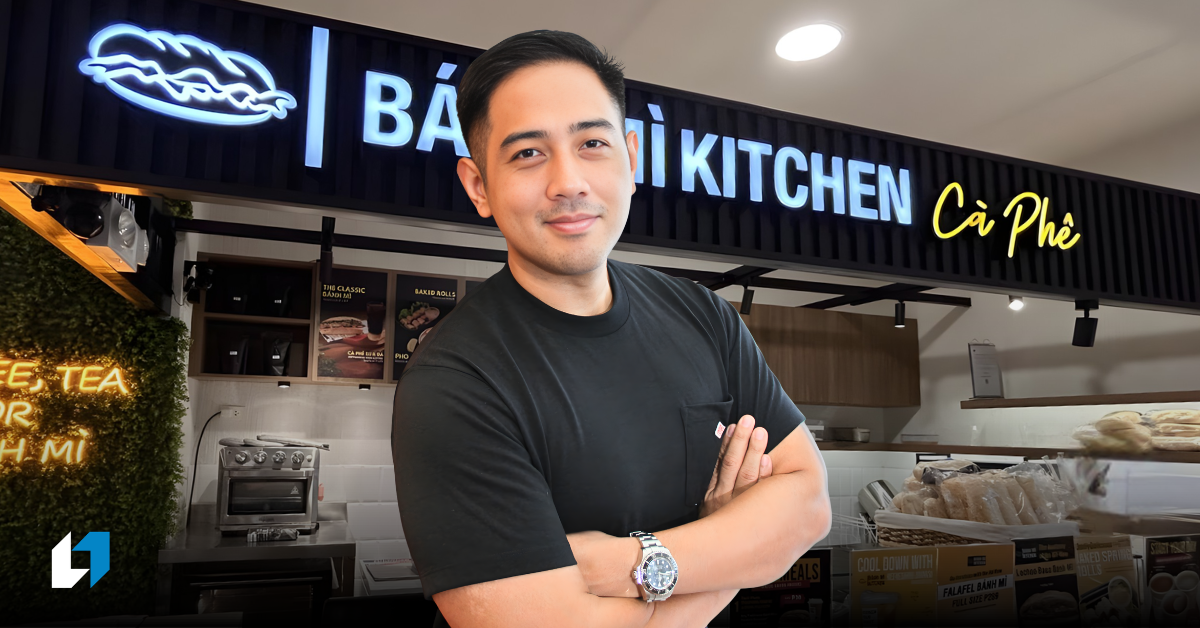
Before Mon Santos built what would eventually become the fast-growing sandwich chain Banh Mi Kitchen, his childhood was shaped by hardship, loss, and the quiet determination of a mother who believed education was the only inheritance she could give her children.
“I lost my parents at an early age,” Santos recalls. “I lost my dad when I was seven and then my mom when I was in high school.”
His father died young from lung cancer. At the time, Santos was still a child trying to understand why their family life had suddenly changed.
“My dad got lung cancer because of smoking. He was 40 years old lang,” Santos says. His father made a living selling fish in Divisoria, a trade that eventually brought his parents together. “He used to sell fish in Divisoria, so doon sila nag-meet ng mom ko. Yung mom ko naman nagba-buy and sell din ng fish.”
When his father passed away, Santos’ mother suddenly became the family’s sole provider. Like many Filipino parents faced with difficult circumstances, she found ways to survive through small entrepreneurial activities.
“When my dad died, she was the sole provider,” Santos explains. “Gagawin niya, bibili siya ng fish sa Divisoria and then ire-resell niya sa village namin, sa garahe namin, para meron siyang pang support sa amin.”
The small home-based business allowed her to keep the household running, especially since the family prioritized education.
“Kasi lahat kami Ateneo nag-aral eh so medyo mahal,” Santos says.
To supplement the income from selling fish, his mother also started other small ventures.
“Nagtayo rin siya ng parang ready-to-wear na mga clothes sa palengke.”
Stories like this are common among Filipino entrepreneurial families. Long before their children become founders or executives, many future entrepreneurs grow up watching parents run small businesses simply to keep the household afloat. These early experiences often shape a person’s understanding of risk, resilience, and hard work—even if they do not immediately enter business themselves.
Despite her determination to provide for the family, tragedy struck again years later. Santos’ mother was eventually diagnosed with breast cancer.
“My mom naman had breast cancer. I think she was 53 years old when she passed away,” Santos recalls.
With both parents gone, Santos and his siblings had to rely on each other to move forward. His older sister stepped up to become a stabilizing force in the family.
“Luckily yung eldest namin, my ate, was very responsible,” he says. “Siya yung nag-alaga sa amin. Parang siya yung kasama naming lumaki.”
His older brother also played an important role.
“My kuya naman medyo malayo ang age gap. I think 10 years, so medyo siya naman parang father figure.”
Behind the scenes, their grandmother also provided the support that kept the family afloat.
“I grew up with my siblings with the support of my lola. Siya yung nagpapa-aral sa amin.”
In many families, entrepreneurship is not always passed down through formal mentorship. Instead, values such as discipline, sacrifice, and perseverance are transmitted through everyday struggles. For Santos, the example set by his family created a strong foundation long before he ever considered starting a business.
Because there were no family businesses or corporate mentors around him, Santos had to find his own path.
“Wala talaga akong exposure sa kahit anong business or corporate,” he says. “Walang nag-guide sakin.”
What his mother emphasized instead was something simpler but far more powerful: education.
“My mom used to say wala kaming mapapamana sa inyo,” Santos recalls. “Yung education lang talaga yung mapapamana ko sa inyo.”
That message left a deep impression on the family.
“And we took that seriously. So we really studied hard.”
The belief that education can change a family’s future is deeply embedded in many Filipino households. For parents who have limited financial resources, schooling often becomes the one investment they can confidently pass on to the next generation.
After graduating from Ateneo de Manila University, Santos entered the corporate world and joined Unilever Philippines, where he began his career in sales.
“Right after I graduated from Ateneo, I worked for Unilever Philippines,” he says.
His early assignments took him outside Metro Manila, exposing him to different markets across the country.
“I worked in sales. I was assigned in Bicol and then Batangas,” Santos explains.
His role involved managing different brands within the Unilever portfolio and working closely with supermarket networks and distributors.
“I handled the different brands of Unilever for the local supermarkets.”
More importantly, the job gave him his first real exposure to how businesses operate.
“My main focus talaga was handling distributors,” Santos says. “That was my first exposure in business because it was like handling the business of the distributor.”
For many future entrepreneurs, corporate careers become an informal training ground. Working inside large companies exposes young professionals to supply chains, distribution networks, marketing strategies, and operational discipline—lessons that are often difficult to learn when starting a business from scratch.
For Santos, the experience opened up a new perspective that would later influence his entrepreneurial journey.
“That’s where my world opened up.”
What began as a childhood shaped by loss, resilience, and a mother’s belief in education would eventually lead Santos toward building a brand of his own. But long before Banh Mi Kitchen existed, the foundations of his entrepreneurial mindset were already forming—from a garage fish business in Divisoria to the lessons learned in corporate sales across the country.

