

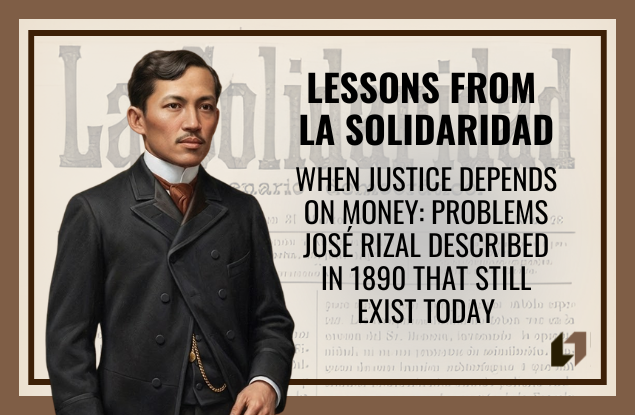
In January 1890, José Rizal published an essay titled “Ingratitudes” in La Solidaridad. The article was written as a response to accusations by the colonial government that Filipino reformists were “ungrateful sons.”
But beyond its political argument, Rizal’s essay offers something more enduring: a candid description of how power, justice, and authority operated in everyday life in the Philippines under Spanish rule.
In recounting the conditions he witnessed growing up in Laguna, Rizal described problems that remain strikingly familiar today—abuse of authority, corruption in the justice system, unchecked economic power, government inaction, and the social cost of speaking the truth.
More than a century later, many of these patterns continue to appear in different forms.
When Authority Becomes a Source of Fear
Rizal begins with a memory from his childhood about encounters with colonial officials.
He recalls how ordinary citizens often feared the very authorities responsible for maintaining order.
“We saw almost every day the Lieutenant of the Civil Guard, the Alcalde, when he visited it, hitting and wounding the helpless and peaceful citizen who did not uncover his head and salute from a distance.”
This description reveals a system in which authority relied heavily on intimidation. The Civil Guard, which functioned as the colonial police force, wielded significant power over local communities.
Rizal observed that violence was not an isolated incident but part of daily life.
“In our town we saw force unleashed, violence and other excesses committed by those who are in charge of keeping public peace.”
What Rizal described reflects a broader pattern that societies continue to confront today: when those entrusted with authority overstep their power, the institutions meant to protect the public can become sources of fear instead of security.
Across the world, debates about law enforcement accountability, abuse of authority, and the proper limits of power remain central to public discourse. The mechanisms may have changed, but the fundamental tension between authority and accountability continues.
When Justice Depends on Money
One of the most powerful observations in Rizal’s essay concerns the administration of justice.
He described what people expected when they had to deal with authorities in the provincial capital.
“I knew from what I had seen and heard that when a resident of the town went to the capital, it was to go to Bilibid, if he did not take money with him to placate justice.”
This sentence captures the essence of systemic corruption.
Justice, in Rizal’s account, was not simply determined by facts or law. It could depend on a person’s ability to pay or influence officials.
The implication was clear: the legal system did not operate equally for everyone.
More than a century later, corruption remains one of the most persistent challenges in governance around the world. While institutions have evolved and legal safeguards have improved, allegations of bribery, political influence, and unequal access to justice continue to surface in many societies.
Rizal’s observation reminds us that the credibility of any legal system depends not only on laws but on the public’s confidence that those laws are applied fairly.
The Power of Landowners and Economic Inequality
Rizal also described the tension between powerful landowners and ordinary tenants.
Large estates in Laguna were controlled by religious orders, particularly the Dominican friars. According to Rizal, rents charged to tenants were increased arbitrarily.
“The high rents which they collect annually from the lands… were increased arbitrarily and unjustly.”
The tenants attempted to raise their concerns with authorities and petitioned the government for intervention.
But their efforts produced little result.
“The government became silent; it did not dare to intervene.”
This dynamic—powerful property owners on one side and vulnerable tenants on the other—illustrates a recurring challenge in many societies: the imbalance between economic power and the protection of ordinary citizens.
Today the context has changed, yet similar debates continue to arise around housing affordability, tenant protections, land ownership, and economic inequality. In many countries, rising rents and housing shortages have revived discussions about how governments should balance property rights with social fairness.
When Government Chooses Silence
Perhaps the most troubling element in Rizal’s account was the passivity of the authorities.
Even when citizens raised legitimate grievances and submitted formal petitions, the government avoided confronting the issue.
“Nothing came of it: the government became silent.”
Rizal explained that the authorities neither investigated the claims nor responded to the complaints.
“It did not answer either the petition of the people or their just complaints.”
This silence allowed abuses to persist.
The problem Rizal described was not simply corruption or injustice, but institutional indifference—a situation where authorities prefer inaction rather than challenging powerful interests.
Today, citizens across many countries continue to express frustration when governments appear slow to act on pressing concerns. Whether the issue involves housing, economic inequality, corruption, or public services, the perception that authorities are unresponsive can erode public trust.
Rizal’s account reminds us that governance requires not only laws but also the willingness of institutions to enforce them.
The Risk of Speaking the Truth
Despite the injustices he described, Rizal believed that exposing abuses was necessary.
But those who spoke out often faced criticism or accusations of disloyalty.
The colonial authorities labeled reformists “ungrateful sons.”
Rizal responded by redefining what that accusation really meant.
“What is meant by ingratitude is the fact of telling the truth so that the abuses of other sons might be corrected.”
His argument was simple yet profound: criticism is not betrayal.
Rather, it is a way to correct wrongdoing.
Even today, individuals who expose corruption or challenge powerful institutions—journalists, reform advocates, whistleblowers—sometimes face similar accusations. They may be labeled disloyal, disruptive, or ungrateful.
Rizal’s response suggests that the willingness to confront uncomfortable truths is often necessary for meaningful reform.
Education and the Purpose of Knowledge
Toward the end of the essay, Rizal addressed the role of education.
He argued that educators should guide students with integrity rather than demand unquestioning loyalty.
“The teachers who educate Filipinos should consider themselves like nurses or tutors that a mother hires to look after her child.”
Education, in his view, should serve the welfare of the nation.
“Between the interests of the friars and those of our Mother Country, we are with the latter.”
If education is used to suppress truth or protect unjust systems, Rizal warned, it loses its true purpose.
“Education with such bastardly aims is not education; it is corruption.”
Even today, debates continue about the role of education in shaping civic values, critical thinking, and public responsibility. Rizal’s reflection underscores the importance of institutions that encourage inquiry rather than obedience.
What Has Not Changed
The Philippines today is vastly different from the colonial society Rizal described in 1890. The country is independent, democratic institutions exist, and many reforms have transformed the political landscape.
Yet the issues Rizal observed remain recognizable.
The tension between authority and accountability, the struggle to maintain fairness in the justice system, the influence of economic power, the challenge of government responsiveness, and the courage required to speak the truth are not problems limited to one era.
They are recurring questions that every society must continually address.
Rizal’s essay therefore serves not only as a historical document but also as a reminder.
The institutions of justice, governance, and education must constantly be strengthened. Otherwise, the patterns he described more than a century ago may quietly persist in new forms.
And that, perhaps, is why Rizal’s observations still resonate today.

