

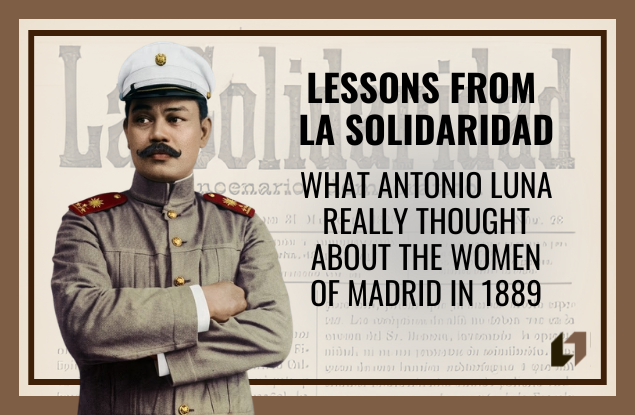
In December 1889, long before he became a revolutionary general, Antonio Luna published a fascinating essay in the reformist newspaper La Solidaridad. Writing under the pen name Taga-Ilog, Luna wrote a piece titled “Bullfighters’ Blood.”
The article begins in an unexpected way. Instead of politics or colonial grievances, Luna opens with a vivid description of the women of Madrid. But what starts as admiration soon becomes a deeper reflection about culture, perception, and the strange experience of being a Filipino in Spain during the late nineteenth century.
Luna’s First Impressions of Madrid Women
Luna begins his essay with a direct and almost playful declaration:
“The women of Madrid are pretty.”
He then paints a detailed portrait of them as he observed them walking through the streets of the Spanish capital.
He describes their diversity and elegance:
“Blondes, brunettes and auburn-haired; tall, short, fat and thin… all breathe the same air.”
To Luna, their faces seemed almost sculpted:
“Round faces, brows of delicate porcelain which would break into fragments at the impact of a kiss.”
Their complexion, he wrote, had the softness of rose petals:
“Ivory complexion with rose petals that intoxicate.”
The description reads almost like poetry. Luna was clearly fascinated by the beauty and style of Madrid women.
Fashion, Grace, and Confidence
Luna was equally struck by how these women carried themselves in public.
He noticed their clothing and movement through the streets.
“They wear their clothes with all grace and their walk is graceful and sedate.”
Their style reflected the influence of Parisian fashion.
“They dress in Parisian style, evince their beauty—everybody walks head high.”
He even observed their pace and confidence:
“Those who do not walk, run; and those who do not run, fly.”
To Luna, the women of Madrid embodied a certain European elegance that he had rarely seen before.
But beneath the admiration, he also sensed something more complex.
“A Mixture of Angel and Devil”
Luna soon realized that Madrid women possessed a strong personality.
He wrote:
“The Madrid woman is a special one: a mixture of angel and devil.”
At times they expressed tenderness and deep emotion.
But at other times they displayed sharp wit and mischief.
Luna describes their conversational power:
“In her natural talkativeness, a ceaseless torrent of persuasive sounds, she always displays her superiority.”
He believed that a Madrid woman could quickly understand hidden feelings.
“Your intimate feelings hidden, she will divine the reason for them.”
Their ability to persuade and influence others impressed him.
“Everyone of them is a disciple of Castelar, and all convince, urge, and persuade.”
This description reflects Luna’s fascination with a society where women participated actively in conversation and public life.
A Sudden Cultural Shock
Yet Luna’s admiration soon encountered a surprising moment.
Despite Spain ruling the Philippines for more than three centuries, many Spaniards—including some Madrid women—knew almost nothing about the colony.
He writes:
“They at times also think of us as Chinese; they also do not know what the Philippines is.”
Some Spaniards confused Filipinos with Igorots or Chinese.
“Sometimes they know of the land of the Igorots and confuse Tagalog with Chinese or some other language.”
Luna recounts a conversation that illustrates this ignorance.
A Madrid woman told him:
“But, how well you speak Spanish.”
He replied:
“Castilian, you mean, madam.”
She answered with surprise:
“Yes, sir, I am surprised that you speak it as much as I do.”
Then she asked the astonishing question:
“But, goodness gracious! In your country, is Spanish spoken?”
For Luna, the moment was deeply ironic. Spain had governed the Philippines for centuries, yet many Spaniards did not even realize that Spanish was the official language of the colony.
Admiration and Disillusionment
Luna’s essay suggests a mixture of admiration and disappointment.
On one hand, he clearly appreciated the beauty, confidence, and intelligence of Madrid women.
But on the other hand, he discovered a troubling reality: the same society that fascinated him also knew almost nothing about the people it governed overseas.
Even worse, Filipinos were often mistaken for foreigners.
“Perhaps we are thought of to be little less than savages or Igorots.”
The experience revealed the strange contradictions of the Spanish empire.
Filipinos were supposedly Spanish subjects—yet in Spain they were often treated as exotic outsiders.
Is Luna’s Observation Still Relevant Today?
More than a century later, Luna’s observations still resonate in surprising ways.
Madrid today remains a vibrant cosmopolitan city. Its streets are filled with confident and stylish women much like those Luna described in 1889.
But the world has changed dramatically.
Today Filipinos travel freely across Europe. Thousands live and work in Spain, and Filipino culture is visible in cities like Madrid and Barcelona.
What once was a distant colony has become part of a global cultural exchange.
Yet Luna’s deeper observation still carries meaning.
His essay reminds us how easily people can misunderstand cultures they think they know.
In 1889, Spaniards ruled the Philippines but barely understood it.
Today the world is more connected—but misunderstandings between cultures still happen.

