

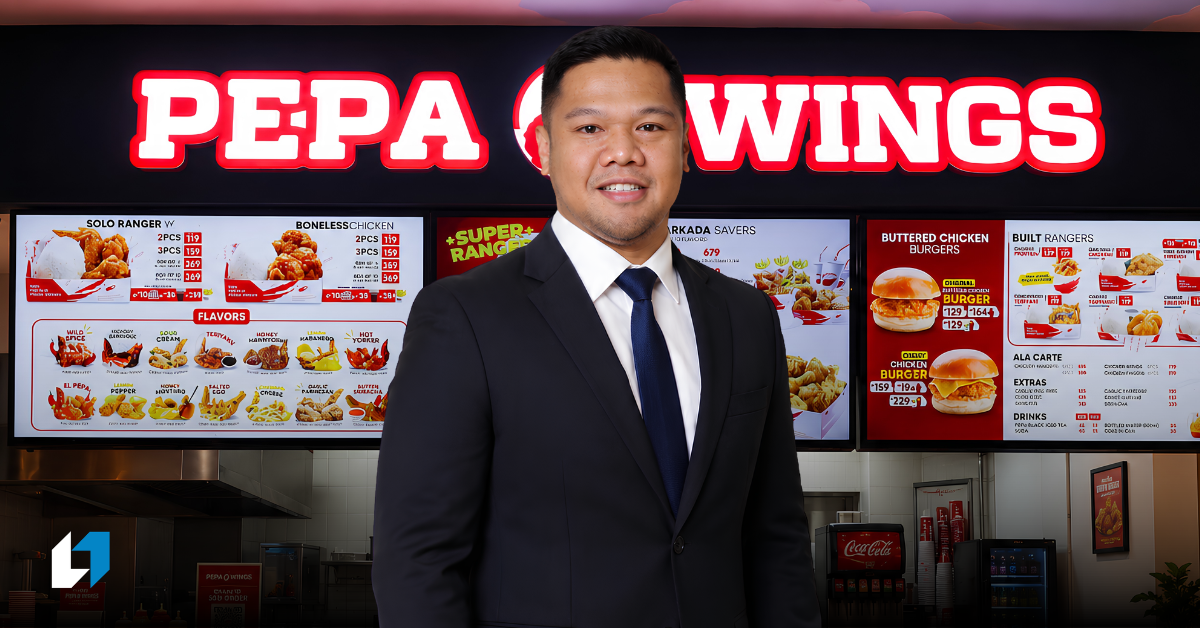
Scaling a food business often exposes its weaknesses.
What works in one store can fall apart across multiple branches. Recipes change subtly. Preparation shortcuts creep in. Customer experience becomes inconsistent.
Paul Lanquino, founder and CEO of Pepa Wings, understood early that growth without systems would undermine the brand.
“Scaling requires structure,” Lanquino says. “You cannot rely on instinct alone.”
As Pepa Wings transitioned from a single-store operation to a multi-branch brand, Lanquino focused less on expansion and more on standardization. The priority was ensuring that every customer, regardless of location, would experience the same flavor, quality, and service.
That discipline led to what he calls the 70–30 strategy.
The 70–30 Model
“Seventy percent of preparation is done at the commissary,” Lanquino explains. “Only 30 percent is completed in-store.”
This centralized production model reduced operational variability. Core sauces, marinades, and preparation steps were controlled at a central facility. Individual outlets handled final cooking and assembly.
The approach solved several scaling problems at once.
First, it minimized flavor inconsistencies. When preparation is distributed across multiple locations without structure, even small deviations can compound over time.
Second, it simplified training. New store staff did not need to master complex recipes from scratch. Much of the precision work had already been standardized at the commissary.
Third, it shortened preparation time in-store, improving operational efficiency during peak hours.
“If you leave everything to the branch level, variation becomes unavoidable,” Lanquino says. “Centralization protects the product.”
Documentation Before Expansion
Beyond the commissary system, Pepa Wings formalized its Store Operating Model. Processes were documented. Preparation steps were written down. Roles were clarified.
Lanquino’s background and training influenced this approach. “I encourage the team to constantly identify inefficiencies and improve systems,” he says, referencing his Six Sigma mindset.
For many small food brands, growth is reactive. A second branch opens because demand increases. A third opens because opportunity appears. Systems are built after problems surface.
Lanquino reversed that sequence.
“You have to make sure the system works before you grow,” he says.
That meant refining procedures while the network was still manageable. It meant measuring consistency before accelerating expansion.
The goal was replicability, not just revenue.
Preparing for Franchising
Franchising introduces a different layer of complexity. When third-party operators run branches, the brand loses direct control over day-to-day execution.
“You have to earn the right to franchise,” Lanquino says. “The business has to be replicable.”
Before offering franchise opportunities, Pepa Wings needed proof that its systems could withstand scale. The commissary model reduced dependence on individual skill levels. The documented processes ensured uniformity. Training programs reinforced execution.
“We provide structured training for both owners and staff,” he says. That includes classroom sessions, operational walkthroughs, and ongoing performance reviews.
Franchise stores and corporate-owned stores may operate under different ownership structures, but brand standards remain identical.
“KPIs may differ, but processes do not,” Lanquino explains.
That distinction is critical. Financial metrics can vary by location. Operational discipline cannot.
Consistency as Competitive Advantage
The flavored chicken wings market has grown increasingly competitive. Entry barriers are relatively low. Recipes can be copied. Pricing can be undercut.
What is harder to replicate is operational consistency across multiple locations.
“Chicken wings are easy to start,” Lanquino says. “They are difficult to sustain and scale consistently.”
The 70–30 system creates structural advantage. By removing variability at the preparation stage, Pepa Wings reduces one of the most common failure points in franchised food concepts.
It also allows the company to onboard franchise partners more efficiently. Training cycles shorten. Errors decrease. Quality control becomes measurable rather than subjective.
“Once systems mature, operations become smoother,” Lanquino says. “That’s when growth becomes sustainable.”
Growth Through Discipline
Today, Pepa Wings continues expanding through a combination of corporate-owned and franchise stores. But Lanquino resists aggressive expansion for its own sake.
The emphasis remains on steady, disciplined growth.
Operational improvements continue alongside geographic expansion. The commissary evolves. Processes are reviewed. Inefficiencies are addressed.
Scaling, in Lanquino’s view, is not about adding branches quickly. It is about building infrastructure that can support them.
“You have to protect the brand at every stage,” he says.
The 70–30 strategy represents more than an operational shortcut. It reflects a philosophy: build systems first, scale second.
In a market where many food concepts grow rapidly and then struggle with consistency, Pepa Wings has taken a more deliberate route.
Standardize. Document. Centralize. Train. Then expand.
And for Lanquino, that sequence has made scaling possible without sacrificing the flavor that built the brand.

