

When the Jaycees World Congress ended, Bobby Claudio had accomplished something few young professionals could claim. He had helped promote a global event, traveled extensively, and played a role in bringing thousands of delegates to the Philippines. But once the celebrations were over, he found himself in an unexpected position.
“So ayun. We were able to bring 5,000 delegates to the Philippines for that conference, and everything went smoothly.”
The success of the event was undeniable. What followed was less certain.
“But after the World Conference, jobless na ako kasi I resigned from my job.”
At the time, Claudio was only in his mid-20s. He had no employer to return to and no immediate plan for what came next. What he did have was a small financial cushion.
“At that time, after I resigned, may konting savings naman ako.”
Rather than spend it, he chose to invest.
“I used that to buy a commercial space in Virra Mall Shopping Center Greenhills.”
The decision was not entrepreneurial in intent. Claudio was not planning to start a business.
“My direction was not to open a store or to be a retailer.”
His thinking was straightforward.
“I just simply wanted to invest in real estate and hopefully resell it once the mall was finished.”
But once the World Congress was over and the travel stopped, the reality of owning that space set in. The unit was no longer just an investment—it came with monthly obligations.
“So yung natapos na yung Congress, sabi ko, ‘Anong gagawin ko rito?’”
Idle space quickly became a problem.
“Gusto ko lang maging productive yung space kasi nagbabayad ako ng amortization.”
The pressure to act grew, even without a clear plan.
“So sabi ko I have to start something.”
A decision without experience
At the time, Claudio had no background in retail. The move toward entrepreneurship was driven more by necessity than confidence.
“At that time, uso pa yung barter trade.”
This context shaped his thinking.
“Yun yung pinaka duty-free natin nung araw.”
Consumer behavior offered a clue.
“Everyone wanted to go to Zamboanga to buy imported goods through the barter trade.”
Claudio’s first instinct was personal rather than analytical.
“So what I did was, as a first instinct, wala naman akong experience in retailing.”
He thought about what he cared about.
“I just loved kids at that time.”
That personal connection mattered.
“My son was only four years old.”
Without overthinking it, he made a simple choice.
“I thought, sige, toys na lang so bumili ako ng toys.”
What’s striking about Claudio’s story is how unplanned this stage was. There was no market study, no long-term vision, and no blueprint. What pushed him forward was discomfort—an empty space, ongoing payments, and the need to stay productive.
The transition from being jobless to becoming an accidental entrepreneur happened quietly. It wasn’t framed as a leap of faith. It was framed as solving a problem in front of him.
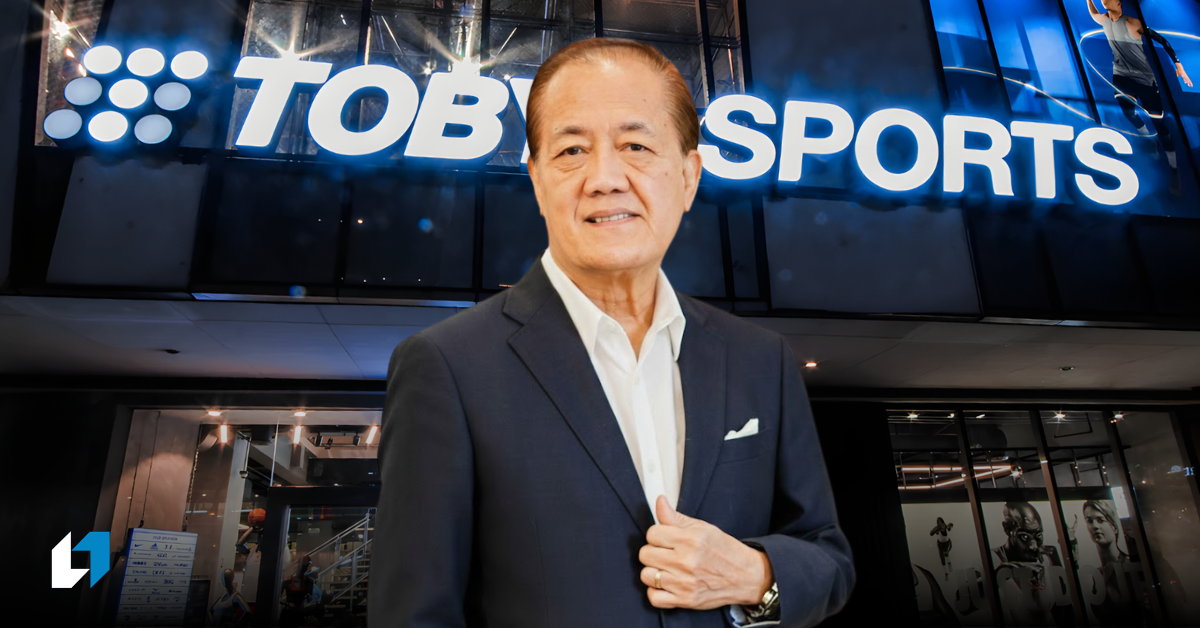
Claudio did not yet know that this decision would eventually lead to Toby’s Sports. At this stage, there was no sports retail, no brand, and no growth strategy. There was simply a young man who had taken a risk, succeeded at a global level, and then found himself asking a very basic question: what now?
The answer did not come from ambition or long-term planning. It came from circumstance.
Being jobless after a major achievement forced Claudio into action. The empty space in Virra Mall became a catalyst—not because he wanted to build a business, but because standing still was not an option.
Many entrepreneurial stories begin with a dream. Claudio’s began with uncertainty—and the realization that momentum, once lost, is hard to regain. So he chose to move forward, even without knowing where that first step would lead.
This article includes quotes from an interview originally published by Esquire Philippines, authored by Henry Ong.

