

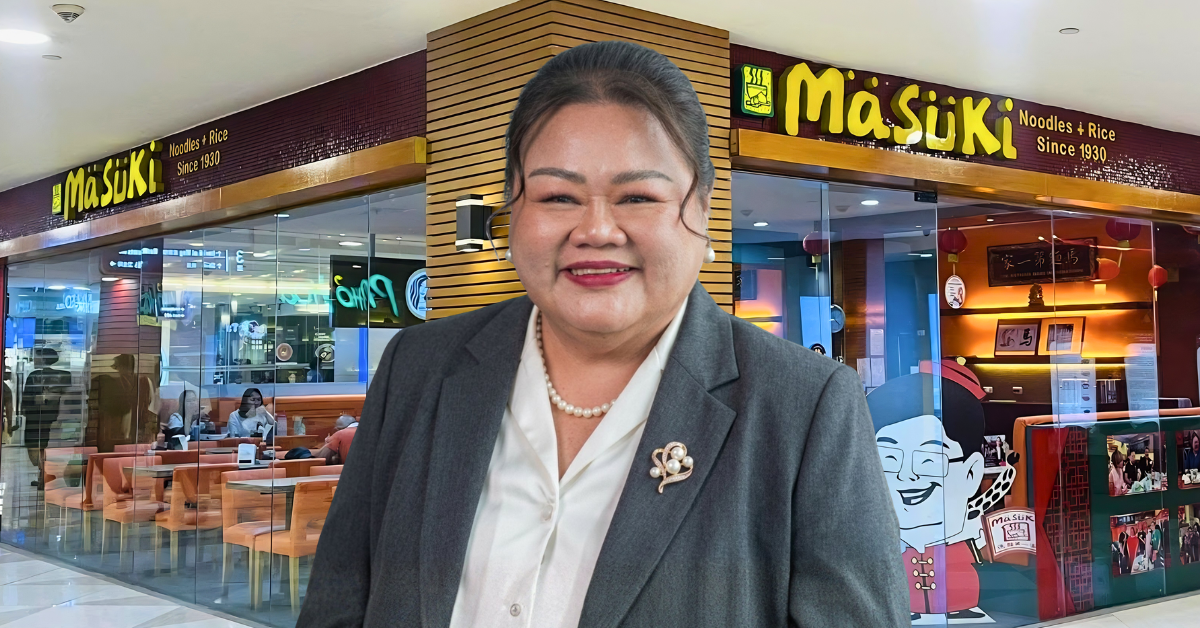
Long before Masuki became a familiar name in Binondo, the Ma family’s mami business started in the most modest way possible—on the streets, powered by hard work and apprenticeship.
“Our mami business started po nung 1930s,” she says. “Yung grand uncle ko po, uncle ng Daddy ko, nagpe-pedal po sila ng mami sa Binondo, nag-iikot po sila na parang taho style.”
At the time, there was no restaurant, no signage, and no fixed location. The business relied entirely on mobility, consistency, and the ability to serve customers wherever they were.
Willen Ma explains that her father entered the trade at a very young age, not as an owner, but as a learner.
“First apprentice po si Daddy ko. Ang pangalan ng Daddy ko ay Ma Chi On.”
That apprenticeship began early—and out of necessity.
“He was only 14 years old nung nag-umpisa sya maging apprentice ng uncle nya kasi lumalaki na yung negosyo niya nung kaya kailangan na nya ng apprentice.”
Learning the craft meant immersion. Recipes, techniques, and discipline were passed down through daily repetition rather than formal instruction.
By the 1950s, the family took a major step forward. What had begun as street vending evolved into a permanent establishment.
“In the 1950s, gumawa ng restaurant yung uncle ng Daddy ko, yung Ma Kong Mami restaurant.”
The restaurant represented stability, but it also carried responsibility. When the older generation passed away, stewardship shifted to the next.
“Right after mamatay po yung uncle nila, iniwan po sa Daddy ko at saka sa mga cousins nya yung restaurant, so kilala po sya as Ma Kong before.”
The name itself carried meaning rooted in family identity.
“Ma Kong kasi, Ma is our surname, ‘kabayo.’ Kong is ‘malaki,’ so ‘malaking kabayo’ daw sya.”
As the business grew, the restaurant moved locations to follow foot traffic and changing neighborhoods—an early sign of adaptability.
“Nauna po itong restaurant sa Ongpin, and then lumipat sa Salazar tapos dito na po sa Benavidez nung 1966.”
Each move reflected a practical decision rather than sentimentality. The goal was to stay close to customers and remain visible in Binondo’s evolving commercial landscape.
Through these transitions, the business remained rooted in the same fundamentals: product consistency, family involvement, and hands-on learning. There were no shortcuts. Knowledge was earned through time spent in the kitchen and on the floor.
The early decades of the Ma family’s mami business reveal a pattern common to long-lasting food institutions: before brand names and generations of customers, there was craft. Before expansion, there was apprenticeship.
For Willen Ma, understanding Masuki’s story begins with understanding that nothing was inherited easily. What her family built took decades of repetition, movement, and quiet discipline—long before the restaurant carried the name it does today.
The foundations laid in the 1930s and strengthened through the 1950s and 1960s created more than a restaurant. They created a system of learning that would later allow the next generation to revive and rename the business when the time came.
But at the start, it was simple: a bicycle, a pot of mami, and a young apprentice learning the trade one bowl at a time.
This article includes quotes from an interview originally published by Esquire Philippines, authored by Henry Ong.

