

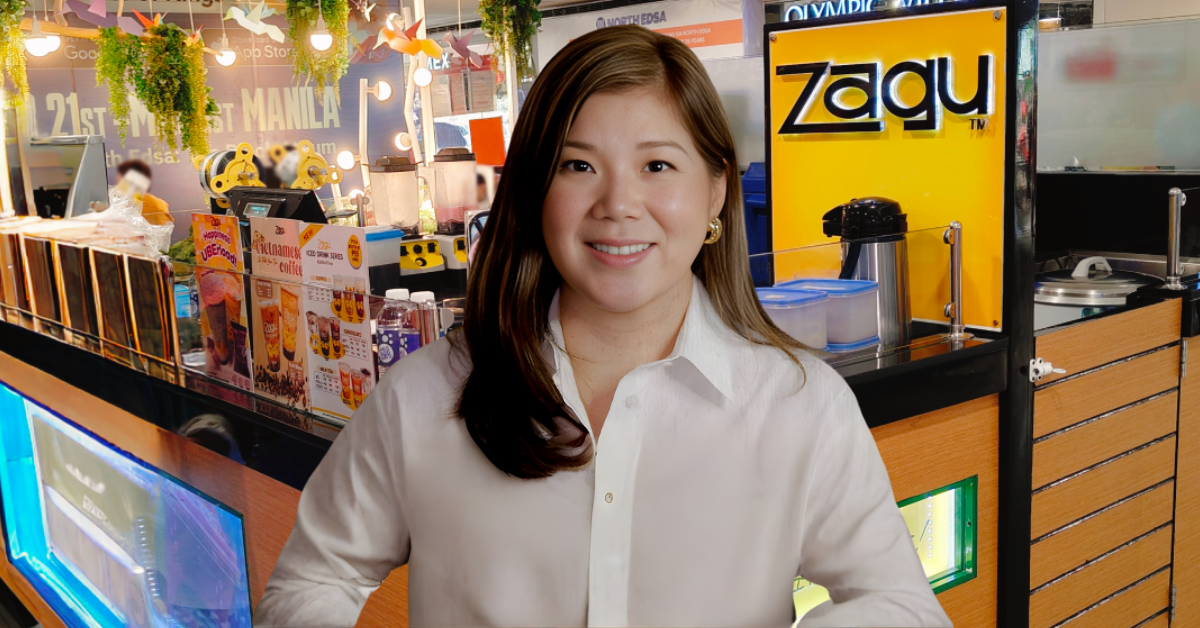
When Genevieve Lim-Santos was studying in Canada, her future looked clear and conventional. She wasn’t thinking about entrepreneurship or starting a beverage brand. Her goal was to build a corporate career grounded in science and research.
“I took up food science in Canada. My plan at that time was to work in laboratory research and development. I didn’t even know the course existed until I spoke to a cousin of mine. She was about to enter university, so I asked her what she was going to take. Sabi niya, ‘food science.’ Sabi ko, ‘What’s that?’”
At the time, food science appealed to her because it wasn’t about cooking—it was technical, structured, and applicable to large companies. It opened doors to product development roles in global food corporations.
“Often, the impression of food science is that it’s culinary, but it’s not—it’s the science of food, so she explained it to me, for example, you could work for Nestlé, and they might ask you to develop a kind of chocolate with low sugar, ganyan-ganyan. Sabi ko, ‘Oh, okay, I find that interesting.’ It’s actually a five-year course. It can even pass as a pre-med course in Canada.”
Her career ambitions reflected that mindset. She imagined herself inside a multinational organization, applying her training in research and development.
“My goal then was to work for a multinational food company. My vision was like Frito-Lay or Nestlé, the big companies in food.”
When the plan ran into reality
By the time Lim-Santos graduated, she was ready to take that next step. She wanted to return to Manila, confident that her Canadian degree would give her an edge in the job market.
“So it started 1999. At that time, I was a fresh grad. I was living in Canada, but I’ve always wanted to return to Manila. I had a degree from Canada, so I felt like I could get a good job with a foreign degree.”
But the timing worked against her. The Asian financial crisis had hit the region, freezing hiring and limiting opportunities—regardless of credentials.
“But this was during the 1997 Asian economic crisis, so walang jobs available. Everyone was on hiring freeze-hiring, and there were no opportunities.”
With few options available in the Philippines, she found herself staying in Canada longer than planned. It wasn’t a strategic decision—it was a response to circumstance.
“So I found myself back in Canada again.”
An idea born from everyday life
While in Canada, Lim-Santos and her friends often spent time in bubble tea shops. What started as a social habit slowly became something more.
“My friends and I would frequently visit bubble tea places. That’s where we would hang out, and we became so addicted to the boba. We thought, ‘This is good, parang this could work in the Philippines.’”
What made the idea feel viable was familiarity. She saw a connection between what they were enjoying abroad and something Filipinos already knew.
“Kasi we’re not foreign naman to sago—we have sago, right? The white one, so sabi namin, parang magcli-click ito.”
When she returned to Manila again, she didn’t immediately launch a business. Instead, she looked for a practical way to test the idea. That opportunity came through her family.
“So I came back again, and at that time, my Dad had acquired the operation of a coffee shop in Green Valley. We operated the coffee shop there. Since we had a coffee shop, that’s where I test-marketed the drinks. I already had the materials kasi nag-uwi na ako.”
She kept the experiment intentionally small.
“At that time, I was only preparing two flavors—Taro and Honeydew, so parang in-include lang nila sa menu and offered them to the bowlers, yung clientele lang ng bowling alley.”
The response stood out immediately.
“The reception was very positive, which gave me more courage to pursue the business. They enjoyed the drink, na parang hinahanap-hanap nila. So ang feeling ko meron nga talagang potential yung product.”
Rejection before momentum
Even before putting up her first cart, Lim-Santos tried to introduce the idea to established food businesses. Not everyone was receptive.
“It was very interesting. In fact, even before I put up the cart, I was already offering it to some establishments, like Goldilocks. I remember trying to sell them the idea, and then I would just supply the product to them.”
Some reactions reflected how unfamiliar the concept was at the time.
“Pero I remember one of them saying, ‘Black sago? Food na black?’ They weren’t interested kasi it was something new, and people didn’t really eat black-colored food, especially 25 years ago.”
Despite the rejection, she continued. What began as a test product in a coffee shop would later grow into Zagu, now a familiar name across Philippine malls.
Looking back, Lim-Santos’ story shows how a carefully planned career can change course—not because of failure, but because of timing. The skills she trained for in a corporate setting didn’t disappear. They shaped how she tested, evaluated, and eventually built something of her own.
Sometimes, when traditional paths close, they lead somewhere entirely unexpected.
This article includes quotes from an interview originally published by Esquire Philippines, authored by Henry Ong.

