

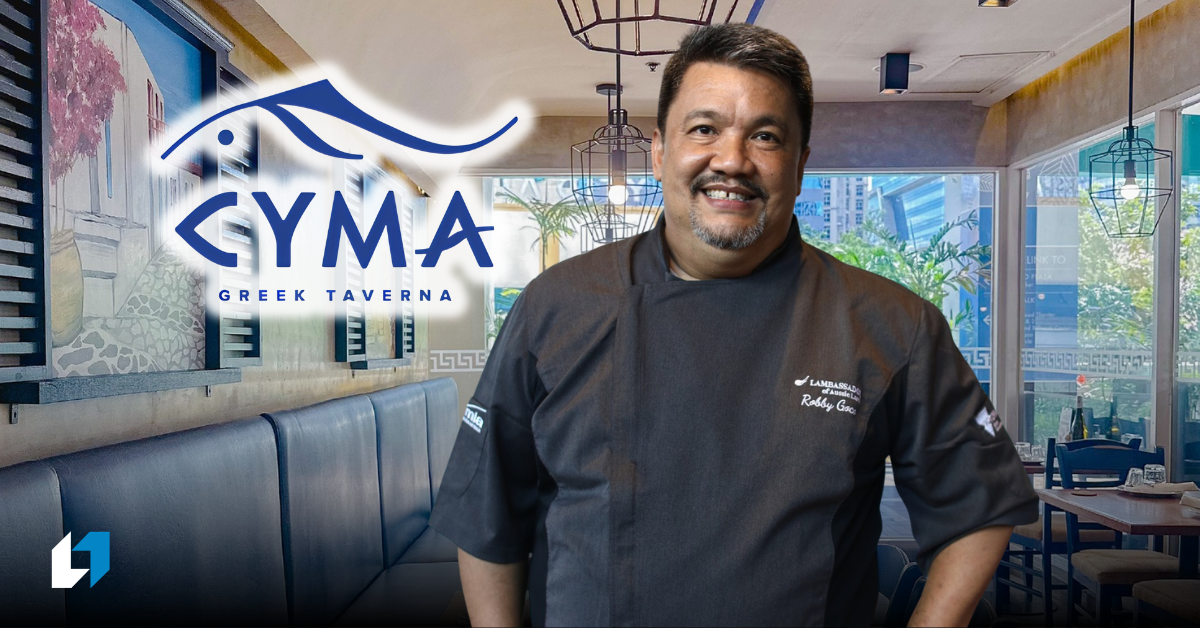
Long before Chef Robby Goco opened restaurants and founded the Greek dining brand Cyma, his fascination with food began in an unlikely place: a quiet library at home.
Growing up in a household filled with books, Goco found himself surrounded by ideas from different disciplines. His father was a lawyer, while his mother was a sociologist, and their home reflected both of their intellectual interests.
“I grew up in a household where both my parents were professionals,” Goco recalls. “When I was growing up, we had a library at home. In the library, there were law books on the top shelf—those were my father’s. Yung sa gitna, sociology books—those were my mom’s naman.”
But it was the bottom shelf that captured his imagination.
“And then sa baba, it was by Time Life, Cuisines of the World,” he says.
The famous Time-Life cookbook series introduced readers to dishes from around the world. For a young Goco, those books became an early window into the possibilities of cooking.
As a child, he spent long hours reading through the recipes and imagining how the dishes might taste. Although the Philippines at that time had limited access to imported ingredients, he and his sister still found ways to experiment in the kitchen.
“Since I was around 10 years old, we would open something from the book, and me and my sister would create it,” Goco says.
Because many ingredients were unavailable locally, they often had to improvise with whatever was already in the pantry.
“During that time, wala naman masyadong restaurants in the Philippines, right? Even imported ingredients were limited. So you really had to make do with what you had,” he explains.
Those early experiments became the foundation of his interest in cooking. Instead of simply following recipes, Goco learned how to adapt and modify dishes based on available ingredients—a skill that would later prove valuable in professional kitchens.
His mother played an important role in encouraging that curiosity. Even when the dishes were simple or experimental, she was supportive.
“From a very young age, my mom was always supportive,” he says. “She would say, ‘Oh, you know what? This is really good. Whatever you made—that peach cobbler—really good. Can you make a lot? I’ll give it to my friends.’”
Without realizing it at the time, Goco was already learning the basics of entrepreneurship.
If his mother’s friends liked the food, she would ask him to prepare more.
“So automatic, I had somebody buying my product,” he recalls.
Cooking soon became more than just a hobby. As he grew older, he began producing baked goods regularly, especially during holidays.
“Every Christmas season, that’s when I would earn a lot of money because of whatever I was making,” he says.
After school, his routine often included both sports and baking.
“For me, after grade school at Ateneo, I used to play basketball, then afterward, I would bake brownies at home, make cookies, make carrot cake,” he recalls.
Looking back, those childhood experiences highlight an important pattern that appears in many entrepreneurial stories: curiosity often comes long before formal training.
In Goco’s case, the combination of books, experimentation, and encouragement created an environment where creativity could flourish. Instead of treating cooking as a structured discipline, he approached it as something to explore.
Entrepreneurship experts often note that many successful founders begin developing their instincts early—through hobbies, small projects, and informal experiments that gradually evolve into more serious pursuits.
For Goco, the kitchen became that early laboratory.
Long before culinary school or restaurant ownership entered the picture, he was already testing ideas, adapting recipes, and discovering that people were willing to pay for something he created.
Those childhood experiments would eventually lead him to pursue a professional career in the culinary world—one that would later result in the creation of some of the Philippines’ most popular restaurant concepts.
But the spark, he says, began with something simple: curiosity, a few cookbooks, and the freedom to try.

