

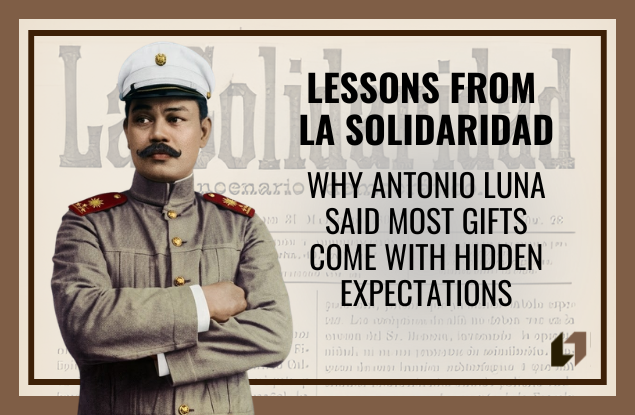
In March 1891, a short satirical essay titled “The Day of St. Joseph” appeared in the reformist newspaper La Solidaridad. The piece was written under the pen name Taga-Ilog, a pseudonym widely associated with Antonio Luna.
At first glance, the essay seems to describe an ordinary celebration. A rainy festival day in Madrid sends churchgoers indoors, where families and friends gather for parties, music, dancing, and conversation.
But the writer is not really interested in the celebration itself.
Instead, he uses the gathering to observe human behavior—how people act in social situations and what their gestures of kindness often reveal about their true intentions.
What begins as a description of a party slowly becomes a quiet critique of social hypocrisy.
When Gifts Are Really Investments
Early in the essay, the narrator notices guests exchanging gifts during the celebration. On the surface, the gestures appear generous and thoughtful. But the author quickly points out that these presents are rarely acts of pure kindness.
They are often strategic.
As he writes with sharp irony:
“Man gives presents because he expects to reap a harvest, as a farmer plants on favorable soil to harvest the desired grain later.”
The comparison is deliberate. Just as a farmer plants seeds expecting a future harvest, people often give gifts expecting something in return.
The essay offers several examples that feel surprisingly familiar even today. An employee brings a gift to his boss hoping it will improve his chances for promotion. A suitor buys expensive flowers to impress the woman he admires. A husband purchases jewelry hoping to please his wife, while a friend brings sweets to secure a dinner invitation.
In each case, generosity quietly becomes a negotiation.
What Happens When Formality Disappears
As the celebration continues, wine begins to flow and the atmosphere changes. The polite conversations of the early evening slowly give way to louder voices, passionate debates, and flirtatious exchanges.
The narrator observes how quickly social restraint fades.
At the beginning of the gathering, guests behave formally, carefully choosing their words and gestures. But as the evening progresses, emotions grow stronger and personalities become more visible. Wine, the author suggests, reveals what polite society tries to hide.
In one striking moment, he writes that the blood begins to “boil,” exposing the thin boundary between elegance and chaos.
The message is clear: beneath the polished manners of social gatherings lies a much more instinctive human nature.
Civilization as a Thin Mask
Perhaps the most philosophical observation in the essay appears when the narrator reflects on the nature of society itself.
He writes:
“The origin of man is the same, only the skin changes — the sugar coating which often turns bitter.”
The line suggests that civilization often functions as a kind of coating—an elegant surface that hides more primitive instincts. Politeness, refined manners, and social rituals create the appearance of sophistication, but they do not necessarily change human nature.
Underneath the sugar coating, ambition, vanity, and desire remain.
The festival simply provides the setting where these instincts quietly emerge.
Pepita and the Rejection of Social Pretension
One character in the essay stands apart from the rest.
A young woman named Pepita dances freely, ignoring the rigid etiquette that governs the other guests. While others move carefully and try to maintain an air of elegance, Pepita simply enjoys the music and the moment.
At one point she mocks a man who is dancing too cautiously, telling him:
“Stop the fancy steps, dance like the rest and don’t be an idiot.”
Pepita represents something rare in the social world the essay describes: authenticity. While the other guests remain preoccupied with appearances and social expectations, she refuses to play the same game.
Her carefree attitude exposes the artificiality of the surrounding environment.
Why Luna’s Observation Still Feels Familiar
Although the essay was written in 1891, the behavior it describes remains strikingly recognizable today.
Modern society has simply changed the setting.
Instead of exchanging gifts during a festival gathering, people today often use networking events, corporate hospitality, and social media gestures to build relationships. Invitations to dinners, carefully chosen presents, and public displays of generosity can sometimes function less as acts of kindness and more as subtle investments in influence.
Even online interactions can carry similar dynamics. A gift, endorsement, or public compliment may appear spontaneous but can quietly signal the beginning of a reciprocal relationship.
The tools have evolved, but the psychology Luna described remains the same.
The Lesson Behind the Celebration
The deeper insight of the essay is not that generosity is always insincere. Rather, it is that human relationships often contain layers of motivation.
Acts that appear purely generous may also carry expectations of reciprocity, influence, or advantage.
More than a century ago, Antonio Luna noticed that society frequently disguises ambition behind gestures of politeness and generosity.
The festival he described may have taken place in a nineteenth-century drawing room, but the lesson still applies today: in many social settings, generosity is not always a gift.
Sometimes it is an investment.

