

When a company announces an acquisition, the first reaction is usually admiration.
It feels like a victory. A new brand is added to the portfolio. A new market opens up. The company looks bigger, more global, and more ambitious overnight. Investors often assume that once a deal closes, growth will automatically follow.
But executives who have been through acquisitions know the truth: the hardest part of M&A begins after the signing ceremony.
The deal itself is just the start. The real challenge is integration—how the acquiring company absorbs the new business without destroying what made it valuable in the first place. Many mergers fail not because the acquired company was weak, but because the buyer tried to “fix” it too quickly, or forced it into a system that didn’t match its identity.
Harvard Business Review’s 2025 research on acquisition timing emphasizes that companies that rush deals or pursue multiple acquisitions too quickly often struggle to generate long-term value. The reason is not the deal price. It is the operational reality of integration, which takes time, attention, and discipline.
In the Philippines, where several local firms have expanded internationally through acquisitions, this is becoming one of the most important strategy lessons for companies trying to scale beyond their home market.
The real question is not whether Philippine companies can buy global brands.
It is whether they can preserve them.
Why Integration Breaks Brands
Many executives assume that integration is mainly about systems—finance, reporting, procurement, and HR. Those are certainly critical. But what often kills an acquisition is something harder to measure: brand identity.
When a company acquires another business, the temptation is to immediately impose the buyer’s processes and culture. The logic sounds reasonable: “We bought this company, so it should run like us.”
But that mindset often destroys the very reason the acquisition was attractive in the first place.
A brand is not just a logo. It is a set of customer expectations. It is the experience that customers recognize, trust, and repeatedly pay for. It is the culture of how employees serve, operate, and execute the business.
And when that identity is disrupted too aggressively, customers notice.
That is why the best acquirers focus less on “absorbing” the company and more on protecting its uniqueness while improving execution quietly.
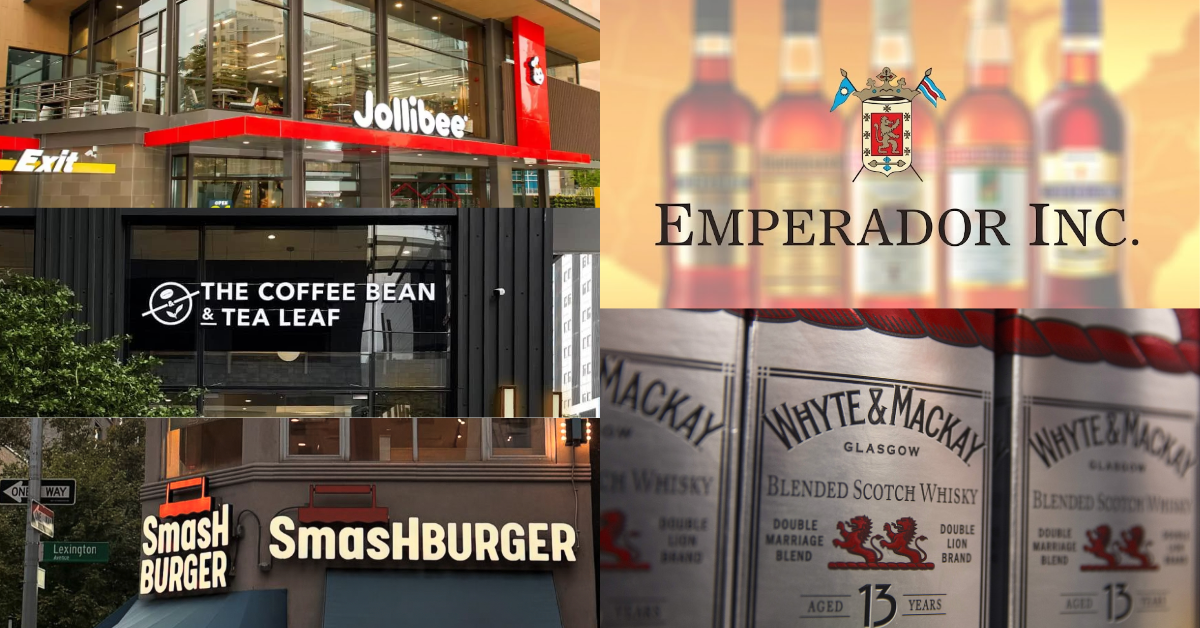
This is where Philippine companies like Jollibee and Emperador offer valuable lessons.
Jollibee’s Global Play: Buying Brands Without Losing Their Soul
When people think of Jollibee Foods Corporation (JFC), they usually think of a Philippine success story—a fast-food brand that became part of national culture. But over the past decade, Jollibee has also been building something more ambitious: a global multi-brand restaurant group.
Instead of expanding purely through organic growth, Jollibee pursued international acquisitions to accelerate its footprint in key markets.
One of the biggest examples was its acquisition of The Coffee Bean & Tea Leaf (CBTL) in 2019.
CBTL is not a typical fast-food brand. It competes in a premium category where customers expect a certain atmosphere, a certain product ritual, and a certain brand personality. Coffee is emotional. People don’t just buy caffeine—they buy a daily routine and an experience that feels familiar.
This is where integration becomes dangerous.
If an acquiring company forces a coffee brand into a fast-food operating model too aggressively—standardizing everything, cutting costs too deeply, changing product sourcing, or altering store experience—the brand can lose its “premium feel.” Once customers sense that the experience is no longer authentic, loyalty declines quickly.
For an operator, the integration question becomes: how do you introduce discipline without stripping identity?
The answer is rarely found in spreadsheets. It is found in the smallest operational details: store design consistency, staff training standards, product sourcing integrity, and the willingness to keep certain processes unchanged even if they are less efficient.
In acquisitions like CBTL, the winning strategy is often to integrate behind the scenes—finance, reporting, procurement synergies—while allowing the brand experience to remain intact.
This is a delicate balancing act, but it is exactly what long-term brand preservation requires.
Smashburger: When the Product Is the Brand
Jollibee’s acquisition of Smashburger, a U.S.-based burger chain, offers a similar but slightly different integration challenge.
Smashburger is positioned around quality and freshness, with a customer promise that goes beyond convenience. In such brands, the product itself becomes the identity. Customers don’t return simply because the store is near—they return because the taste feels distinctive.
That means integration decisions cannot be purely operational. They must protect what makes the product recognizable. Ingredient changes, cooking methods, portion adjustments, or supply chain substitutions may improve margins, but they can also dilute the brand.
This is one of the biggest integration traps: when executives treat the acquired brand as a “platform” rather than a living identity.
For operators, the correct mindset is often to treat an acquired brand like an ecosystem. Some systems can be improved. Some processes can be standardized. But the core brand promise must remain protected, even if it means slower optimization.
Emperador’s Whyte & Mackay Deal: Integrating Heritage Without Disrupting It
In a different industry, Emperador Inc. provides another compelling example.
In 2014, Emperador completed its acquisition of Whyte & Mackay, a Scotland-based whisky company, for about £430 million.
This was not simply a business expansion. It was a cultural acquisition.
Whisky brands are not built overnight. They are built through heritage, storytelling, and deep consumer trust developed across decades. A Scottish whisky company carries a brand identity rooted in geography, tradition, and a premium perception that cannot be replicated by simply investing in marketing.
For Emperador, acquiring Whyte & Mackay offered global reach, premium positioning, and entry into the world of international spirits. But it also introduced a major integration challenge: how do you integrate a heritage Western brand into a Philippine-led corporate group without damaging its authenticity?
If a whisky brand begins to feel “over-managed” or treated as a commodity, it risks losing its premium image. In the spirits industry, perception is often the product. A slight shift in brand narrative can impact pricing power and long-term loyalty.
That is why the best acquirers of heritage brands typically integrate carefully. They maintain local expertise, preserve existing brand teams, and avoid aggressive restructuring that might disrupt the identity customers trust.
Emperador’s acquisition illustrates a key principle of post-merger integration: when you acquire a brand built on history, the integration strategy must respect that history. Otherwise, the acquisition destroys the very value it was meant to capture.
The First 100 Days: Where Most Brands Are Accidentally Broken
In many acquisitions, the first 100 days are when executives attempt to prove progress. They push for quick wins. They want to show the board that the acquisition is “working.”
But that is exactly when mistakes happen.
Because the first 100 days are often when companies make irreversible decisions:
- restructuring leadership too early
- changing suppliers too quickly
- forcing internal systems without adaptation
- replacing brand culture with corporate bureaucracy
- imposing reporting structures that slow down customer execution
In the rush to integrate, companies unintentionally damage brand loyalty.
And unlike financial systems, brand trust is not easy to repair. Once customers feel that a brand has “changed,” they may never return.
That is why post-merger integration should be viewed not as an efficiency project, but as a brand protection project.
What Philippine Operators Should Learn From These Cases
For Philippine companies looking to expand through acquisitions, whether locally or globally, these cases offer a practical playbook.
First, executives must identify what part of the acquired company is truly valuable. Is it the distribution network? The product innovation? The customer loyalty? The premium brand positioning? Without clarity, integration teams may optimize the wrong areas and weaken the business.
Second, acquirers should avoid “copy-paste management.” A fast-food operator cannot treat a coffee chain exactly the same way. A Philippine spirits company cannot manage a Scottish whisky heritage brand as if it were a domestic product line.
Third, integration success requires humility. The acquiring company must recognize that the acquired company often knows its customers better. Brand teams should be empowered, not overridden.
Finally, the best integration strategy is often gradual. It is tempting to pursue fast results, but many acquisitions win through patient execution: protecting the brand first, then improving systems quietly over time.
Acquisitions are often celebrated as strategic victories. But in reality, buying a company is easy compared to keeping it valuable.
For Philippine firms like Jollibee and Emperador, global acquisitions represent ambition and long-term growth potential. Yet the deeper lesson is that long-term success depends not only on capital or deal-making, but on operational discipline and brand preservation.
The smartest acquirers understand that integration is not about control. It is about stewardship.
Because in mergers and acquisitions, the real risk is not paying too much.
The real risk is breaking what you paid for.

