

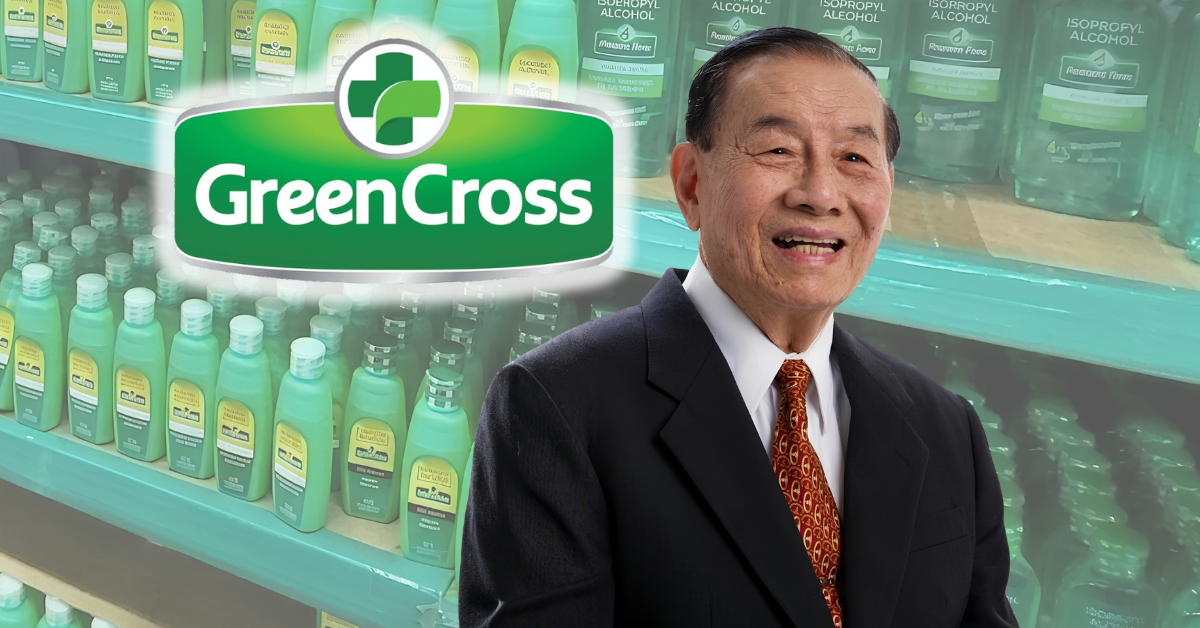
Some business empires begin with groundbreaking inventions.
Others begin with a simple observation: a product is already in the market, but nobody knows what to do with it.
That was exactly the case with rubbing alcohol in the Philippines in the late 1940s.
In his memoir “Greencross Saga: My Autobiography,” Gonzalo Co It—founder of Green Cross Rubbing Alcohol—shared that before Green Cross existed, rubbing alcohol was not yet widely used as an everyday household product. It was not part of Filipino routine. It was not a standard item in most homes.
In fact, it was barely selling at all.
“This alcohol product languished in the Jabonero Street bodega of Manila Commercial for a long, long time,” Gonzalo wrote, “probably because the salesmen didn’t know what to do with it.”
That one sentence reveals something important: the product itself was not the problem. The problem was that nobody had yet created the habit.
And Gonzalo realized that the true opportunity in business is not always in making something new. Sometimes, it is in teaching people how to use what already exists.
A Product That Was Sitting in Storage
Before he became an entrepreneur, Gonzalo worked at Manila Commercial Company, a trading firm that distributed health care and beauty products. The company sourced its products from abroad, including a rubbing alcohol brand from the United States.
“Manila Commercial bought its products from Rabin Company of New York, USA,” he wrote. “Rabin Company supplied Manila Commercial with face powder, skin lotion, face cream, other beauty products and isopropyl alcohol, called Gray Cross Rubbing Alcohol.”
At the time, Gray Cross was not yet a consumer staple. It was not like today, where rubbing alcohol is found in every grocery store, pharmacy, or household cabinet.
It was a product without a story, without a routine, and without a strong local market.
The salesmen did not know how to sell it. The market did not know how to demand it. And so it stayed inside the warehouse.
But Gonzalo had a different instinct.
The Insight: Alcohol Could Be for Everyone
In his autobiography, Gonzalo described the moment he saw the opportunity. It did not come from a marketing seminar or a business book. It came from a practical understanding of what Filipino households needed.
He wrote: “I had this idea that we could market it for everyday, household use.”
That sentence may sound ordinary today, but it was revolutionary for that time.
Because in the 1940s, alcohol was not yet widely positioned as a daily necessity. It was not yet marketed as something that every family should keep in the house. It was not yet part of the culture.
Gonzalo saw what others did not see: the real demand was not only in hospitals or clinics. The real demand could be in kitchens, in living rooms, in schools, in small neighborhood stores.
And instead of waiting for someone else to act, he acted immediately.
“So, I brought it out of the warehouse and introduced it to the vendors in Quiapo,” he wrote.
It was not a complicated strategy. He did not begin by launching an expensive campaign.
He began by doing the most basic thing in business: testing demand where people actually buy.
He Created a Market by Selling to Vendors
Modern entrepreneurs talk about “go-to-market strategy.”
Gonzalo did it the old-school way: he went to the streets and offered the product directly to the people who could sell it fastest.
Quiapo, at that time, was one of Manila’s busiest commercial districts. Vendors sold products that ordinary families could afford. If something sold well in Quiapo, it had the potential to spread across the city.
And Gonzalo saw the market clearly.
He even remembered the exact price:
“It sold at P2 per 500 ml bottle,” he wrote. “At that time, it was packaged in a glass bottle because plastic bottles were not yet being used.”
Those details matter because they show how grounded his strategy was. He was not guessing. He was paying attention to consumer behavior and price sensitivity.
Then Gonzalo wrote the line that should be studied by anyone who wants to build a consumer brand in the Philippines:
“That was the first time rubbing alcohol was introduced for common use in the Philippines and it started selling very well.”
In other words, he did not just sell a product.
He introduced a new household habit.
When Demand Exploded, the Company Was Not Ready
The true proof of a great business idea is not whether it sells once.
It is whether demand becomes so strong that supply struggles to keep up.
Gonzalo wrote that after the product finally reached consumers, sales rose quickly—so quickly that they faced a new problem.
“It started selling very well,” he recalled. “In fact, it sold so quickly that we ran into problems with the stock.”
This is the type of problem that most entrepreneurs dream of having. But it is also one of the most dangerous.
When a product becomes popular, the company must scale quickly. If supply cannot keep up, competitors take advantage. Customers lose interest. Retailers shift to substitutes.
But Gonzalo was learning something critical: rubbing alcohol had the potential to become a mass-market essential.
The product had proven itself.
Now the business had to survive.
The Crisis That Forced Local Production
Just as the demand for rubbing alcohol grew, a major external shock hit the company.
In 1950, the Philippine government imposed strict import controls. This meant companies could no longer freely import products from abroad.
“In 1950, during President Elpidio Quirino’s term, the newly established Central Bank imposed import controls,” Gonzalo wrote. “Manila Commercial Company could not import products.”
For many businesses, that would have been the end.
If your product depends on imported supply and the government suddenly blocks your ability to import, you lose your entire market overnight.
But Gonzalo described how they tried to solve the problem locally.
“So we bought raw products from La Tondeña and made rubbing alcohol in the house of Mr. Yu Cho Im on Benavidez Street,” he wrote.
The image is almost unbelievable today: alcohol production happening inside a private home in Manila, not in a formal factory.
But that was how businesses survived during that era. Entrepreneurs improvised. They adapted. They did what was necessary to keep selling.
Yet despite their efforts, the company continued to struggle.
“We did this for a while,” Gonzalo wrote, “but we could not turn the tide for the ailing Manila Commercial Company, which continued to do poorly.”
This was the moment where Gonzalo’s story becomes more than just an origin story. It becomes a lesson in business survival.
A product may be successful, but if the company’s structure cannot adapt to policy changes and supply disruptions, it collapses.
And Gonzalo recognized that.
The Real Business Lesson: Selling Is Not About Persuasion—It’s About Education
What Gonzalo accomplished with rubbing alcohol was not simply “marketing.”
It was education.
He taught the market how to use a product. He introduced a new routine. He reframed alcohol from a niche item into a household necessity.
This is one of the most powerful principles in consumer business:
People do not buy what they do not understand.
If customers cannot imagine how a product fits into their daily lives, they will ignore it—even if it is useful.
That was exactly what happened when Gray Cross was first introduced. It sat in storage. The sales force did not know how to position it. Consumers did not know why they needed it.
But Gonzalo did.
He did not rely on complicated advertising. He relied on direct selling, practical distribution, and the simple logic of household demand.
And once the product reached the right market, the response was immediate.
Why This Story Still Matters Today
Many entrepreneurs today chase flashy ideas. They want to build the next app, the next platform, the next trend-driven product.
But Gonzalo Co It’s story reminds us that some of the most enduring brands are built from products that are not exciting—but essential.
Rubbing alcohol is not a luxury item. It is not aspirational. It is not something people buy once and forget. It is the kind of product that fits naturally into everyday life. Once a household begins using it, the demand becomes routine.
What Gonzalo did was not merely sell alcohol.
He made the product understandable.
He made it familiar.
He made it part of the Filipino household mindset.
And he did this by identifying what everyone else failed to notice: the product was not moving because nobody had yet framed it as a daily necessity.
In his autobiography, he described the situation plainly, almost with disbelief at how long the opportunity sat untouched:
“This alcohol product languished in the Jabonero Street bodega of Manila Commercial for a long, long time, probably because the salesmen didn’t know what to do with it. I had this idea that we could market it for everyday, household use. So, I brought it out of the warehouse and introduced it to the vendors in Quiapo.”
That paragraph alone shows what separates an ordinary employee from an entrepreneur. Most people see stagnant inventory and accept it as a failure. Gonzalo saw it as a signal that the market had not yet been educated.
And when he tested the product in Quiapo, he saw immediate validation.
He even recorded the details that prove he was not simply telling a story—he was documenting a real business experiment:
“It sold at P2 per 500 ml bottle. (At that time, it was packaged in a glass bottle because plastic bottles were not yet being used.) That was the first time rubbing alcohol was introduced for common use in the Philippines and it started selling very well.”
The key phrase is not “it sold.”
The key phrase is “introduced for common use.”
Because that is how consumer markets are created. Products do not become household staples by accident. They become staples because someone takes responsibility for building the habit.
In Gonzalo’s case, demand grew so quickly that the company faced the kind of problem that is both exciting and dangerous—stock shortages.
“It started selling very well,” he wrote. “In fact, it sold so quickly that we ran into problems with the stock.”
That is the moment every entrepreneur wants to reach. But it is also the moment where business reality becomes harsher. A company may discover demand, but it must still survive supply constraints, policy shocks, and operational limitations.
Gonzalo later described how external forces threatened the business just as the opportunity became clear. Import restrictions forced them to improvise local production.
“In 1950, during President Elpidio Quirino’s term, the newly established Central Bank imposed import controls. Manila Commercial Company could not import products, so we bought raw products from La Tondeña and made rubbing alcohol in the house of Mr. Yu Cho Im on Benavidez Street. We did this for a while, but we could not turn the tide for the ailing Manila Commercial Company, which continued to do poorly.”
It is one of the most revealing passages in the book. It shows that Gonzalo’s entrepreneurial instincts were shaped by crisis. He saw firsthand how a good product could still fail if the company behind it could not adapt.
But the more lasting lesson is this: in consumer business, the real breakthrough often happens when someone sees a product not as an item to be sold, but as a habit waiting to be formed.
That was what Gonzalo Co It understood early—long before Green Cross became a brand.
And it is why his story remains relevant to every entrepreneur today, whether they are selling health products, food, services, or even digital tools.
Because the biggest opportunities are not always new inventions.
Sometimes, they are simply the things nobody has taught the market to value yet.

