

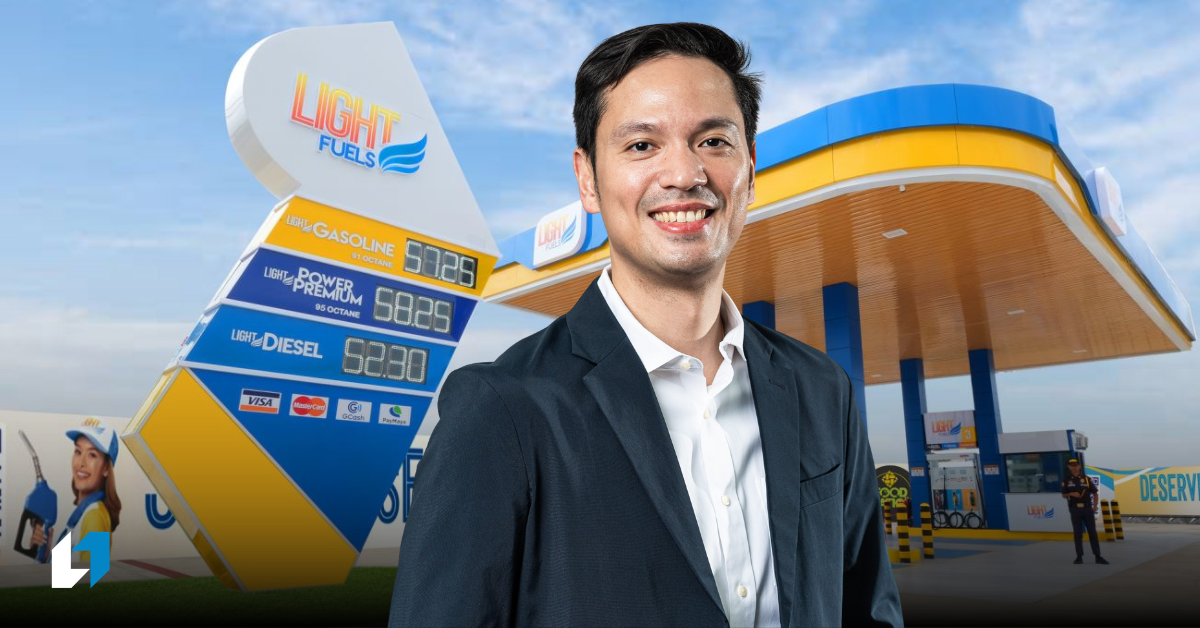
Before helping grow Top Line Business Development into a diversified company that includes fuel distribution, its co-founder and CEO Erik Lim began his career in a place that was already familiar: the family business.
After graduating from University of San Carlos, Lim immediately joined the family’s real estate operations, becoming part of the third generation involved in the business.
“When I graduated from college, sa University of San Carlos—I went straight to the family business,” Lim recalls.
Like many next-generation leaders in family enterprises, he started by learning the fundamentals from the ground up.
“I went to the real estate side so parang from the ground, I was learning everything,” he says.
The family’s earlier generations had built their business around property development. The first two generations focused mainly on malls and real estate investments.
“We’re actually part of the third generation in our family business,” Lim explains. “The first two generations focused on mall development and real estate.”
For many family businesses, the third generation often faces a strategic challenge. The first generation typically builds the business, while the second generation stabilizes and expands it. By the time the third generation enters, the question often becomes how to create new engines of growth without abandoning the company’s core strengths.
By the time Lim entered the business, he began thinking about how their generation could pursue opportunities beyond traditional property development.
“In 2013, I suggested, how about we incorporate our own company, and then whatever opportunities come along the way, we can probably put everything there,” he says.
His parents supported the idea.
“My dad and my mom were very supportive,” Lim recalls. “Ang sabi nila nga, ‘If you want to pursue this, why not?’”
That support led to the creation of Top Line, a company formed by members of their branch of the family.
“So gumawa kami ng another company for our branch of the family and we created Top Line,” he says.
At the beginning, the company relied on assets from the family’s real estate holdings. The business focused primarily on generating lease income from property developments.
“We started with basically yung asset ng family with all of us as the founders,” Lim explains.
One of his main responsibilities was managing mall development projects.
“We were doing real estate business—basically for lease income. I was in charge of the mall development.”
But several years later, an unexpected opportunity began to appear—literally just behind one of their malls in Cebu.
The mall had a port located at the back of the property. Over time, Lim began noticing a pattern of activity involving ships and fuel tankers.
“And then after that, by 2017, we saw this opportunity to go into the liquid fuel na business,” he says.
The observation came from watching vessels refuel at the nearby port.
“Kasi yung mall namin sa Cebu, may port sa likod eh,” Lim explains. “When I saw the opportunity na, ‘Uy, may mga fuel tankers pumupunta sa port and nagpapa-fuel sa mga barko’ and everything, I said, ‘How about we try that business?’”
Entrepreneurial opportunities often emerge not from complex market research but from observing patterns in one’s immediate environment. In Lim’s case, the opportunity came from noticing an activity that was already happening within the ecosystem of their existing property assets.
At the time, Lim admits he had limited knowledge about the fuel distribution industry.
“I didn’t really know if it was a good business, to be honest,” he says.
But the company was still relatively young, and he believed it was the right moment to explore new ventures.
“I just said na, how about we try this business?” Lim recalls.
Because Top Line had only recently been established, he saw value in experimentation.
“Since the company was still quite new, especially for Top Line, I think it was also nice to try different things.”
His approach reflected a common entrepreneurial strategy: testing opportunities before committing fully.
“So sabi ko, if the barriers of entry are not very high, how about we try it?”
Beyond curiosity, there was also a strategic advantage: location.
Since their mall operated next to a port, vessels docking there already needed fuel.
“We were talking about distribution, and since we’re also operating the port sa likod ng mall namin,” Lim explains.
That meant potential customers were already present.
“Sabi namin, lahat ng mag-fuel sa port, so we have our own customers kaagad,” he says. “So parang in a way may captured customers na tayo.”
For new businesses, having access to built-in demand can significantly reduce startup risk. By leveraging their location and infrastructure, Lim recognized that the company could begin the fuel distribution venture with an existing customer base.
After discussing the idea with the family, everyone agreed to test the opportunity.
“When I spoke with everyone in the family, they agreed.”
The company soon began supplying fuel to vessels docking at the port.
“When we tried that business, we were supplying to the vessels in the port.”
The results quickly showed promise.
“And we realized okay pala,” Lim says.
Encouraged by the early success, the fuel distribution operation eventually became an official part of Top Line’s portfolio.
“So we incorporated the fuel business under Top Line.”
What began as a simple observation at a port behind a mall eventually grew into a new business line for the company. For Lim, the experience highlights how the next generation in family enterprises can create growth by identifying opportunities that complement the assets their predecessors built.
Rather than abandoning the family’s real estate foundation, Lim expanded it—transforming proximity, infrastructure, and observation into a completely new business opportunity.
Sometimes, growth does not require building something entirely new. It simply requires seeing possibilities where others see ordinary activity.

