

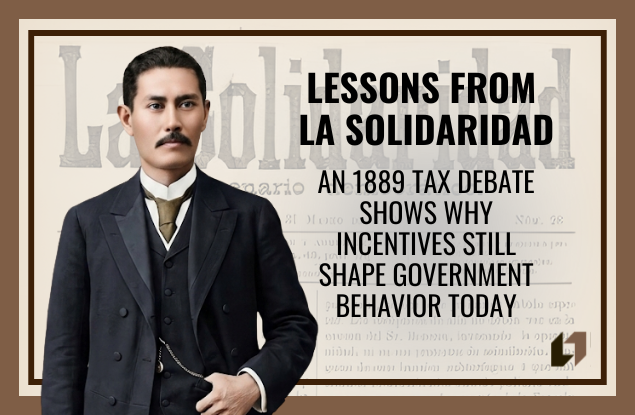
More than a century before economists popularized the idea that “incentives shape behavior,” Filipino reformists were already warning about the same problem.
In July 1889, an editorial published in the reformist newspaper La Solidaridad examined a controversial fiscal reform in the Philippines under Spanish rule. At the time, the paper was edited by Graciano López Jaena.
The issue they were discussing may sound technical: a dispute over how tax revenues should be shared between the colonial government and parish priests. But behind the debate was a strikingly modern economic insight.
The reformists were pointing out something that economists, regulators, and policymakers still emphasize today:
When incentives are poorly designed, systems stop working as intended.
The Cedula Tax System
In the late nineteenth century, Filipinos were required to pay a personal tax known as the cedula. This tax served as both an identification document and a major source of government revenue.
Under the existing system described in the editorial, parish priests—known as curates—received 12.5 percent of the cedula tax collected in their parish.
This meant that a portion of tax revenue went directly to the clergy.
The proposed reform sought to eliminate this arrangement. Instead of allowing the clergy to keep a share of the tax, the entire amount would go to the government treasury.
Supporters of the friars argued that removing the clergy’s share would harm the Church and threaten political stability.
The editorial rejected that argument.
A Problem of Incentives
The writer argued that giving tax collectors—or anyone involved in administration—a percentage of tax revenue creates a powerful conflict of interest.
One passage described how the population lists used to calculate taxes were prepared by the curates themselves:
“The lists are made at the will of the curates; their data are far above the real and actual population… thus on the day of collection the returns do not reach the bright prospect of the list.”
In other words, expected tax revenues often turned out to be unrealistic because the numbers used to calculate them were inflated.
The article concluded that the system encouraged manipulation and inefficiency.
At one point, the writer even described the situation bluntly as a “defraudation of the Treasury.”
Why This Issue Still Exists Today
Although the debate took place in 1889, the problem it identified remains extremely relevant.
Modern governments constantly struggle with the same question:
How do you design systems where public officials act in the public interest rather than in their own financial interest?
For example, today:
- Tax authorities avoid paying revenue officers commissions based on collections because it could encourage aggressive or abusive enforcement.
- Governments try to separate tax assessment from tax collection to reduce manipulation.
- Anti-corruption rules limit situations where officials directly benefit from decisions they influence.
These policies are based on the same principle the reformists were highlighting in 1889.
When people receive direct financial benefits from the outcomes they control, the system can easily become distorted.
Incentives Shape Behavior
Modern economics has given this principle a clear name: incentive structures.
Whether in business, finance, or government, people tend to respond to the rewards and penalties built into a system.
If incentives are aligned properly, they encourage responsible behavior.
But if incentives are poorly designed, they can encourage manipulation, abuse, or inefficiency.
The 1889 editorial recognized this long before the concept became widely discussed in economic theory.
The writer understood that a tax system in which local officials personally benefited from higher tax collections could easily lead to inflated figures and unrealistic expectations.
A Lesson That Still Applies
Today, discussions about governance often focus on transparency, accountability, and institutional reform.
But the lesson from the Propaganda Movement editorial reminds us that another factor is just as important: the design of incentives.
When policies unintentionally reward the wrong behavior, even well-intentioned institutions can produce poor outcomes.
More than 130 years later, the message still resonates.
Effective governance is not only about laws and regulations—it is also about creating systems where the incentives encourage people to act in the public interest.
And that insight, first highlighted in a Philippine reformist newspaper in 1889, remains one of the most important principles in modern economic policy.

