

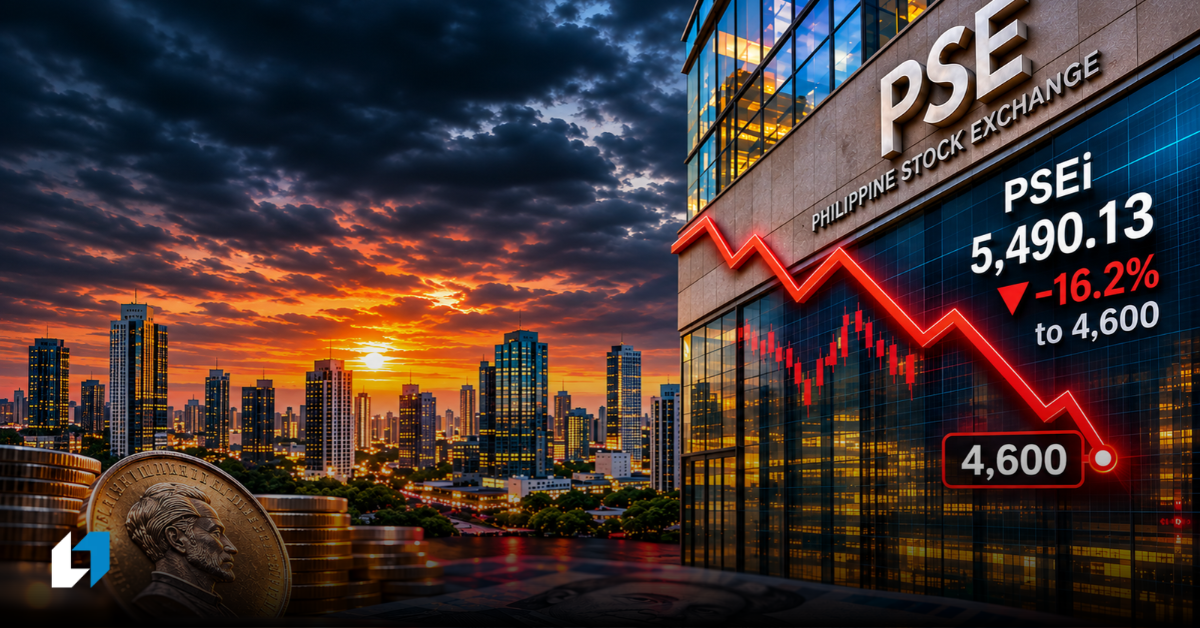
When Philippine Daily Inquirer financial columnist Henry Ong wrote an article titled “Why the Stock Market May Fall Further” on March 10, 2026, he raised the possibility that the Philippine Stock Exchange Index (PSEi) could eventually decline to the 4,600 level.
At the time, such a forecast may have appeared excessively pessimistic, particularly given the already depressed valuations of many Philippine stocks.
Ong’s analysis drew on Elliott Wave theory and the concept of socionomics, which examines how changes in collective social mood may influence financial markets, economic activity and political developments.
Nearly nine months later, economic and financial developments appear to be increasingly consistent with the bearish outlook he presented earlier this year.
On November 20, the PSEi fell to an intraday low of 5,249.76 before closing at 5,306.98. Although the market subsequently recovered to 5,490.13 on November 26, the economic conditions necessary to support a sustainable recovery remain challenging.
From its recent closing level, the PSEi would need to decline by another 16.2 percent to reach 4,600.
Interestingly, such a decline may no longer require a major financial crisis or an economic recession. A moderate deterioration in corporate earnings, combined with a further increase in investors’ required rates of return, could be sufficient to bring the market to that level.
Is the stock market anticipating a deeper economic slowdown?
One of the central arguments in Ong’s March article was that financial markets do not necessarily wait for economic conditions to deteriorate before they begin to decline.
Stock prices reflect changes in collective expectations. When confidence weakens, investors become less willing to accept uncertainty and begin demanding greater compensation for taking risks.
The economic developments of recent months appear consistent with this interpretation.
The Philippine economy expanded by only 2.1 percent during the third quarter of 2026, down from 2.4 percent in the preceding quarter and four percent during the same period last year.
Meanwhile, inflation accelerated to 7.8 percent in October from 7.2 percent in September, as higher fuel prices and transportation costs placed additional pressure on household budgets.
The combination of slowing economic growth and accelerating inflation has increased the risk of stagflation, one of the most difficult economic environments for businesses and investors.
When inflation rises faster than household incomes, consumers lose purchasing power. Families allocate a greater portion of their budgets to food, transportation, electricity and other necessities, leaving less money for discretionary spending.
For businesses, this creates pressure on both revenues and profit margins.
Companies face higher operating costs, but their ability to pass these costs on to customers becomes increasingly limited as consumer demand weakens.
Consider a company with annual revenues of ₱10 billion and a net profit margin of five percent, equivalent to earnings of ₱500 million.
If inflationary pressures reduce its net profit margin by just one percentage point, its annual earnings would decline by 20 percent even if its revenues remain unchanged.
This explains why corporate earnings can deteriorate much faster than the economy itself during periods of stagflation.
The recent weakness of Philippine stocks may therefore reflect growing concerns not only about current economic conditions but also about corporate profitability in 2027.
Why are rising interest rates making stocks less attractive?
Under normal circumstances, slowing economic growth would encourage the Bangko Sentral ng Pilipinas (BSP) to reduce interest rates to stimulate consumption and investment.
However, with inflation significantly above its target range of two to four percent, the central bank has limited flexibility to support economic growth through monetary easing.
The BSP’s benchmark policy rate currently stands at 5.50 percent following a series of monetary tightening measures.
Higher interest rates affect stock valuations in two ways.
First, they increase borrowing costs, which reduce corporate profitability and discourage business expansion.
Second, they increase the returns investors can earn from relatively safer fixed-income investments, which raises the required return from investing in stocks.
When investors can earn attractive yields from government securities, they become less willing to pay high prices for companies whose future earnings are uncertain.
For example, assume that a company generates sustainable annual earnings of ₱1 billion with no expected long-term growth.
If investors require a return of 10 percent, the theoretical value of its earnings would be ₱10 billion.
If the required return increases to 12 percent, its theoretical value would decline to ₱8.33 billion, representing a decrease of 16.7 percent, even without any deterioration in earnings.
If annual earnings also decline by 10 percent, the company’s theoretical valuation would fall further to ₱7.5 billion, or 25 percent below its original value.
Interestingly, Ong discussed this phenomenon in another Inquirer column published on March 18, titled “Why Investors Want More Now.”
At the time, he estimated that the implied market risk premium of Philippine stocks had already increased to approximately 11.3 percent, close to the 12.5-percent level observed during the pandemic in 2020.
He estimated that if the market risk premium returned to its pandemic-era level, the PSEi could decline to around 5,000, assuming earnings and growth expectations remained unchanged.
With economic growth now substantially weaker and inflation considerably higher, corporate earnings expectations could also deteriorate.
This creates the possibility that the market could fall below the 5,000 level and move closer to the original 4,600 downside scenario.
Why is the weakening peso making the situation worse?
In another Inquirer column published on May 19, titled “Why the Peso Could Weaken to 65:$1,” Ong raised the possibility that the Philippine currency could experience further depreciation as structural economic imbalances became increasingly apparent.
As of November 26, the peso closed at ₱63.72 against the US dollar, less than two percent away from the ₱65 level.
A weaker peso makes imported goods more expensive, particularly petroleum products, industrial materials, machinery and agricultural inputs.
Because the Philippines depends heavily on imported energy, currency depreciation can amplify the inflationary effects of higher international oil prices.
For companies with unhedged foreign currency obligations, a weaker peso can also increase the peso equivalent of their outstanding debt and financing expenses.
But currency depreciation creates another problem for the stock market: it reduces the investment returns of foreign investors.
Suppose a foreign investor purchased Philippine stocks when the exchange rate was ₱58 to the US dollar.
With the peso now trading at ₱63.72, the investor would have suffered a currency-related loss of approximately nine percent in US dollar terms even if local stock prices remained unchanged.
If Philippine stock prices also declined by 15 percent, the combined loss in US dollar terms would reach approximately 23 percent.
This helps explain why historically low stock valuations may not necessarily be sufficient to attract foreign capital.
If the peso continues to weaken toward ₱65, foreign investors may demand even greater discounts before committing additional capital to Philippine equities.
Further currency depreciation could also complicate the BSP’s efforts to contain inflation, which increases the possibility that interest rates may remain elevated despite slowing economic growth.
How could the PSEi mathematically fall to 4,600?
Stock market declines are often driven by two fundamental factors: lower expected earnings and lower valuation multiples.
At its November 26 closing level of approximately 5,490, the PSEi would need to lose about 890 points to reach 4,600.
If aggregate corporate earnings remain unchanged, a 16.2-percent contraction in the market’s valuation multiple would be sufficient to bring the index to that level.
However, if corporate earnings also decline, the required valuation contraction becomes considerably smaller.
For example, if aggregate earnings of PSEi companies decline by 10 percent and investors reduce the valuation multiple they are willing to pay by seven percent, the index could theoretically decline to approximately 4,595.
Even a five-percent decline in earnings, combined with a 12-percent contraction in valuation multiples, could bring the index to approximately 4,590.
Neither scenario requires an extraordinary collapse in corporate profitability.
The greater risk is that current corporate earnings may not yet fully reflect the deterioration in economic conditions.
Many listed companies may still be reporting earnings that reflect relatively favorable operating conditions earlier in the year.
As higher borrowing costs, weaker consumer demand and rising operating expenses become more apparent in subsequent quarterly financial statements, analysts could begin revising their earnings forecasts for 2027 downward.
The stock market could therefore experience another round of selling before the full extent of the economic slowdown becomes evident in reported corporate earnings.
Why could the decline happen sooner than expected?
When Ong discussed the possibility of a larger market correction in March, his analysis suggested that the deterioration in investor confidence could be part of a broader negative social mood cycle.
Under Elliott Wave theory, the final phase of a major corrective movement, commonly referred to as Wave C, can be particularly damaging because it often occurs when investors begin abandoning their expectations of an economic and financial recovery.
The Philippine stock market’s recent behavior appears consistent with some characteristics of such a corrective phase, although this does not establish that the proposed wave count is correct.
Market recoveries have repeatedly struggled to develop into sustained advances. Investors have become increasingly selective, while concerns about inflation, interest rates, currency depreciation and economic growth continue to undermine confidence.
The PSEi has recovered by approximately 3.5 percent from its November 20 closing level, partly because of bargain hunting and positioning ahead of the MSCI rebalancing.
However, a short-term recovery does not necessarily signal that the larger market correction has ended.
Unless the economic outlook improves, temporary rallies may continue to encounter selling pressure from investors seeking to reduce their exposure to equities.
A sustained decline below the psychologically important 5,000 level could further undermine investor confidence.
From 5,000, the market would need to decline by only another eight percent to reach 4,600.
What appeared to be a distant downside target in March could therefore become a realistic possibility over the coming months if economic conditions continue to deteriorate.
Would the PSEi at 4,600 represent a buying opportunity?
If the PSEi falls to 4,600, the market would be trading approximately 49 percent below its historical peak of 9,078 in 2018.
This would bring the index below its pandemic-era lows, despite nearly nine years of economic activity, corporate investments and business expansion since its historical peak.
For long-term investors, such a decline could create significant opportunities to acquire financially sound businesses at historically depressed prices.
However, investors must distinguish between companies that are temporarily undervalued because of unfavorable market conditions and those whose long-term earning power has been permanently impaired.
Companies with strong balance sheets, positive free cash flows, manageable debt obligations and the ability to maintain profit margins may emerge from the current economic difficulties in a stronger competitive position.
The forecast of a PSEi decline to 4,600 made in March was never a certainty.
A sustained decline in oil prices, a stabilization of the peso, improving corporate earnings or an earlier-than-expected reversal in monetary policy could prevent the market from reaching that level.
But what makes the original forecast particularly interesting today is that several of the economic and financial risks that could justify such a decline are already materializing.
The economy is slowing. Inflation is accelerating. Interest rates are rising. The peso is approaching another psychologically important threshold.
The Philippine stock market may already appear cheap based on historical valuations, but cheap stocks can become even cheaper when corporate earnings deteriorate and investors demand higher returns for taking risks.
At 4,600, the Philippine stock market could offer one of the more attractive long-term investment opportunities in recent years.
The challenge for investors is to recognize when declining prices reflect excessive pessimism rather than a continuing deterioration in economic fundamentals.

