

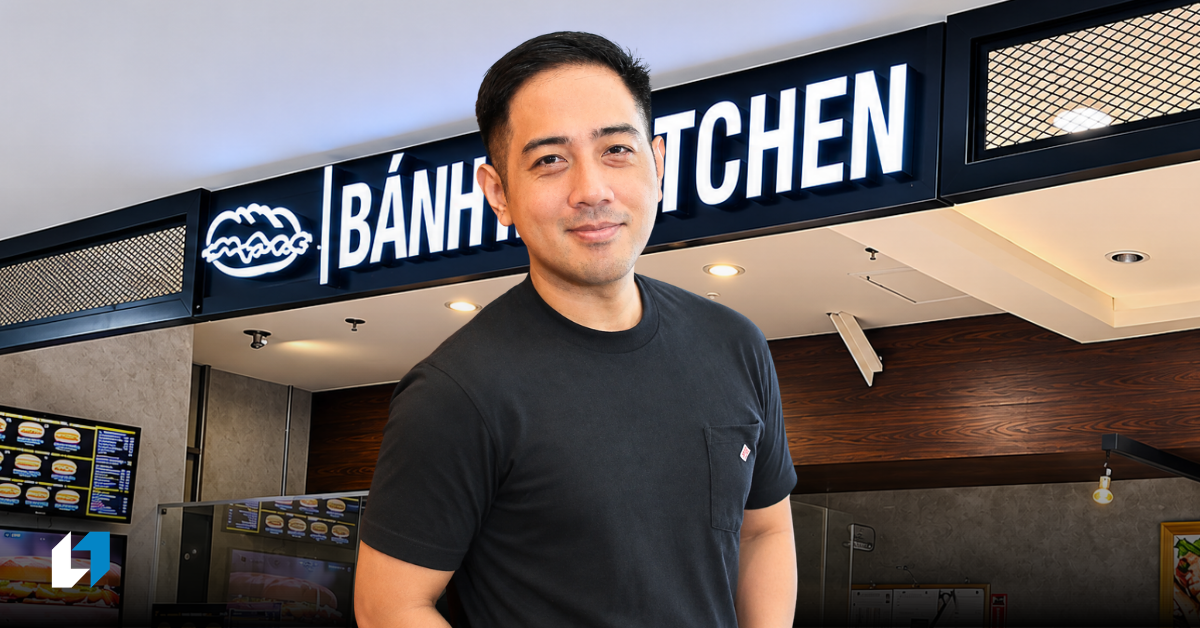
Before Mon Santos became the founder and CEO of Banh Mi Kitchen, he was raised with a simple but sobering truth: education was the only thing his family could give him. There would be no business to inherit, no financial cushion to fall back on—only what he could earn through discipline and effort.
“My mom used to say wala kaming mapapamana sayo,” Santos recalls. “Yung education lang talaga yong mapapamana ko sayo.” It was not framed as motivation or inspiration. It was a statement of reality. And in a household shaped by loss and uncertainty, that reality carried weight.
Santos lost his father when he was seven and his mother while he was still in high school. After his father’s death, his mother became the sole provider, doing whatever she could to support the family. “When my dad died, she was the sole provider,” Santos says. “Gagawin nya, bili sya ng fish sa Divisoria and then ire-resell nya sa village namin, sa garahe namin, para meron siyang pang support samin.” She also ran a small ready-to-wear clothing business in the palengke to supplement their income.
Despite the financial strain, education remained non-negotiable. “Kasi lahat kami Ateneo nag-aral eh so medyo mahal,” Santos explains. School was expensive, but his mother treated it as an investment rather than a luxury. There was no illusion that schooling would guarantee success—only that it would provide a fighting chance.
After both parents passed away, Santos and his siblings were raised with the support of their grandmother. “I grew up with my siblings with the support of my lola,” he says. “Siya yung nagpapa-aral samin.” In that environment, studying was not just encouraged—it was expected. There was no room for complacency.
What Santos did not have was exposure to business or corporate life as a clear career path. “Wala talaga akong exposure sa kahit anong business or corporate,” he admits. “Walang nag-guide sakin.” Unlike many entrepreneurs who grow up around family businesses, Santos had no early models to follow. Education became his only structured path forward.
That absence of guidance made him more serious about school, not less. Without mentors or connections, performance mattered. Santos focused on doing well academically, understanding that credentials were one of the few assets he could control.
Education also represented stability in a life marked by disruption. Losing both parents early forced Santos to mature quickly. School became a constant—something predictable in an otherwise uncertain world. It gave him structure, routine, and a sense of progress.
Santos and his siblings internalized their mother’s message deeply. “We took that seriously,” he says of her insistence on education. “So, we really studied hard.” There was no entitlement in that effort—only urgency. Studying well was not about ambition; it was about preparedness.
That mindset carried into his early professional life. After graduating from Ateneo, Santos joined Unilever Philippines, entering a corporate environment that was entirely new to him. While his business instincts would develop later, the discipline to learn, adapt, and perform had already been shaped by years of academic focus.
Looking back, Santos does not view education as a guarantee of success. Instead, he sees it as a foundation—one that allowed him to navigate unfamiliar environments with confidence. Without it, he believes his options would have been far narrower.
“My mom used to say wala kaming mapapamana sayo,” Santos repeats. At the time, it may have sounded like a limitation. In hindsight, it became a form of clarity. By naming what they could not provide, his mother made it clear what mattered most.
For Santos, education was not a privilege handed down—it was an inheritance earned daily through effort. And long before Banh Mi Kitchen existed, that inheritance shaped how he approached risk, responsibility, and opportunity.
When everything else felt uncertain, school was the one investment his family never questioned. And for Santos, it became the quiet starting point of a journey that would eventually lead him to build something of his own.
This article includes quotes from an interview originally published by Esquire Philippines, authored by Henry Ong.

