

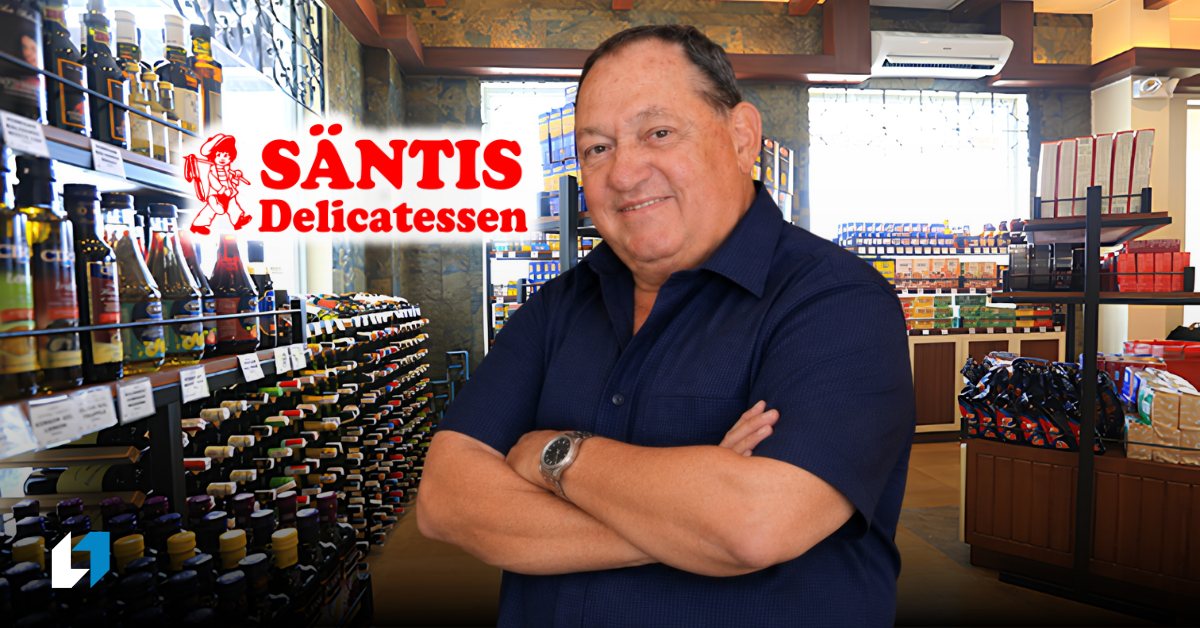
When Santi’s Delicatessen first opened, founder Werner Berger noticed an unusual pattern among wealthy Filipino consumers.
At the time, many Filipinos who wanted imported gourmet products traveled abroad to buy them.
“Filipinos who had money would usually fly to Hong Kong to buy chocolate, wine, and cheese,” Berger recalls.
For Berger, that behavior revealed something important about the market. If consumers were willing to travel overseas for specialty food, it meant the demand already existed—it simply had not been served locally.
Rather than seeing the absence of these products in the Philippines as a limitation, Berger saw an opportunity.
“So, I started importing these products for them in small quantities,” he says.
In the early days, the product selection focused heavily on European food.
“Since we were very much European-oriented back then, we focused on bringing in specialty products from Switzerland, Austria, Germany, and Italy,” Berger explains.
At the time, few businesses in the Philippines offered these items.
“We were the only ones doing this,” he says.
Entrepreneurs often succeed not by inventing entirely new products, but by recognizing gaps between what customers want and what the market currently offers. In Berger’s case, the gap was simple: Filipinos who wanted gourmet products had to leave the country to find them.
The business began modestly.
“In the beginning, we sold sausages and some meat—yes, meat was in high demand,” Berger says.
Transactions were simple and straightforward.
“Customers came here and paid in cash,” he recalls.
For Berger, maintaining strong cash flow was essential during the early years.
“At that time, there were no credit terms like today, so we always made sure we had enough cash to pay our suppliers.”
In retail businesses that depend on imported products, managing working capital carefully can determine whether a company survives its early stages. Importing requires paying suppliers upfront while sales may take time to materialize.
Stocking imported goods also created logistical challenges.
“Sometimes we had the products, sometimes we didn’t,” Berger says. “You know, it was the typical struggle when you start a business.”
Yet the demand for specialty food continued to grow.
“A lot of people would ask us, ‘Can you bring in this? Can you bring in that?’” he recalls.
Customer requests gradually shaped the store’s inventory and expanded the product range.
Listening closely to what customers wanted allowed Berger to adjust the business organically. Instead of relying on formal market research, the store’s product selection evolved through direct feedback from buyers.
Over time, Santi’s began to establish itself as a destination for imported gourmet food.
“In the food and beverage industry, demand was always stable because people need to eat and drink,” Berger says.
Food businesses often benefit from this stability. Even during periods of economic uncertainty, demand for essential products tends to remain relatively steady.
For Santi’s, that steady demand helped support the company’s gradual growth.
“In fact, demand kept bigger and bigger,” Berger recalls.
What began as a small importer serving a niche group of customers eventually grew into one of the Philippines’ best-known gourmet delicatessens.
Berger’s experience illustrates a common entrepreneurial lesson: many successful businesses start by identifying demand that already exists but is not yet being served locally.
Instead of trying to create a completely new market, Santi’s simply brought products closer to customers who were already searching for them abroad.

