

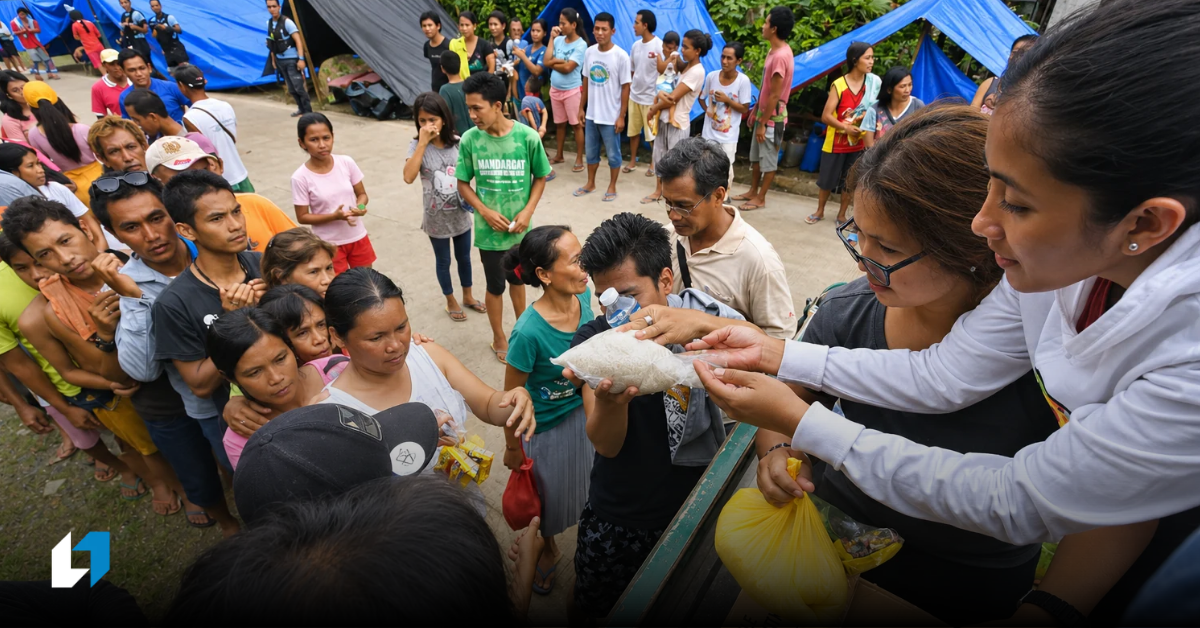
When typhoons strike the Philippines, thousands of Filipinos volunteer to pack relief goods, distribute food, clean flooded communities and help families rebuild their homes.
Many spend entire weekends helping people they have never met. Others travel long distances, sometimes spending their own money on transportation and meals, just to participate in relief operations.
This spirit of bayanihan has long been part of Filipino culture. But what if donating money instead of volunteering time could sometimes help more people?
Research from Northwestern University’s Kellogg School of Management suggests that people generally prefer donating their time because they believe their personal involvement creates a greater impact, even when financial contributions may be more effective.
The findings raise an interesting question for Filipinos: Is personally helping others always the best way to make a difference?
Why People Prefer Giving Time
In a study involving 601 participants, researchers Samantha Kassirer and Rima Touré-Tillery examined how people decided between donating their time and money.
They found that 60 percent of participants were willing to donate their time, compared with only 33 percent who donated money they had already earned.
Interestingly, when participants earned money specifically for charitable giving, the willingness to donate increased to 44 percent.
The researchers explained that people associate their time more closely with their personal identity than their money.
As Kassirer explained, “People see less of themselves in their money and more of themselves in their time.”
This personal connection makes volunteering feel more meaningful. People believe they are contributing something of themselves rather than simply transferring financial resources to someone else.
However, the researchers found that this emotional connection can also distort perceptions of effectiveness.
People may believe their time is more valuable even when donating money would produce better results.
The Filipino Culture of Bayanihan
This preference for personal involvement is particularly relevant in the Philippines, where volunteering is deeply associated with bayanihan.
A study published in February 2026 by iVolunteer Philippines, titled Bayanihan Pulse: The State of Philippine Volunteerism, examined the experiences of 406 respondents surveyed in 2024.
Among active volunteers, 81.2 percent primarily contributed their time, while only 10.3 percent prioritized financial donations.
The study also found that 34.7 percent of respondents identified a deeper sense of purpose as a personal benefit of volunteering.
Although the survey was not representative of the entire Philippine population, its findings suggest that personal participation plays an important role in how Filipino volunteers experience generosity.
Consider a typical relief operation following a major typhoon. A professional may spend an entire Saturday traveling to a volunteer center, packing food supplies and helping distribute donations.
The experience provides an immediate sense of accomplishment. The volunteer can see the relief goods being prepared and knows that the effort will help families affected by the disaster.
But there is another way to evaluate the contribution.
The Hidden Economic Value of Time
Suppose a professional earns ₱1,000 per hour and spends eight hours volunteering.
The economic value of those eight hours, measured against the person’s earning capacity, is ₱8,000.
Instead of volunteering, the professional could theoretically donate ₱8,000 to an organization that distributes relief goods.
If the organization could use that money to purchase supplies at wholesale prices, support transportation or employ trained personnel, the financial contribution might help more families than eight hours of volunteer work.
Of course, this comparison assumes that the professional could earn an additional ₱8,000 during those hours or would otherwise be willing to donate that amount. An hourly salary does not automatically mean that leisure time can be converted into additional income.
It also assumes that the organization can use the funds efficiently.
The researchers found that, on average, donating the equivalent of an hour’s salary could generate a greater charitable impact than volunteering for an hour.
This does not mean volunteering is unimportant. Some activities require specialized skills, personal attention or community participation that cannot easily be replaced with money.
The important lesson is that the value of a contribution should be measured not only by the sacrifice involved but also by the results it produces.
Filipinos Are Generous With Money, Too
Although volunteering is an important part of Filipino culture, financial generosity is also widespread.
According to the World Giving Report’s Philippine findings for 2025, 78 percent of Filipinos surveyed reported giving money through at least one channel.
About 54 percent donated directly to individuals or families in need, while 34 percent donated to charitable organizations.
The findings suggest that Filipino generosity often takes the form of direct personal assistance rather than donations through formal institutions.
This distinction matters because giving directly to someone in need can create the same emotional connection associated with volunteering.
A person who hands ₱1,000 to a struggling family can immediately see who benefits from the contribution.
By comparison, donating the same amount to a large charitable organization may feel less personal because the donor does not directly observe how the money is used.
Yet an established organization may be able to pool donations, purchase supplies more efficiently and reach beneficiaries who would otherwise receive little assistance.
The challenge is convincing donors that their money can accomplish as much as, or sometimes more than, their personal involvement.
Why Showing Results Matters
In another experiment involving 819 participants, the Kellogg researchers examined whether explaining the effectiveness of monetary donations would influence people’s willingness to contribute.
They found that 55 percent of participants who received a general charitable appeal donated money.
When the appeal emphasized that financial contributions were effective and impactful, the proportion increased to 63 percent.
The findings suggest that people may be more willing to donate when they understand what their money can accomplish.
This has important implications for Philippine charities, foundations and nonprofit organizations.
Instead of simply asking Filipinos to donate ₱1,000 to a relief fund, an organization could explain how that amount would be used.
For example, it might demonstrate how a ₱1,000 contribution could provide meals, drinking water or other essential supplies to disaster victims.
Such claims should be supported by actual procurement costs and distribution records.
The objective is to make financial contributions as tangible and meaningful as volunteering.
When donors understand the results their money can produce, they may become more willing to contribute financially.
The Importance of Trust
There is another factor that may influence charitable giving in the Philippines: trust.
The Philippine findings of the World Giving Report 2025 identified transparency, accountability and integrity as important considerations in encouraging greater donations.
This helps explain why some people may prefer personally delivering assistance rather than giving money to organizations.
When volunteers distribute relief goods themselves, they can observe how the assistance reaches beneficiaries.
Financial donations require greater confidence that the receiving organization will use the funds appropriately.
For charitable institutions, communicating impact therefore involves more than describing how much money is needed.
They must also demonstrate how contributions are spent, how beneficiaries are selected and what results have been achieved.
The more transparent an organization becomes, the easier it may be for donors to recognize the effectiveness of financial giving.
Giving Should Be About Impact, Not Just Sacrifice
The Kellogg research offers an important lesson about the economics of generosity.
People naturally value activities that make them feel personally involved. Volunteering creates emotional satisfaction because individuals can directly experience the difference they are making.
But the feeling of making a difference is not always the same as producing the greatest impact.
For Filipinos who want to help others, the decision should not necessarily be between giving time and giving money.
A doctor volunteering medical services may contribute more through professional expertise than through a financial donation. A business owner, on the other hand, may create greater impact by funding relief supplies rather than spending several hours performing tasks that other volunteers can accomplish.
Similarly, a student with limited financial resources may be able to contribute more meaningfully through volunteer work than through monetary donations.
The most effective contribution depends on individual circumstances and the needs of the organization receiving assistance.
Bayanihan has always been about communities working together to help one another.
The Kellogg research suggests that this tradition can become even more effective when generosity is guided not only by personal involvement but also by an understanding of economic value.
After all, the true measure of generosity is not simply how much time or money people sacrifice, but how much their contributions improve the lives of others.

