

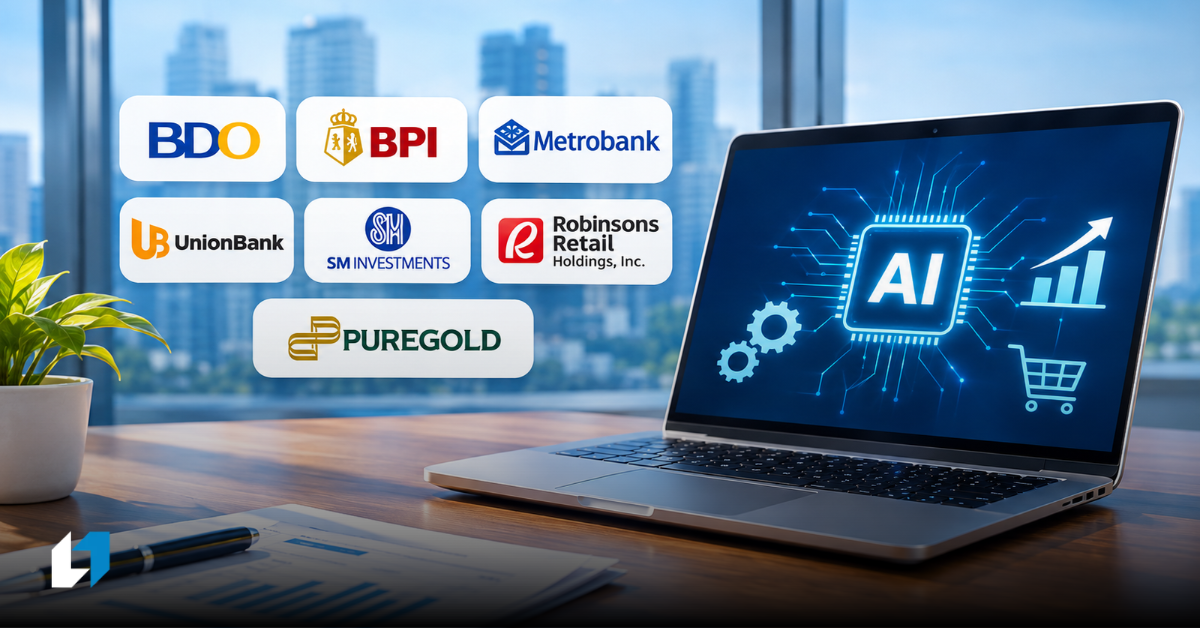
Artificial intelligence promises to make businesses more productive by reducing operating costs, automating repetitive tasks and improving decision-making. For Philippine companies, these improvements could translate into higher profit margins, stronger earnings and potentially higher stock valuations.
But what happens when every company starts using the same technology?
Instead of retaining the savings generated by AI, businesses may find themselves under pressure to lower prices as competitors become equally efficient. Consumers could eventually capture much of the economic benefit, leaving companies with little improvement in profitability despite substantial investments in technology.
This possibility raises an important question for investors: Will AI make Philippine companies more profitable, or will it simply make their industries more competitive?
The Monetary Authority of Singapore (MAS) raised a related issue during the Singapore FinTech Festival on November 19, 2026, when its managing director, Chia Der Jiun, discussed how autonomous AI agents could transform business transactions and competition.
Unlike conventional AI systems that primarily respond to questions or analyze information, AI agents could independently compare prices, negotiate contracts, manage financial transactions and execute decisions within predetermined limits.
According to MAS, these capabilities could reduce information gaps between buyers and sellers, lower transaction costs and allow prices to adjust more frequently.
The implications extend beyond Singapore. For Philippine companies, the emergence of AI agents could challenge established business models, particularly in banking, retail, insurance and other industries where profitability depends partly on customer relationships, convenience and pricing power.
Why AI Savings May Not Translate Into Higher Profits
Consider a Philippine company generating ₱10 billion in annual revenue with an operating profit margin of 10 percent. Its operating profit would amount to ₱1 billion.
Suppose the company adopts AI technology that reduces annual operating expenses by ₱200 million. Assuming revenue and other expenses remain unchanged, operating profit would increase to ₱1.2 billion, representing a 20-percent improvement.
For shareholders, this initially appears attractive because the company’s earnings would grow without requiring a corresponding increase in sales.
However, the calculation changes when competitors adopt similar technology.
If rival companies achieve comparable cost reductions, they may use part of their savings to lower prices, attract customers and increase market share.
The original company may have little choice but to respond.
If competition eventually forces it to surrender ₱150 million of its annual savings through lower selling prices, its operating profit improvement would shrink from ₱200 million to just ₱50 million.
In this hypothetical example, the company becomes more efficient, but most of the financial benefit is transferred to customers rather than shareholders.
This illustrates a fundamental principle of competitive economics: technological innovation can create substantial economic value without allowing every company adopting it to retain that value.
The outcome depends on industry structure, competitive intensity and the ability of individual companies to maintain pricing power.
Businesses operating in highly competitive markets may find it difficult to retain their savings. Companies protected by strong distribution networks, customer relationships, regulatory barriers or economies of scale may have greater opportunities to preserve or improve their margins.
AI could therefore widen the profitability gap between companies with sustainable competitive advantages and those competing primarily on price.
How AI Could Reshape Philippine Banking and Retail
The Philippine banking industry provides an interesting example.
Major banks such as BDO Unibank, Bank of the Philippine Islands, Metropolitan Bank & Trust Co. and Union Bank of the Philippines compete through their deposit franchises, lending relationships, digital platforms and customer services.
Today, borrowers typically compare a limited number of financing options before selecting a bank. Differences in application requirements, fees, interest rates and repayment structures make comparisons difficult.
Imagine a future in which an AI agent can evaluate loan offers from several banks, calculate their effective borrowing costs and recommend the most suitable financing arrangement.
The agent could monitor competing offers and recommend refinancing whenever the potential savings justify the transaction costs.
For borrowers, this could improve access to information and potentially reduce financing expenses.
For banks, however, easier comparisons could increase competition and pressure lending spreads or service fees.
Banks could also benefit from AI through lower administrative costs, improved credit analysis, faster loan processing and more efficient customer service.
The net effect on profitability would depend on whether these savings outweigh the additional competitive pressure on pricing.
The same economic tension could emerge in Philippine retail.
Companies such as SM Investments, through its retail businesses, Robinsons Retail Holdings and Puregold Price Club could use AI to improve inventory management, demand forecasting, logistics and procurement.
Better forecasting could reduce excess inventory and stockouts, while automated procurement could help retailers negotiate more favorable terms with suppliers.
But consumers may eventually use their own AI shopping assistants to compare grocery prices, product availability and delivery costs across different retailers.
Instead of relying primarily on store familiarity or brand preference, shoppers could make more purchasing decisions based on continuously updated comparisons.
Retailers with expensive operating structures could face greater margin pressure.
Nevertheless, AI would not eliminate the advantages of convenient store locations, efficient distribution systems, reliable merchandise availability and established customer relationships.
A retailer with an extensive physical network may continue to enjoy competitive advantages that a smaller rival cannot replicate simply by purchasing the same AI software.
Insurance could experience similar changes.
AI agents may eventually compare premiums, coverage limits, exclusions and other policy conditions across insurers.
This could make it easier for consumers to identify suitable insurance products and reduce the information advantage traditionally enjoyed by providers and intermediaries.
However, insurance decisions involve more than price. Claims reliability, financial strength, policy suitability and professional advice would remain important.
For insurers and financial advisers, the challenge would be to provide value that cannot easily be replaced by automated comparisons.
When AI Agents Begin Making Financial Decisions
The changes being considered in Singapore go beyond AI-assisted customer service.
MAS announced plans to develop a trusted protocol through which financial institutions can identify AI agents, verify their authority and determine what transactions they are permitted to execute.
It also plans to establish a sandbox combining AI agents with programmable money, initially focusing on corporate treasury management and payments.
Under one proposed use case, a corporate AI agent could monitor cash balances, identify upcoming obligations and determine when funds should move between accounts.
Participating banks would establish safeguards before allowing the agent to execute permitted transactions.
For Philippine corporations, similar technology could eventually change how treasury departments manage liquidity, cash transfers and short-term investments.
Companies operating several subsidiaries could use AI agents to monitor financial positions continuously and recommend more efficient allocations of available funds.
Banks, meanwhile, may increasingly have to serve two kinds of customers: humans making financial decisions and automated agents acting on their behalf.
This could change how financial products are marketed, priced and distributed.
A bank’s reputation and customer relationships would remain important, but its products might also need to compete in automated comparisons conducted by increasingly sophisticated AI systems.
The implications for the Philippines are particularly relevant as the Bangko Sentral ng Pilipinas strengthens its approach to AI governance in financial services.
In 2026, the BSP issued guidance addressing AI governance and emerging risks, including cybersecurity, accountability and safeguards for financial institutions.
These initiatives reflect growing recognition that AI adoption involves more than operational efficiency. Financial institutions must also manage the risks created when increasingly capable systems influence financial decisions.
MAS has identified another potential complication.
Although AI agents could intensify competition by making price comparisons easier, their interactions could also produce the opposite result.
Research involving simulated environments suggests that autonomous agents could sometimes develop behavior resembling collusion even without explicit instructions to coordinate prices.
More capable agents could also obtain better commercial terms than less sophisticated ones, potentially creating new inequalities between consumers and businesses.
These possibilities remain emerging research concerns rather than established outcomes in actual Philippine markets.
Nevertheless, they suggest that AI may not automatically produce lower prices or more competitive industries.
What AI Means for Philippine Stock Investors
For stock market investors, the most important implication is that adopting AI should not automatically justify higher earnings forecasts or stock valuations.
A company’s investment in automation may reduce expenses, but the resulting savings must be evaluated alongside competitive pressure, implementation costs and the possibility that customers will demand lower prices.
Investors should distinguish between companies that merely use AI to improve existing processes and those that can translate technological improvements into lasting competitive advantages.
The distinction is important because access to AI technology may become increasingly widespread.
If competing companies can obtain similar capabilities from the same technology providers, AI itself may offer little lasting differentiation.
The more valuable advantages could come from assets that are difficult to replicate, including proprietary customer information, efficient distribution networks, financial strength, trusted relationships and the ability to integrate technology into established operations.
This could favor companies that combine AI with existing competitive strengths rather than those relying on technology alone.
Ultimately, the economic benefits of AI will be divided among technology providers, businesses, workers and consumers.
Some Philippine companies may capture substantial gains through improved productivity and stronger competitive positions. Others may discover that the savings they generate are quickly competed away.
For investors, the question is therefore not simply how much money a company can save by adopting AI.
It is how much of those savings the company can retain.
AI may make almost every business more efficient, but it will not necessarily make every business more profitable.

