


When I hear that the Philippines has a National AI Council, I ask what it could mean for a family’s money.
Could it help protect someone from a fake investment pitch? Could it help a worker learn new skills before a job changes? Could it help a small firm use AI without putting customer data at risk?
Those questions matter more to me than the council’s title. They also help explain why some people sound angry about its creation.
A family plans around pay, bills, school fees, and savings. A new government body offers little comfort until people can see how it may help with those real needs.
I read EO 131 with that in mind. It creates a council to bring agencies together, guide work, and track progress. It does not replace the regulators that already oversee their own sectors.
That point matters in finance. I would not tell a reader that a new AI council now checks every AI investment product or can settle every complaint. The order does not make that promise.
In my recent DZMM interview, I welcomed the council as a step the business sector had long wanted. I also said the effect on ordinary people remained to be seen.
I think that is a fair place to start. Better teamwork across government may help. It still has to become something a household can use.
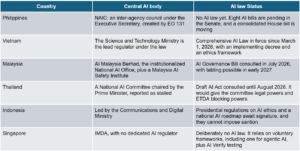
The ASEAN comparison shows that countries use different tools. Vietnam has an AI law in force. Malaysia has a national AI body and is working on a law. Thailand has a committee and a draft act. Indonesia’s digital ministry leads its plans. Singapore uses guidance and AI testing tools.
I take a simple lesson from that mix. A council and a law are parts of a system. Neither title tells me, on its own, how well a person will be protected.
I want to see the path from policy to help.
For a saver who meets an AI scam, that path should be clear. Which office takes the report? What facts should the person keep? How do the right agencies share the case? Who explains the next step?
In my interview, I discussed AI use in scams and online posts. I see a strong need for plain public lessons about how these tools can be misused. People need examples they can understand, not a wall of tech terms.
The same care should apply to jobs. I cited a reported drop in contact center employment and suggested AI might be a factor. I would not treat that as proof of a cause. The figure and the reasons need checking.
Still, families cannot build plans on vague comfort. If work changes, they need clear information and support that arrives in time.
EO 131 includes a working group on skills. I want it to focus on training people can afford to take. A free course still has a cost if attending means losing a day’s pay.
Access matters too. I spoke about weak internet and the need for computing power. A national plan should ask whether support reaches small firms and places beyond the main cities.
Then there is the question of trust. The reactions shared with me include doubts about whether business and political interests will shape the council too much.
I cannot prove those charges from a pair of posts. I do think clear records would help answer them. Show who advises the council, what interests they hold, and how decisions are made.
The order calls for plans with goals and deadlines, along with progress reports. I want public updates that connect spending to results people can grasp.
How many workers gained useful skills? Which public tools were tested? What support reached small firms? Where did the plan fall short?
I also want simple measures of success. Counting events tells me little. Showing that people learned useful skills tells me much more about the work itself.
I would judge this effort as I would any serious use of limited funds: by its purpose, its risks, and its results. The council has a chance to earn trust. It should begin by showing families why its work deserves a place in their future.
(Video credit: DZMM Teleradyo)
Dominic “Doc” Ligot is one of the leading voices in AI in the Philippines. Doc has been extensively cited in local and global media outlets including The Economist, Channel News Asia, South China Morning Post, Washington Post, and Agence France Presse. His award-winning work has been recognized and published by prestigious organizations such as NASA, Data.org, Digital Public Goods Alliance, the Group on Earth Observations (GEO), the United Nations Development Programme (UNDP), the World Health Organization (WHO), and UNICEF.
If you need guidance or training in maximizing AI for your career or business, reach out to Doc via https://docligot.com.

