It’s November, and many Philippine companies are getting ready for annual performance reviews. In many places, those ratings also determine bonuses, promotions, and raises.
One review scene has stayed with me. The employee believed he had met expectations. His manager rated him “needs improvement.” They went back and forth and could not agree on the final score. The manager had never been vocal about how the employee was doing and had no structure for giving feedback, so the employee had every reason to think he was doing well. In fact, he wasn’t, and no one had ever told him clearly. The issue was not the score; it was the result of conversations that never happened in the months before the verdict.
The numbers explain why scenes like this happen. Gallup found that 74 percent of employees get a performance review once a year or less, and just 14 percent strongly agree these reviews motivate them to do better. Meanwhile, 80 percent of employees who get meaningful feedback every week are fully engaged. The annual review and its forms still matter as documentation, but they work best when they record conversations that have already happened.
In the Philippines, Gallup’s State of the Global Workplace 2026 report found that 39 percent of employees are engaged, against a global average of 20 percent. Still, only 42 percent of Philippine employers hold regular feedback sessions, according to the Robert Walters Talent Trends 2026 survey.
When feedback is missing, people don’t always leave. Sometimes they resort to quiet quitting. The term went viral on TikTok in 2022, after New York engineer Zaid Khan described it as quitting the idea of going above and beyond. The employee stays but does only what the job requires. A quieter version is “quiet cracking,” a term TalentLMS introduced in 2025 for lasting unhappiness at work that leads to disengagement. The Robert Walters survey found that over 38 percent of Filipino professionals often experience it. On the outside, the person looks fine, so a manager may never notice.
Here’s what good looks like. The employee already knows they’re up for regularization or a promotion, because the conversations have been happening all along. Expectations are clear, and they’ve been given a bigger scope of work and a part in projects that stretch them. When the form finally comes out, it just writes down what both people already know.
I follow one rule for reviews. If the employee is surprised by anything in the review, it’s already too late. I know managers are busy, but feedback doesn’t always need a formal sit-down. It can be a quick check-in after a meeting, or five minutes together as you walk back from a session. If you can set aside at least 15 minutes each week with every team member, that’s great. If not, aim for monthly. For a large team, rotate your one-on-ones through the month and use small group check-ins for updates. What matters is that feedback is regular and timely, so small issues get handled while they’re still small.
When something comes up, like an error, a mistake, or a deviation from the process, talk about it soon and keep a level head. Find the root cause and work on it together. A cold shoulder won’t fix it, and neither will hoping that broad statements about following the SOP or core values will stick. At times, you have to be very clear. Don’t make people guess or assume.
You also don’t have to wait for HR or the company’s evaluation calendar. Start on day one with a new hire. Tell them what you expect (their KPIs), your rules of engagement, and how you work as a team. Then ask questions too: what do they expect from you, how do they like to get feedback, and what support do they need? Say that you value open communication and want them to feel safe telling you when something isn’t working. That’s psychological safety. Do the same with your tenured team members. People are better off knowing how you operate than doing the job blindly, unsure what’s expected, how they’ll get feedback and support, or how they’ll progress. Always partner with HR, but remember that you are the first level of HR for your people.
If I could change one thing about year-end reviews, I would turn them into regular two-way meetings, as Gallup’s weekly feedback findings support. Let the employee talk first. Ask what went well, what challenges they faced, and what they need next. Then ask for feedback about yourself: what’s one thing I could do differently to make your work easier? The hard part is not defending yourself. This is called reflective listening: listen to their answer, say back what you heard, and then respond. If the talk gets tense, pause and name what you see, like “This feels hard to hear,” then bring it back to the goal you both share. Pick one thing you heard, act on it within the month, and tell them you did. They need to see that their feedback mattered.
If you’re the employee, you don’t have to wait to be asked. Before your next check-in, send your manager three short lines: what you’re proud of this quarter, what difficulties you faced, and what you want for next quarter.
In 2027, keep the 15-minute meetings going, and keep using the form. A written record protects both the employee and the company, and now it reflects the conversations you’ve had all year. In each meeting, check on goals and workload, then ask what’s going well and what’s getting in your way. Write the answers down as you go. By the next review cycle, there won’t be any surprises left in the form, and your year-end meeting may be the easiest one on your calendar.
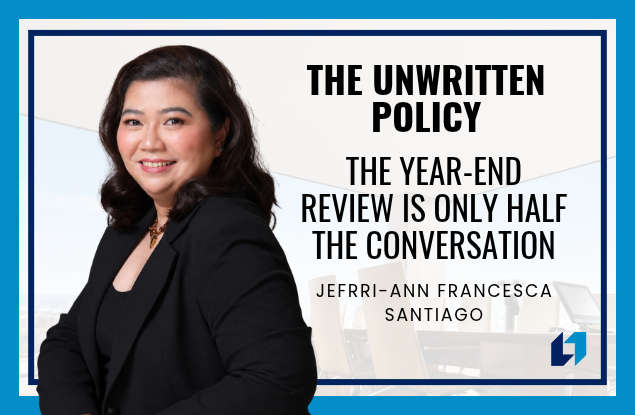
Jefrri-Ann Francesca Santiago, MSHRM, CMC, CHRP, is the Founder and Principal Consultant of Strategence Consulting, a boutique HR, organizational development, and leadership advisory practice in the Philippines. She has more than 20 years of experience in corporate HR leadership across IT, BPO, retail, and professional services. Learn more at strategenceconsulting.com.
Sources
- Gallup, “Creating a Culture of Recognition & Feedback” (Nov 12, 2024)
- Gallup, State of the Global Workplace 2026, Philippines country-level data (data collected Jan to Dec 2025)
- BusinessWorld, “Worker disengagement seen eroding productivity” (May 22, 2026, on the Robert Walters Talent Trends 2026 report)
- Built In, “What Is Quiet Quitting?” (on the term’s 2022 TikTok origin, citing the Los Angeles Times)
- RTÉ, “Is quiet cracking the new quiet quitting?” (Sept 6, 2025, on TalentLMS and the term “quiet cracking”)
- Original Strategence article, “Leadership Beyond Metrics: Turning Employee Feedback Into Transformative Action”

