

The Philippine economy is already struggling with rising oil prices, a weakening peso, accelerating inflation and slowing economic growth. But if the conflict in the Middle East escalates into another major confrontation involving the United States and Iran, how much worse could conditions become?
Could the peso reach ₱70 against the dollar? Could inflation rise to double digits? Could the Bangko Sentral ng Pilipinas (BSP) raise interest rates to 6.5 percent? And could Philippine economic growth fall below 2 percent?
These are questions worth examining because the country is entering another period of geopolitical uncertainty with its economy already under considerable pressure.
As of October 30, Brent crude was trading at approximately $117.64 per barrel, while the peso stood at ₱63.85 against the dollar. Inflation had accelerated to 7.2 percent in September, prompting the BSP to raise its policy rate by 50 basis points to 5.5 percent.
Economic growth has also weakened. The Philippine economy expanded by only 2.3 percent in the second quarter of 2026, while the International Monetary Fund (IMF) expects full-year growth of just 3.4 percent.
The risk is that another major escalation could intensify these pressures simultaneously, leaving policymakers with increasingly difficult choices.
To assess the possible consequences, Financial Adviser PH developed a preliminary stress-test framework covering a renewed conflict beginning in November 2026.
The analysis considers two scenarios: a major escalation that disrupts regional shipping and energy supplies for several weeks, and an extreme disruption that substantially restricts Gulf energy exports for several months.
These are conditional forecasts rather than predictions that either scenario will occur. The purpose is to estimate how far economic indicators could move beyond their already elevated levels.
1. Oil prices could initially surge toward $180 per barrel
Oil prices would likely react first to a renewed military escalation.
Brent crude has already risen sharply because of the Middle East conflict. On October 30, prices reached six-month highs following attacks on commercial shipping in the Strait of Hormuz and renewed concerns about US military action.
The strait is particularly important because it connects major Gulf oil exporters to international markets. Any disruption to shipping would increase the risk of supply shortages, higher insurance premiums and additional transportation costs.
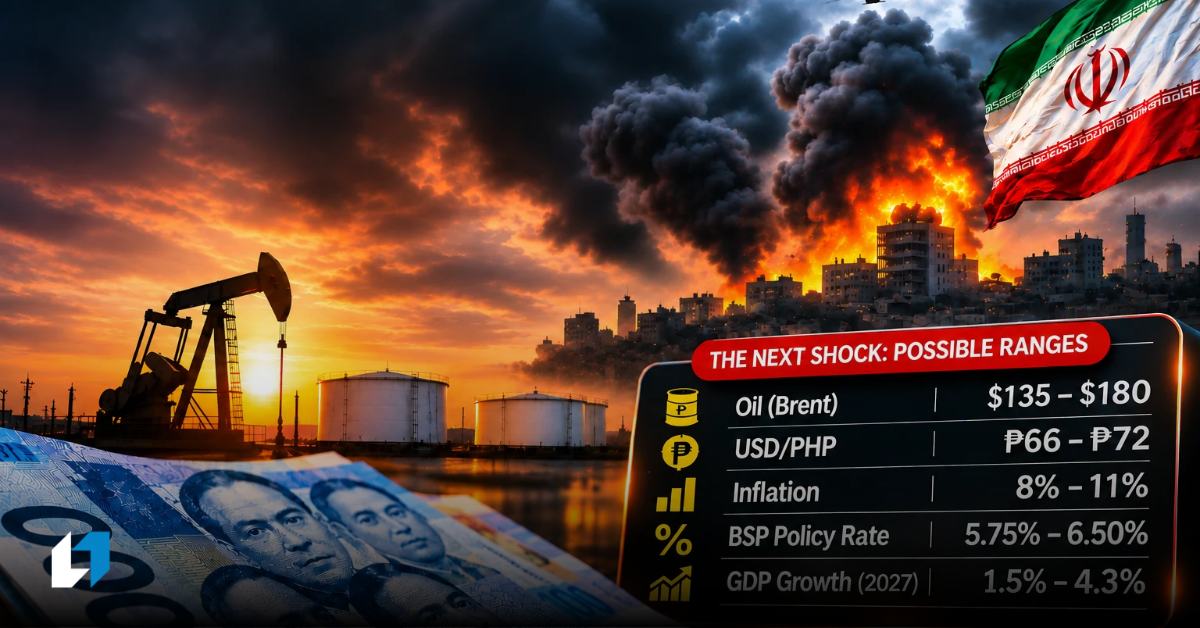
Under a major escalation, Brent could initially rise to $135–$150 per barrel, representing an increase of approximately 15–28 percent from its October 30 level.
An extreme disruption involving substantial restrictions on Gulf exports could temporarily push prices toward $160–$180, or approximately 36–53 percent above the current reference price.
But how long will prices remain elevated? A temporary increase to $180 would create immediate financial-market volatility. But oil averaging $150 for several months would cause much greater economic damage because the additional costs would spread through transportation, electricity, manufacturing, agriculture and food distribution.
For the Philippines, which relies heavily on imported petroleum, another sustained increase would create a new wave of cost pressures just as businesses and households are already adjusting to expensive energy.
2. The peso could initially weaken to ₱68, with ₱70 possible under extreme conditions
The peso has already depreciated substantially, but another escalation could produce additional pressure.
Two forces would likely operate simultaneously. First, global investors could increase their holdings of US dollars and other perceived safe-haven assets, reducing demand for emerging-market currencies.
Second, Philippine oil importers would require more dollars to pay for increasingly expensive petroleum products.
Under a major escalation, USD/PHP could initially move toward ₱66–₱68. An extreme disruption accompanied by heavy capital outflows could temporarily push the exchange rate toward ₱69–₱72.
At ₱70 per dollar, the peso would have depreciated by approximately 9.6 percent from its October 30 reference rate of ₱63.85.
The combination of a weaker peso and more expensive oil would be especially damaging.
At $117.64 per barrel and ₱63.85 per dollar, the peso cost of one barrel of crude is approximately ₱7,511 before freight, refining and other expenses.
If crude rises to $150 and the peso weakens to ₱70, the equivalent cost increases to ₱10,500 per barrel. That represents an increase of approximately 40 percent in the peso-denominated cost of imported crude.
For consumers, this shows why the exchange rate and oil prices cannot be analyzed independently. Even if the dollar price of crude stabilizes, further peso depreciation could continue to increase domestic energy costs.
The BSP could use its foreign exchange reserves to smooth excessive volatility, but sustained intervention would become more difficult if expensive oil continued to increase demand for dollars.
A brief breach of ₱70 would not necessarily mean the peso would remain at that level. Sustained depreciation would depend on the duration of the conflict, foreign capital flows, domestic interest rates and the country’s external financing position.
3. Inflation could climb toward 9 percent and potentially reach double digits
Philippine inflation is already running well above the BSP’s 2–4 percent target.
The Philippine Statistics Authority reported that headline inflation reached 7.2 percent in September, compared with 6.1 percent in August. Transport inflation was 14.6 percent, while housing, water, electricity, gas and other fuels increased by 8.4 percent.
Another oil shock could accelerate these pressures. Under a major escalation, inflation could rise toward 8–9 percent over the following one to three months.
An extreme scenario involving oil above $160, a peso approaching ₱70 and prolonged supply disruptions could push inflation toward 9–11 percent.
The upper end assumes that businesses pass a substantial portion of higher energy and import costs to consumers, rather than absorbing them through lower profit margins.
The impact would not be immediate across all products. Fuel prices would respond relatively quickly, while transportation, electricity, food and manufactured goods would adjust over subsequent weeks and months.
For households, the consequences could be substantial. A family spending ₱40,000 per month would need approximately ₱44,000 to maintain the same consumption basket after a cumulative 10 percent increase in prices.
This does not mean a 10 percent annual inflation reading would suddenly increase every family’s monthly expenses by 10 percent. It means the overall price level would be 10 percent higher than a year earlier.
The burden would be particularly severe for lower-income households, which allocate a greater share of their budgets to food, transportation and other necessities.
The danger is that high inflation could become more persistent as workers demand higher wages and businesses repeatedly adjust their selling prices.
4. BSP interest rates could reach 6–6.5 percent
The BSP has already begun tightening monetary policy in response to rising inflation.
On October 30, the Monetary Board raised its target reverse repurchase rate by 50 basis points to 5.5 percent.
Another major escalation could force the central bank to consider further increases, particularly if inflation expectations deteriorate and the peso experiences sustained depreciation.
Under a major escalation, the policy rate could rise toward 5.75–6 percent over subsequent monetary policy meetings.
Under an extreme and prolonged disruption, a policy rate of 6.5 percent becomes a plausible stress scenario. However, this is not an automatic response. The BSP could also choose to look through a temporary supply shock if economic growth weakens sharply and inflation expectations remain contained.
The challenge is that monetary policy cannot directly produce more oil or reopen disrupted shipping routes.
Higher interest rates could help stabilize inflation expectations and reduce pressure on the peso, but they would also increase financing costs for businesses and households.
Property developers, manufacturers and other highly leveraged companies could face more expensive refinancing. Consumers with floating-rate loans could experience higher debt-service payments.
Banks could initially benefit from higher lending yields, but a prolonged economic slowdown would increase the risk of loan defaults.
The BSP would therefore face a difficult choice between containing inflation and protecting economic growth.
5. Philippine stocks could fall toward 5,000, with 4,500 possible in a severe selloff
A renewed escalation could trigger another round of selling in Philippine equities.
Foreign investors may reduce their exposure to emerging markets, while domestic investors could become more cautious as interest rates and economic uncertainty increase.
Higher energy prices would also affect corporate earnings. Airlines, manufacturers, transportation companies, consumer businesses and property developers could experience higher operating costs or weaker demand.
With the Philippine Stock Exchange Index trading around 5,680 at the end of October, a major escalation could initially push the market toward 5,000–5,300.
An extreme disruption could produce a deeper decline toward 4,300–4,800.
A fall to 5,000 would represent a decline of approximately 12 percent from the reference level, while a decline to 4,500 would amount to nearly 21 percent.
These estimates are market stress scenarios, not price targets derived from a valuation model.
The actual decline would depend on how much geopolitical risk is already reflected in stock prices, the level of foreign selling, corporate earnings expectations and the response of domestic interest rates.
Higher bond yields could also make equities less attractive, particularly dividend-paying stocks and real estate investment trusts.
However, a sharp decline could create investment opportunities if market prices fall more rapidly than the long-term earnings capacity of financially strong companies.
6. GDP growth could slow below 3 percent, with recession risk under an extreme scenario
The most serious economic damage would likely emerge several months after the initial market shock.
Higher energy costs would reduce household purchasing power. Businesses would face increasing operating expenses, while elevated interest rates could discourage borrowing and investment.
The IMF’s September 2026 assessment projected Philippine GDP growth of 3.4 percent in 2026 and a recovery to 5.1 percent in 2027.
That projected recovery provides a useful reference for measuring the additional damage from a renewed conflict.
If energy prices stabilize and geopolitical tensions ease, economic growth could recover toward the IMF’s 2027 projection. However, a prolonged escalation could reduce 2027 growth to approximately 3.5–4.3 percent.
An extreme disruption involving sustained energy shortages, weaker remittances, tighter financial conditions and a further deterioration in consumer confidence could reduce growth to approximately 1.5–3 percent.
The severe scenario would imply a growth shortfall of roughly 2.1–3.6 percentage points relative to the IMF’s 5.1 percent recovery projection.
Using the Philippine economy’s approximately ₱28-trillion nominal GDP in 2025 as a reference, a two-percentage-point shortfall in annual real output growth would represent roughly ₱560 billion in economic output at that base-year scale.
A three-percentage-point shortfall would be equivalent to approximately ₱840 billion.
These figures represent output that could be lost relative to a stronger-growth scenario. They are not direct government revenue losses, and the calculation is an approximation rather than a detailed national-accounts forecast.
A technical recession, commonly defined as two consecutive quarters of declining real GDP, would become possible under the most severe conditions, particularly if the energy shock coincides with weaker investment and household consumption.
However, even GDP growth of 2 percent would not automatically constitute a recession if economic output continued expanding.
7. OFW remittances and employment could come under pressure
A wider Middle East conflict would create another risk for the Philippines through overseas employment.
Saudi Arabia, the United Arab Emirates, Qatar, Kuwait, Bahrain and other Gulf economies employ substantial numbers of Filipino workers.
A prolonged conflict could disrupt construction projects, tourism, transportation, retail businesses and other industries employing overseas Filipinos.
Employers could postpone hiring, reduce working hours or terminate contracts. In areas directly affected by fighting, workers might require evacuation or repatriation.
For stress-testing purposes, a moderate disruption could reduce total Philippine remittances by approximately 1–3 percent relative to a no-escalation scenario, although this range is an illustrative assumption rather than a measured forecast.
The effect would depend heavily on the countries and industries affected, and on whether workers continue receiving salaries during the disruption.
A weaker peso would increase the peso value of remittances that continue to arrive, partly offsetting the impact for some families. But this benefit would not extend to households whose relatives lose their jobs.
A large-scale return of OFWs could also increase domestic unemployment and place additional pressure on government assistance programs.
8. Government borrowing could increase as the fiscal deficit comes under pressure
The economic consequences of a prolonged conflict could eventually affect public finances.
Higher oil prices and inflation would increase demands for government assistance.
Transport operators could seek additional fuel subsidies. Workers might demand wage adjustments, while consumer groups could call for lower fuel taxes and additional support for vulnerable households.
The government might also need to finance emergency fuel purchases, OFW repatriation and other contingency measures.
At the same time, weaker economic activity could reduce tax collections.
To show the potential scale, an additional ₱50-billion relief package would be equivalent to approximately 0.18 percent of the country’s ₱28-trillion nominal GDP reference.
A ₱100-billion package would represent approximately 0.36 percent. These figures are hypothetical spending scenarios, not announced government programs.
The actual fiscal impact would depend on the size of assistance, the effect on tax revenues and whether higher spending is financed through borrowing or cuts to other programs.
If domestic interest rates also increase, the government could face higher financing costs on newly issued debt.
The risk is that measures intended to protect households from the immediate shock could increase fiscal pressure if the crisis lasts for several quarters.
9. A prolonged economic shock could reshape Philippine politics ahead of 2028
A wider conflict could eventually become a domestic political issue, particularly if the economic consequences persist into 2027.
High inflation tends to be politically sensitive because households experience it directly through food prices, transportation costs and electricity bills.
If wages fail to keep pace with living expenses, public dissatisfaction could increase even if the government attributes the problem to international events.
Transport organizations, labor groups, farmers and consumer advocates could demand additional assistance, tax relief or wage adjustments.
Congress could intensify its scrutiny of energy security, fuel taxation, public spending and the administration’s economic response.
These pressures could become more significant as the Philippines approaches the 2028 presidential election.
Political debates could increasingly focus on the cost of living, employment, energy security and the government’s ability to manage external economic shocks.
However, it would be premature to predict specific changes in approval ratings, electoral outcomes or political alliances.
The political impact would depend on the duration of the crisis, the effectiveness of government intervention and whether households believe the economic burden is being distributed fairly.
A prolonged period of weak growth and high inflation could nevertheless reduce the administration’s flexibility in pursuing other economic priorities.
10. Philippine relations with the United States could face new complications
The conflict could also create difficult foreign-policy questions. The Philippines maintains a mutual defense treaty with the United States and provides access to certain military facilities under the Enhanced Defense Cooperation Agreement.
A wider confrontation could raise questions about whether Washington might request additional logistical support or access to facilities in the region. This would not automatically require the Philippines to participate in a US war against Iran.
The Mutual Defense Treaty does not create an unconditional obligation to join every American military operation, while the use of Philippine facilities would remain subject to applicable agreements and domestic legal requirements.
Nevertheless, any proposal perceived as involving the Philippines in military operations outside its immediate security interests could generate political debate.
Manila would also need to consider its economic relationships with Middle Eastern governments that supply energy and employ Filipino workers.
The government could therefore face competing pressures to preserve its security relationship with Washington while maintaining diplomatic neutrality and protecting Philippine economic interests in the Gulf.
A prolonged conflict might also accelerate discussions about energy independence, military preparedness and the country’s vulnerability to geopolitical developments beyond Southeast Asia.
How far could the next shock go?
The following table summarizes Financial Adviser PH’s illustrative stress scenarios based on economic and financial conditions at the end of October 2026.
|
Indicator |
Current reference | Major escalation |
Extreme disruption |
| Brent crude |
$117.64 |
$135–150 |
$160–180 |
| USD/PHP |
₱63.85 |
₱66–68 |
₱69–72 |
| Inflation |
7.2% |
8–9% |
9–11% |
| BSP policy rate |
5.50% |
5.75–6.00% |
6.00–6.50% |
| PSEi |
~5,680 |
5,000–5,300 |
4,300–4,800 |
| 2027 GDP growth IMF baseline: |
5.1% |
3.5–4.3% |
1.5–3.0% |
How the forecasts were developed
The scenario analysis uses October 30 market and monetary conditions as its starting point, including Brent crude at $117.64, USD/PHP at ₱63.85 and the BSP policy rate at 5.5 percent. The latest reported Philippine inflation rate of 7.2 percent is used as the inflation reference.
For the medium-term economic outlook, the analysis uses the IMF’s September projection of 5.1 percent GDP growth and 4.1 percent average inflation in 2027 as reference forecasts.
The major-escalation scenario assumes renewed attacks that disrupt shipping, raise energy prices and increase global risk aversion, but do not produce a prolonged shutdown of Gulf energy exports.
The extreme scenario assumes a substantially larger and more persistent energy disruption, accompanied by additional peso depreciation, tighter financial conditions and weaker consumer and business confidence.
The exchange-rate, stock-market and interest-rate ranges are judgment-based stress estimates. They should not be interpreted as outputs of an econometric forecasting model.
Similarly, the inflation ranges reflect possible near-term peaks rather than full-year averages. A temporary increase in oil prices would not necessarily produce the same inflation outcome as a prolonged increase.
The forecasts also assume that the BSP and the government continue responding through monetary policy, foreign exchange operations and targeted fiscal measures. A more effective policy response could reduce the damage, while additional supply disruptions could worsen it.
The greater danger is the combination of shocks
The Philippines does not need to participate directly in a Middle East war to experience serious economic consequences.
A renewed escalation could initially affect oil prices, the peso and financial markets. But the more damaging effects would emerge over subsequent months as higher costs weaken household consumption, businesses postpone investment and interest rates remain elevated.
The greatest risk is that these pressures reinforce one another. Higher oil prices increase the country’s import bill. Greater demand for dollars weakens the peso, which makes imported energy even more expensive.
Higher energy and import costs then push inflation upward, increasing pressure on the BSP to raise interest rates.
Higher borrowing costs and weaker purchasing power subsequently reduce consumption and investment, slowing economic growth.
If the conflict is contained quickly, these pressures could ease. Oil prices could retreat, the peso could stabilize and the BSP could eventually regain room to lower interest rates.
But if the conflict continues for several months, the economic consequences could become much more difficult to reverse.
Under an extreme scenario, the Philippines could face oil approaching $180, a peso temporarily breaching ₱70, inflation reaching double digits and economic growth slowing toward 2 percent.
Such an outcome would also increase fiscal pressure, complicate foreign policy and intensify domestic political debate ahead of the 2028 election.

