

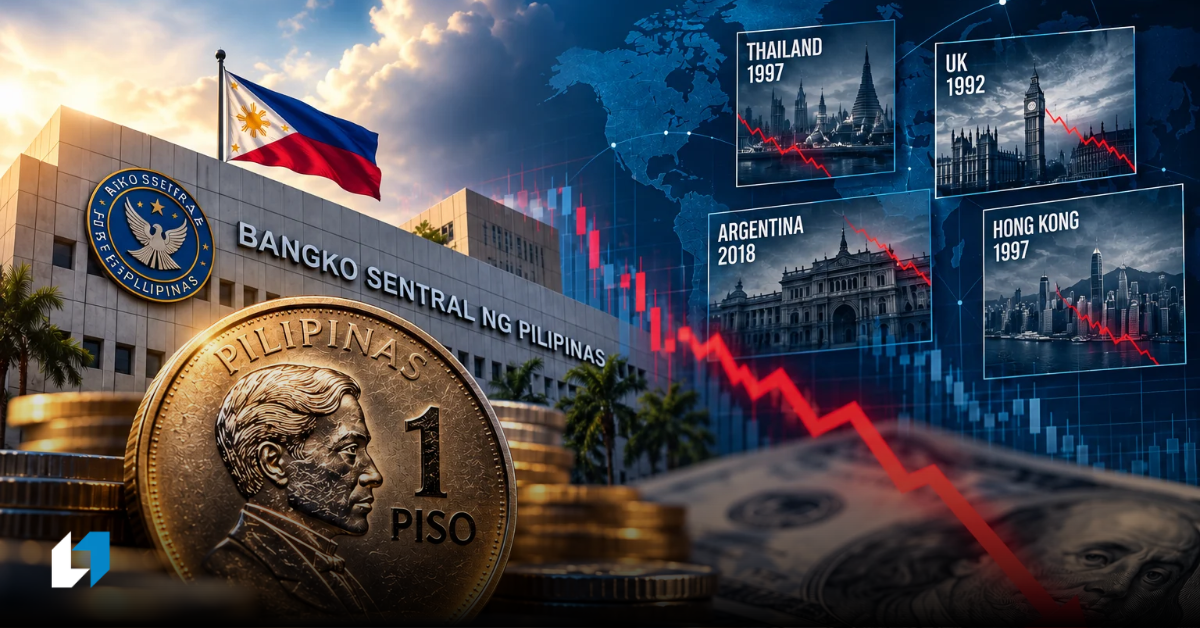
The Philippine peso has fallen to record lows against the US dollar, raising questions about whether the country has sufficient financial resources to prevent further depreciation.
On October 27, the peso closed at ₱64.17 against the dollar, its weakest closing level on record. Although it recovered slightly to ₱64.025 the following day, the currency remains under considerable pressure.
The Philippines has substantial foreign exchange reserves, estimated at $99.5 billion as of September 2026. These reserves provide the Bangko Sentral ng Pilipinas (BSP) with the capacity to intervene in the foreign exchange market when necessary.
But having enough dollars to defend the peso in the short term is different from having the economic fundamentals to sustain its value over time.
History provides several examples of countries that attempted to defend their currencies through foreign exchange intervention and higher interest rates. Some eventually abandoned their exchange rate targets after exhausting substantial resources, while others suffered severe economic consequences from their defensive policies.
The question is therefore not simply whether the Philippines has enough reserves to defend the peso. It is how long those reserves can support the currency, how much the defense could cost, and whether the economy can withstand the consequences.
How Does the BSP Defend the Peso?
The BSP can intervene in the foreign exchange market by selling US dollars from its international reserves and buying pesos.
When the central bank supplies additional dollars to the market, it helps satisfy demand from importers, investors and other institutions that need foreign currency.
This can reduce immediate pressure on the exchange rate and prevent abrupt movements that could disrupt financial markets.
However, intervention has a cost.
Every dollar sold reduces the BSP’s foreign exchange holdings unless the reserves are replenished through other inflows or investment returns.
The Philippines had approximately $104.85 billion in gross international reserves in August 2026. By September, reserves had declined to $99.5 billion, a reduction of about $5.35 billion in one month.
This decline does not necessarily mean the BSP spent the entire amount defending the peso. International reserves also change because of foreign currency valuation adjustments, government transactions and movements in the market value of reserve assets.
Nevertheless, the decline illustrates why foreign exchange reserves cannot be treated as unlimited resources.
If the BSP continuously sells dollars to support the peso while the country experiences persistent external deficits, its capacity to intervene will gradually weaken.
How Long Can $99.5 Billion Last?
At first glance, $99.5 billion represents a substantial financial buffer.
The amount is equivalent to approximately 6.2 months of imports of goods and payments for services and primary income.
This is above the commonly used benchmark of three months of import cover, which suggests that the Philippines maintains a meaningful reserve cushion.
However, import cover measures the adequacy of reserves relative to external payment requirements. It does not tell us how much the BSP can safely spend defending a particular exchange rate.
Consider a hypothetical situation in which the central bank needs to sell $1 billion every month to stabilize the currency.
After one year, the intervention would amount to $12 billion, equivalent to approximately 12 percent of September’s reserves.
If the required intervention increases to $2 billion monthly, the annual cost would reach $24 billion, or approximately 24 percent of reserves.
These calculations are illustrative rather than forecasts. They assume no offsetting inflows, valuation changes or other reserve transactions.
The important point is that even substantial reserves can decline rapidly if a central bank attempts to maintain an exchange rate that is inconsistent with market fundamentals.
The BSP therefore cannot use its entire reserve portfolio to defend the peso without considering the country’s other foreign currency obligations.
Thailand: When Currency Defense Ended in Financial Crisis
Thailand’s experience during the 1997 Asian financial crisis provides one of the clearest warnings about the consequences of defending an unsustainable exchange rate.
Before the crisis, Thailand maintained an exchange rate arrangement that effectively linked the baht to the US dollar.
However, the country was experiencing large current account deficits, rapid credit growth and substantial short-term foreign borrowing.
As investors became concerned about the country’s financial vulnerabilities, they began selling the baht.
The Bank of Thailand responded by intervening in the foreign exchange market and tightening monetary conditions.
It also entered into forward foreign exchange commitments that reduced the amount of reserves effectively available to defend the currency.
Despite these efforts, Thailand eventually lacked sufficient usable foreign exchange reserves to maintain its exchange rate arrangement.
On July 2, 1997, the government abandoned the currency peg.
The baht depreciated sharply, which increased the domestic currency value of foreign currency debts owed by Thai companies and financial institutions.
Businesses that had borrowed heavily in dollars suddenly faced much larger repayment obligations.
The resulting financial distress contributed to widespread corporate failures, banking sector problems and a severe economic contraction.
Thailand’s economy contracted by more than 10 percent in 1998.
The country eventually required an international financial assistance package exceeding $17 billion, supported by the International Monetary Fund and other lenders.
The consequences extended beyond the currency market. Businesses failed, unemployment increased, property values collapsed and the financial system required extensive restructuring.
Thailand demonstrated how an unsuccessful currency defense can worsen an existing financial crisis when it delays necessary exchange rate adjustments and consumes resources needed to manage the eventual collapse.
The lesson is not that intervention itself caused Thailand’s crisis. The country already faced serious financial vulnerabilities.
Rather, the attempt to maintain an unsustainable exchange rate reduced the authorities’ room to respond when the crisis intensified.
Britain: When Defending the Pound Became Too Expensive
A different experience occurred in the United Kingdom in September 1992.
At the time, Britain participated in the European Exchange Rate Mechanism, which required member currencies to remain within specified exchange rate bands.
As investors questioned whether Britain could maintain its exchange rate commitment, selling pressure on the pound intensified.
The Bank of England intervened in foreign exchange markets to support the currency.
The authorities also raised interest rates from 10 percent to 12 percent and announced a further increase to 15 percent.
These measures were intended to make pound-denominated assets more attractive and discourage investors from selling the currency.
However, higher interest rates also threatened to worsen Britain’s already weak economic conditions.
Mortgage borrowers, businesses and financial institutions faced the prospect of significantly higher financing costs.
Despite the intervention and interest rate announcements, market pressure continued.
On September 16, 1992, Britain abandoned the exchange rate arrangement in an episode that became known as Black Wednesday.
The failed defense resulted in substantial financial losses for the government, later estimated at more than £3 billion.
Britain’s experience illustrated that even an advanced economy with a sophisticated central bank could not indefinitely defend an exchange rate that had become inconsistent with economic conditions.
It also demonstrated the policy dilemma created by currency defense.
A government may have the technical capacity to raise interest rates and intervene in foreign exchange markets, but the economic costs of doing so can eventually outweigh the benefits.
Interestingly, Britain subsequently benefited from greater monetary policy flexibility after leaving the exchange rate arrangement.
The pound’s depreciation and lower interest rates helped support the country’s eventual economic recovery.
This suggests that abandoning an unsustainable currency defense does not necessarily represent a long-term economic failure.
In some circumstances, allowing the exchange rate to adjust can create better conditions for recovery.
Argentina: When High Interest Rates Failed to Stop Depreciation
Argentina provides a more recent example of the limitations of currency defense.
In 2018, concerns about inflation, fiscal deficits and external financing requirements caused investors to withdraw capital and sell Argentine assets.
The Argentine central bank responded by selling dollars and raising interest rates aggressively.
During the stabilization effort, interest rates reached levels of 40 to 60 percent.
Such rates were intended to encourage investors to hold peso-denominated assets and discourage capital outflows.
However, the peso continued to depreciate sharply.
Between late April and September 2018, the currency lost approximately half its value against the dollar.
Argentina eventually secured a large financing arrangement from the International Monetary Fund, initially worth $50 billion and later expanded.
The currency crisis also imposed severe costs on the domestic economy.
High interest rates restricted credit availability, weakened business investment and increased financing costs.
Currency depreciation added to inflationary pressures because imported goods and foreign currency obligations became more expensive.
Argentina entered a recession, and inflation continued to erode household purchasing power.
The experience demonstrated that high interest rates alone cannot guarantee currency stability when investors lack confidence in a country’s economic fundamentals.
Even substantial international financial assistance may fail to restore confidence if the underlying fiscal and external vulnerabilities remain unresolved.
Why Some Countries Succeeded
Not every attempt to defend a currency has ended in failure.
Hong Kong successfully maintained its exchange rate link to the US dollar during the Asian financial crisis despite intense speculative pressure.
Its currency board system was supported by substantial foreign exchange reserves and an institutional framework that automatically adjusted monetary conditions when the currency came under pressure.
As investors sold Hong Kong dollars, banking system liquidity tightened and interest rates increased.
These adjustments helped maintain the exchange rate commitment. However, the successful defense came with significant economic costs.
Higher interest rates placed pressure on businesses, property markets and financial institutions.
Hong Kong also experienced a severe economic contraction during the regional crisis, although the downturn reflected several factors beyond the currency defense itself.
The experience demonstrated that a country can maintain its exchange rate if it has sufficient financial resources, a credible monetary framework and the willingness to tolerate substantial economic adjustments.
But successful currency defense does not mean the economy escapes the consequences.
Sometimes, the cost of maintaining a stable exchange rate is transferred to borrowers, businesses and households through higher interest rates, lower asset prices and weaker economic activity.
What Happened to the Philippines in 1997?
The Philippines also experienced severe currency pressure during the Asian financial crisis.
At the time, the country had significantly smaller foreign exchange reserves than it does today. As investors withdrew capital from emerging Asian markets, the peso came under substantial pressure.
The BSP’s predecessor, the Central Bank of the Philippines, had already been replaced by the BSP in 1993. During the 1997 crisis, the BSP intervened in the market and tightened monetary conditions, but ultimately allowed the peso to depreciate.
The peso weakened substantially from its pre-crisis level of approximately ₱26 per dollar.
Although depreciation increased the cost of imported goods and foreign currency debts, the Philippines avoided the scale of financial collapse experienced by Thailand and Indonesia.
The country’s banking system was relatively less exposed to some of the vulnerabilities that had accumulated elsewhere in the region.
The Philippine experience demonstrated the importance of allowing the exchange rate to adjust when market conditions change.
Attempting to maintain an unsustainable exchange rate could have required substantially greater reserve losses and more aggressive monetary tightening.
The Philippines today has a much larger reserve buffer and a more flexible exchange rate system than it did during the Asian financial crisis.
These differences reduce the likelihood that the country would experience the same type of currency crisis simply because the peso continues to depreciate.
The Problem Is the Balance of Payments
The international experiences highlight why foreign exchange reserves alone cannot determine the long-term value of a currency.
During the first nine months of 2026, the Philippines recorded a balance of payments deficit of approximately $9.1 billion.
The balance of payments measures the country’s economic transactions with the rest of the world, including trade, investment flows, remittances and other financial transactions.
A deficit indicates that external transactions resulted in an overall financing shortfall reflected in the country’s reserve position.
This matters because the Philippines depends heavily on imported goods, particularly petroleum, machinery, electronics and other production inputs.
When imports exceed exports, the country needs additional foreign currency inflows from remittances, services exports, foreign investment, borrowing or other sources to finance the difference.
If these inflows are insufficient, pressure can develop on the peso. The BSP can temporarily supply dollars from its reserves, but it cannot permanently eliminate an external imbalance through intervention alone.
For the peso to stabilize sustainably, the country needs a stronger balance between its foreign currency earnings and payments.
Can Higher Interest Rates Defend the Peso?
Another instrument available to the BSP is monetary policy.
Higher interest rates can support the peso because they increase the potential returns on peso-denominated investments.
If Philippine interest rates become more attractive relative to US rates, investors may have greater incentives to hold peso assets.
Higher rates can also reduce borrowing and domestic spending, which may eventually moderate demand for imports.
However, the experiences of Britain and Argentina demonstrate that monetary policy involves substantial economic trade-offs.
Higher interest rates increase financing costs for businesses and households. Companies may postpone expansion plans, while consumers may reduce spending on housing, vehicles and other purchases financed through credit.
If interest rates remain elevated for an extended period, economic growth could weaken.
The BSP raised its policy rate to 5.5 percent in October 2026, yet the peso continued to face depreciation pressure.
This does not necessarily mean the policy adjustment was ineffective. Exchange rates respond to several factors beyond interest rates, including global dollar movements, commodity prices, capital flows and investor expectations.
It does suggest that interest rate adjustments alone may not be sufficient to reverse persistent currency weakness.
The BSP must therefore balance the need to maintain price stability with the economic consequences of tighter monetary conditions.
Why the Government Cannot Defend Any Exchange Rate
There is another important distinction between defending the peso and defending a particular exchange rate.
The Philippines operates a market-determined exchange rate system. The BSP generally allows the peso to respond to supply and demand while retaining the ability to intervene against excessive volatility.
This means the central bank does not necessarily need to prevent the peso from reaching ₱65 or any other particular level.
A weaker peso is not automatically evidence of monetary policy failure. Exchange rates adjust to changes in inflation, trade competitiveness, investment flows and global financial conditions.
If the peso’s equilibrium value has weakened because of structural economic factors, attempting to maintain an artificially strong exchange rate could become expensive.
For example, suppose the market-clearing exchange rate is ₱65 per dollar, but the BSP attempts to maintain it at ₱60.
At the stronger exchange rate, demand for dollars could remain elevated because foreign currency is relatively cheaper for importers and investors.
The BSP would need to supply the difference between market demand and available private dollar supply.
Unless the underlying conditions change, intervention could continue indefinitely.
Allowing an orderly adjustment toward the market-clearing rate may therefore be more sustainable than using reserves to defend an exchange rate that the economy cannot support.
What Would Strengthen the Peso Permanently?
A sustainable recovery in the peso requires improvements in the country’s ability to earn foreign currency and attract investment.
Stronger exports would generate additional dollar revenues and reduce the country’s dependence on external financing.
Higher foreign direct investment could support the currency by bringing capital into the country while expanding productive capacity.
Remittances and business process outsourcing revenues also provide important sources of foreign exchange.
However, these inflows must be considered alongside the country’s growing requirements for imported energy, equipment, consumer goods and foreign debt payments.
Foreign portfolio investments can enter and leave financial markets relatively quickly. Foreign direct investments generally involve longer-term commitments to businesses, facilities and productive assets.
A country that relies heavily on short-term capital inflows may remain vulnerable to sudden reversals in investor sentiment.
Ultimately, confidence in the peso depends on the economy’s capacity to generate sufficient foreign currency earnings, maintain manageable external obligations and preserve stable macroeconomic conditions.
Do We Really Have the Means to Defend the Peso?
The experiences of Thailand, Britain and Argentina demonstrate that having the financial resources to defend a currency does not guarantee that the defense will succeed.
Thailand exhausted much of its usable reserve capacity before abandoning its exchange rate peg and suffering a severe financial crisis.
Britain spent substantial resources and threatened extremely high interest rates before concluding that maintaining its exchange rate commitment was no longer sustainable.
Argentina imposed extraordinarily high interest rates and obtained international financial assistance, yet the peso continued to depreciate while the economy entered recession.
These countries faced different circumstances, but their experiences reveal a common problem.
When the market value of a currency becomes inconsistent with the exchange rate authorities attempt to maintain, defending that rate can impose increasingly severe economic costs.
The Philippines is not currently in the same position as these countries were during their respective crises.
Its international reserves remain substantial, and its flexible exchange rate system allows the peso to adjust without requiring the BSP to maintain a fixed value.
This gives policymakers greater room to manage currency volatility without committing to an exchange rate that may become unsustainable. But the availability of reserves should not create the impression that the peso can be defended indefinitely.
The country’s defensive capacity should not be simply the number of dollars held by the central bank. It should be whether those reserves can be used without undermining financial stability, or weakening the economy.
History suggests that the greatest danger may not be allowing a currency to depreciate, but exhausting the country’s financial resources in an attempt to prevent an adjustment that economic fundamentals ultimately require.

