

Business ownership often changes hands during periods of crisis. When markets collapse and companies struggle to survive, unexpected opportunities can emerge for those already positioned inside the industry.
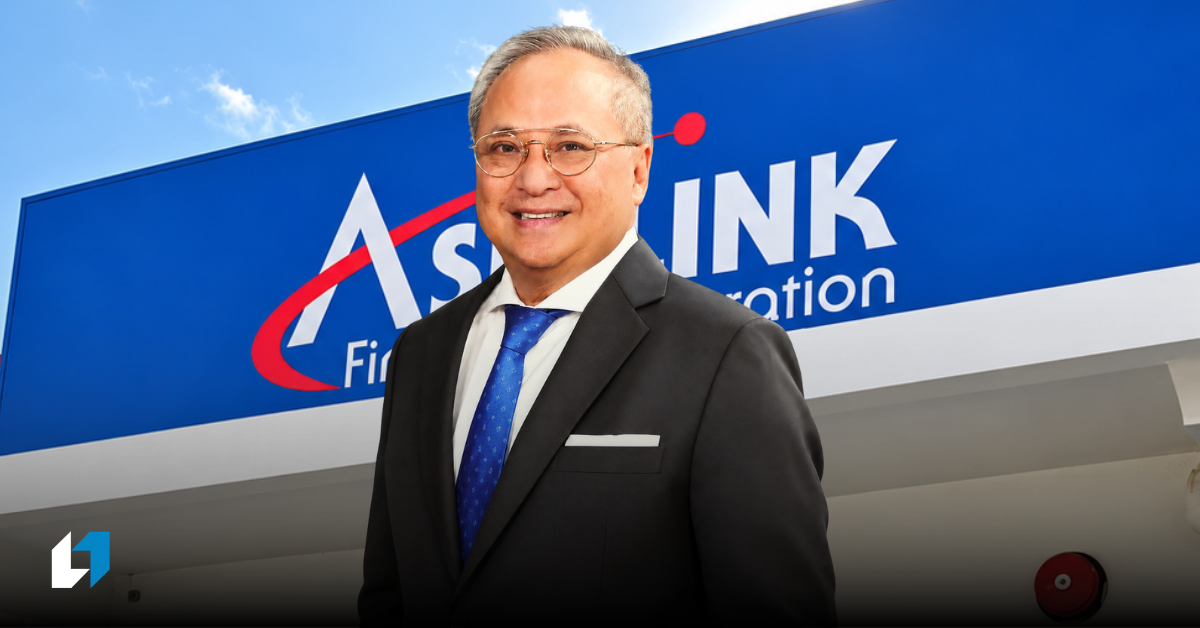
For Rubby Lugtu, chairman and co-founder of Asialink Finance, a turning point in his career came during one of the most turbulent economic periods in Asia: the 1997 Asian Financial Crisis.
The crisis reshaped the financial landscape across the region, collapsing property markets, bankrupting companies, and forcing many businesses to restructure. But for Lugtu, it also created the unexpected circumstances that would eventually make him a majority owner of Asialink.
An invitation into a larger lending venture
Before the crisis, Lugtu was already involved in lending through his own small financing activities. Over time, he developed close relationships with several borrowers, including a client who later introduced him to a new opportunity.
That client was being invited to participate in a lending venture organized by banker Bobby Jordan.
The business would eventually become Asialink Finance.
But there was a condition.
According to Lugtu, his client refused to participate unless Lugtu was also included in the venture.
“Sabi niya sakin, ‘Since tinutulungan mo ako, eto baka gusto mo eto. Linya mo magpautang eh, di ba?’”
For Lugtu, the opportunity was appealing for a practical reason. Unlike his earlier lending activities, this venture offered a more structured environment.
“Interesado ako kasi one-man army ako magpautang,” he explains.
The new business would allow him to work alongside a professional banker and learn how a larger financing operation was managed.
“Partner ko pa si Bobby na bangkero talaga. I will learn a lot from him.”
From informal lending to professional finance
Lugtu’s earlier experience in lending had been highly informal. He managed loans on his own, often without the infrastructure typically associated with financial institutions.
“Kasi my father, mag-request ka ng computer, pahirapan. Walang office. Wala akong lawyer. Mahirap.”
Despite the limitations, those early years forced him to develop a crucial skill: evaluating borrowers.
“Naging skill ko how to size up people kung magbabayad or not.”
This ability to assess creditworthiness—often based on business judgment and experience—would later become valuable in the structured lending environment of Asialink.
When crisis changes ownership
The real turning point, however, came when the Asian Financial Crisis struck in 1997.
The crisis triggered severe disruptions across Asia. Real estate markets collapsed, companies defaulted on loans, and many investors found themselves unable to sustain their businesses.
For one of Lugtu’s major clients, the downturn proved devastating.
“Then, here came the ’97 crisis,” Lugtu recalls.
The real estate business of his client—who was also involved in the Asialink venture—collapsed during the crisis.
As a result, the client could no longer repay his financial obligations to Lugtu.
But instead of defaulting outright, the client offered another solution.
“Sabi nya, ‘Since I owe you money, you can get my shares in Asialink—sayo na ’yan.’”
That moment would change Lugtu’s position in the company.
Through the transfer of shares, he and his partners eventually gained majority ownership in Asialink.
“So naging majority kami.”
Opportunity hidden inside disruption
From a financial perspective, Lugtu’s story illustrates a recurring pattern in business history: economic crises often trigger shifts in ownership and control.
When markets are strong, businesses tend to hold onto assets and equity. But when crises strike, distressed companies are forced to restructure, sell assets, or transfer ownership to creditors.
Those who are already part of the financial ecosystem—lenders, investors, or partners—are often the ones positioned to acquire those assets.
In Lugtu’s case, the crisis did not create the opportunity from scratch. Instead, it amplified relationships and financial arrangements that were already in place.
Because he had previously lent money to his client, he was in a position to receive equity in the company when the borrower could no longer repay his debt.
From lender to majority owner
The transition from lender to shareholder highlights one of the unique dynamics of financing businesses.
Unlike many industries where income comes primarily from selling products or services, lenders often accumulate ownership stakes when borrowers cannot meet their obligations.
These situations can reshape companies in ways that would not have been possible during normal economic conditions.
For Lugtu, the 1997 crisis was one such moment.
What began as a lending relationship ultimately led to a shift in ownership—transforming him from a financier into a majority stakeholder in Asialink Finance.
It was a reminder that in business, moments of instability often carry the seeds of long-term opportunity.

