

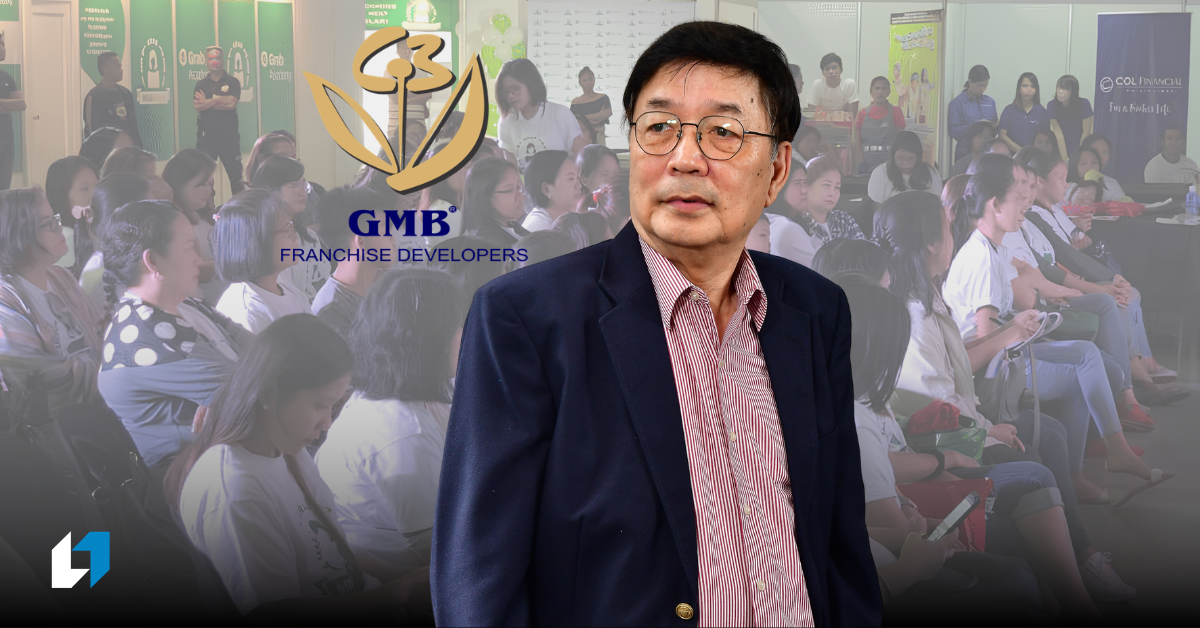
Long before Armando Bartolome became one of the most recognized names in Philippine franchising, he was something far more familiar to many Filipino entrepreneurs: a businessman struggling to make things work.
He lost money. Some ventures failed. Plans did not always go as expected. Like many entrepreneurs starting out, he discovered that passion alone was not enough to build a sustainable business.
But those difficult years eventually shaped the philosophy that would define the rest of his career.
“My journey into franchising wasn’t planned — it was lived,” Bartolome says. “I started as an entrepreneur myself, building businesses from the ground up. I made mistakes. I lost money. I learned the hard way what systems really mean.”
Today, nearly three decades after founding GMB Franchise Developers in 1996, Bartolome has helped develop more than 650 franchise brands across the Philippines. But behind the success is a lesson he learned early through failure: a business that depends entirely on the owner is often far more fragile than it appears.
Failure became his business education
Before entering franchising, Bartolome experienced firsthand the uncertainty many entrepreneurs quietly endure.
“Failure was my greatest teacher,” he says. “Before GMB, I ran businesses that didn’t work. I know what it feels like to close up shop, to tell your family that things aren’t going as planned.”
Those experiences eventually changed how he viewed business itself.
Many entrepreneurs initially believe growth comes from working harder, staying longer hours, or becoming more hands-on. Bartolome eventually realized that the opposite was often true. Businesses become scalable not when the owner does everything personally, but when systems allow the business to function consistently without relying entirely on one person.
“But those years taught me something no textbook ever could — that a business without a system is just a job with more stress,” he says.
That insight later became the foundation of his entire consulting philosophy.
Over the years, Bartolome observed that many Filipino entrepreneurs built businesses around personal skill, instinct, and relationships. The founder often became the center of operations. Customers trusted the owner personally. Employees depended on the owner’s daily supervision. Decision-making stayed centralized.
That approach can work for one location. But it becomes difficult to replicate at scale.
For Bartolome, the real challenge was not simply building a profitable store. It was creating a business model that could consistently work even when the founder was no longer physically present.
The moment franchising changed his direction
Bartolome says one experience pushed him toward franchising permanently.
“There was a business owner I admired who collapsed because he couldn’t replicate himself,” he recalls. “He had one great store, but no system, no manual, no way to duplicate what made him special.”
That experience revealed something deeper about entrepreneurship.
Many businesses fail not because the product is weak, but because the founder becomes the bottleneck. Operations stay trapped inside the owner’s head. Processes are undocumented. Quality depends entirely on personal oversight.
Bartolome realized that franchising, when done properly, was not merely about expansion. It was about turning experience into a repeatable system others could follow.
“I thought: this man has something worth multiplying. He just doesn’t have the tools,” he says.
That insight eventually led him to establish GMB Franchise Developers in 1996.
“When I founded GMB Franchise Developers in 1996, I wasn’t just starting a consultancy,” Bartolome says. “I was answering a call: to help Filipino entrepreneurs build something that could outlast them.”
Why franchising appealed to him
To Bartolome, franchising represented leverage.
“When you build a single business, your growth is limited by your time, your capital, your energy,” he says. “When you build a franchise system, you multiply your impact through other people’s commitment.”
In many ways, franchising allows entrepreneurs to expand using systems instead of personal supervision.
The franchisor provides the blueprint. The franchisee provides the execution, capital, and local commitment. When the partnership works properly, businesses can scale far faster than traditional owner-operated models.
Bartolome also believed franchising fit the Philippine entrepreneurial landscape particularly well.
“And for a country like the Philippines — where entrepreneurial spirit runs deep but capital is limited — franchising is not just a model,” he says. “It’s a movement.”
Over the years, franchising became one of the major pathways for Filipinos seeking business ownership without starting entirely from scratch.
But Bartolome also warns against romanticizing it.
“Easier? No. Safer? Yes — if done right,” he says.
A franchise may reduce risk through systems, branding, and operational support, but success still depends heavily on discipline, execution, and consistency.
“The franchisees I’ve seen fail are usually those who bought into a franchise thinking they were buying success on a platter,” Bartolome says. “Success is never served — it’s earned.”
Building businesses from the “raw”
One of the things that differentiated GMB from many consulting firms was its hands-on approach.
Bartolome says his team does not evaluate businesses based on polished presentations or idealized projections. Instead, they study the actual operations, finances, and daily realities of the company.
“We go in and look at the mess — because that’s where the truth is,” he says.
That often means telling entrepreneurs difficult truths.
Sometimes the business is simply not ready for franchising yet. Systems remain weak. Margins are unstable. Supply chains are inconsistent. Documentation is incomplete.
According to Bartolome, many founders attempt to franchise too early because demand excites them before the business model itself has fully matured.
“They franchise their dream, not their reality,” he says.
This becomes especially dangerous when entrepreneurs use franchising primarily to raise capital quickly rather than to build a sustainable network of operators.
“The most common cause of failure is a franchisor who treated franchising as a fundraising strategy rather than a business development strategy,” Bartolome says.
In many failed franchise systems, expansion moves faster than operational infrastructure. Locations multiply rapidly, but training, support, and quality control lag behind. Eventually, customer experience deteriorates and franchisees lose confidence.
“I’ve seen brands open 20 locations in a year and lose half of them within two years,” Bartolome says. “Controlled growth is not slow growth — it is smart growth.”
Why systems matter more than personality
After decades in franchising, Bartolome believes the businesses that last are rarely built around charisma alone.
The strongest franchise brands usually share several characteristics: documented systems, operational consistency, founder discipline, and continuous improvement.
“The brands that endure are those whose founders never stopped being students of their own business,” he says.
He also believes one of the biggest mindset shifts entrepreneurs must make is learning to step away from being the center of everything.
“You have to stop being the star and start being the director,” Bartolome says.
That transition can be emotionally difficult for many founders because entrepreneurship often begins with personal hustle and direct involvement. But scaling requires standardization, delegation, and trust in systems.
“As a franchisor, you must build a system that works without you on the floor,” he says.
His belief in Filipino entrepreneurs
Despite witnessing both successes and failures over nearly 30 years, Bartolome remains optimistic about Filipino entrepreneurship.
“I’ve also learned that the best franchise systems are built on humility,” he says. “The franchisor must always be willing to improve, to listen, to evolve.”
He believes Filipino entrepreneurs possess unusual resilience and creativity, especially when given the right tools and support systems.
“The Filipino entrepreneur, when given the right tools and support, is among the most resilient and creative in the world,” Bartolome says.
Looking ahead, he sees continued opportunities in service-oriented franchises, technology-enabled systems, logistics, wellness, and education. But regardless of industry, he believes the core principles remain the same.
Strong systems. Operational discipline. Consistency. Documentation. Support.
In the end, Bartolome’s philosophy on business remains remarkably simple.
“Build a business that works for you,” he says, “then build a system that works for others.”

