

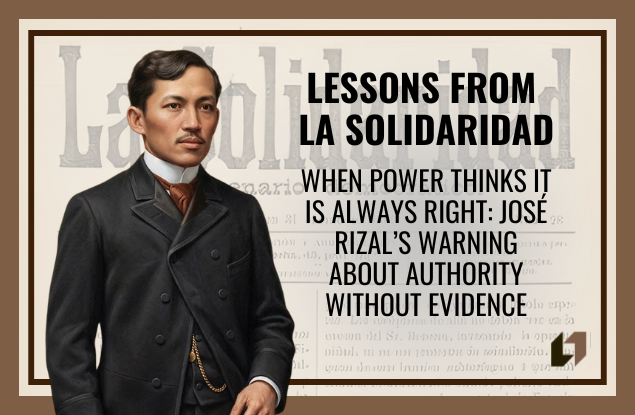
In April 15, 1889, Filipino reformist José Rizal published a sharp response in the reformist newspaper La Solidaridad directed at Vicente Barrantes.
Barrantes had written several essays criticizing Filipino culture and the Tagalog theater. In his articles, he portrayed Filipinos as intellectually inferior and culturally backward. But Rizal believed Barrantes had made these sweeping judgments without properly studying Philippine history, literature, or society.
What followed was one of Rizal’s most pointed critiques of intellectual arrogance. His response was not only a defense of Filipino culture—it was also a powerful lesson about a problem that continues to exist today: the belief that authority can replace evidence.
When Authority Becomes a Substitute for Truth
One of Rizal’s central criticisms was that Barrantes seemed to assume his opinions were correct simply because of his position and background.
Rizal responded with biting sarcasm:
“Enough that Your Excellency, a man of the superior race, says so… in spite of all historical citations whether these be true or not.”
Behind the sarcasm was a serious argument. Rizal believed that truth must be grounded in evidence, not in status or rank.
Barrantes had written confidently about Filipino culture, yet Rizal pointed out that many of his claims ignored historical records and documented facts. Instead of studying the subject carefully, Barrantes relied on assumptions and stereotypes.
For Rizal, this was not merely a personal disagreement. It revealed a dangerous mindset: when authority believes it no longer needs proof.
The Importance of Evidence
Throughout his writings, Rizal consistently relied on historical sources to support his arguments. In defending Filipino culture, he pointed to early accounts by historians and missionaries who had documented the customs, industries, and literary traditions of the archipelago long before Spanish critics dismissed them.
Rizal argued that a serious intellectual discussion must always begin with evidence.
At one point in the essay, he noted that critics had accused Barrantes of ignoring historical knowledge about the Philippines. Rizal wrote that some observers believed Barrantes had written his articles merely to display superficial knowledge while insulting the people he was describing.
Rizal’s response was firm but measured. Instead of responding with personal insults, he insisted that arguments should be judged by their facts and reasoning.
The Role of Intellectual Responsibility
For Rizal, the responsibility of writers and commentators was clear. Anyone who wished to criticize a society must first take the time to understand it.
He wrote that Barrantes could have avoided many of his mistakes had he studied the subject more carefully:
“If Your Excellency had studied the background of the subject, you might have dispensed with the following paragraphs.”
The remark highlights Rizal’s belief that knowledge requires effort. Without study and research, criticism becomes shallow and misleading.
In Rizal’s view, intellectual authority is earned through understanding—not through titles, nationality, or power.
A Lesson That Still Matters
More than a century later, Rizal’s argument remains remarkably relevant.
In modern public discourse, people often encounter confident opinions delivered by individuals who hold positions of authority. Political leaders, commentators, and public figures frequently make strong claims about social, economic, or cultural issues.
But as Rizal warned in 1889, authority alone does not guarantee accuracy.
When statements are accepted simply because of who says them—rather than because of the evidence behind them—public debate becomes weaker and less reliable.
The principle applies equally to politics, economics, and journalism. Good decisions depend on facts, research, and careful analysis.
Rizal’s Timeless Principle
At its core, Rizal’s response to Barrantes was about intellectual humility.
Power, position, or reputation cannot replace knowledge. Arguments must stand on their evidence.
By exposing the weaknesses in Barrantes’s claims, Rizal was defending more than Filipino culture. He was defending the idea that truth should be guided by reason and facts rather than by arrogance.
More than a hundred years later, the lesson still resonates.
In any society—whether in government, business, or public debate—authority should never be mistaken for truth.

