

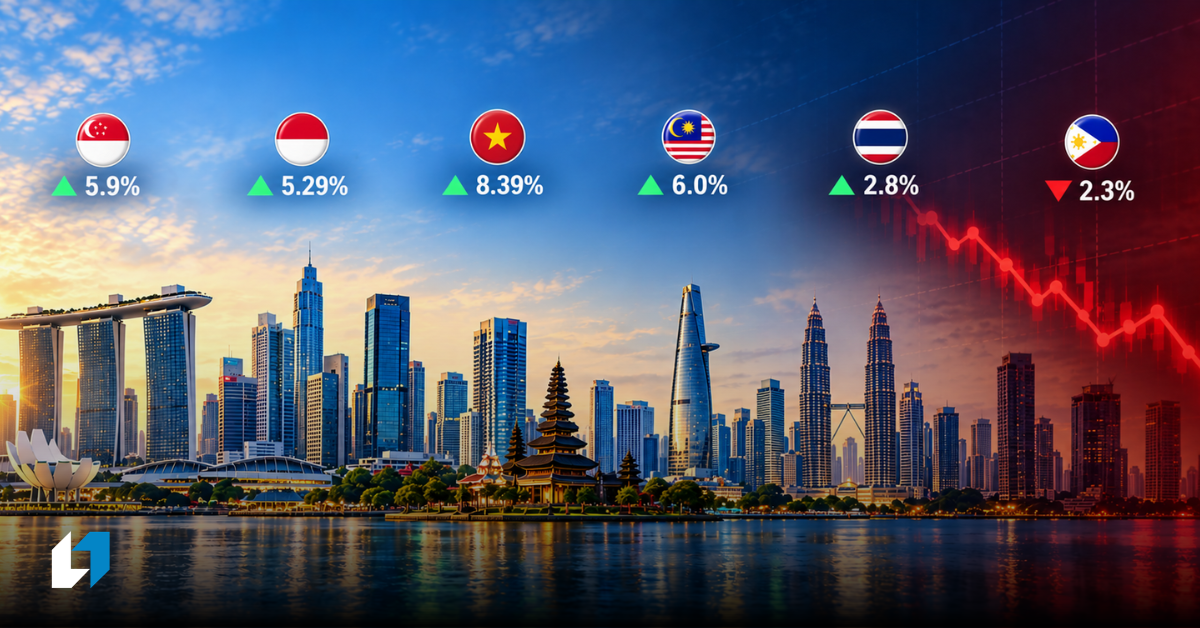
Stock markets across Southeast Asia have delivered some impressive gains this year. Singapore’s Straits Times Index has reached record levels, while Thailand has posted one of the region’s strongest performances. Indonesia and Vietnam have also seen periods of strong market gains.
The Philippine stock market, however, has struggled to keep pace. The PSEi remains around the 6,000 level despite renewed investor interest in several Asian markets.
The gap suggests that investors may be looking beyond individual company earnings and focusing instead on the risks surrounding the Philippine economy. Slower economic growth, a weaker peso, higher oil prices, interest rates and political uncertainty can all affect how much investors are willing to pay for Philippine stocks.
Economic growth has slowed
One of the biggest concerns is the economy. Philippine GDP grew by only 2.3 percent in the second quarter, the slowest pace since 2021. This compared with 8.39 percent growth in Vietnam, 6 percent in Malaysia, 5.9 percent in Singapore and 5.29 percent in Indonesia.
More concerning for investors was the composition of growth. Philippine industry contracted by 2.4 percent, while gross capital formation fell 9.2 percent. Construction declined 14.8 percent, with government construction down 32.4 percent.
A slowdown in investment can eventually affect corporate earnings. When companies invest less, construction weakens and economic activity slows, investors may also reduce their expectations for future profit growth.
A weaker peso adds another layer of risk
The peso has also come under pressure this year. Higher oil prices are particularly challenging for the Philippines because the country depends heavily on imported energy.
For foreign investors, the currency can have a major impact on actual investment returns. A foreign fund that earns 8 percent on a Philippine stock, for example, would lose much of that gain if the peso depreciated 6 percent against the dollar during the same period.
A weaker currency therefore makes Philippine equities less attractive unless investors expect sufficiently high stock returns to compensate for the additional currency risk.
The effect can also spread through the economy. A weaker peso makes imported goods more expensive, which can add to inflation and put pressure on interest rates.
Higher rates make stocks work harder
Interest rates represent another challenge. When rates rise, borrowing becomes more expensive for businesses and consumers. Companies may postpone expansion, households may reduce spending and economic growth can slow.
Higher rates also give investors more alternatives to stocks. If government bonds and fixed-income securities offer attractive yields, investors have less reason to take additional equity risk unless stocks offer sufficiently higher prospective returns.
This is especially important for the Philippine market because many listed companies operate in sectors sensitive to financing costs, including property, banking, utilities and consumer businesses.
Political uncertainty raises the risk premium
Political and policy uncertainty can also affect the amount investors are prepared to pay for Philippine assets.
Markets generally prefer an environment where fiscal policy, infrastructure spending, regulation and economic reforms are relatively predictable. Greater uncertainty makes future business conditions harder to estimate and can cause investors to demand higher returns before committing capital.
Recent concerns over governance, public spending and delays in infrastructure projects have therefore become more than political issues. They can also affect business confidence, investment and ultimately stock market valuations.
For foreign portfolio managers deciding among several ASEAN markets, the Philippines is competing directly with countries that may currently offer stronger economic growth or a more favorable perception of risk.
Oil exposes a structural weakness
The recent rise in global oil prices has added another complication.
Unlike major energy exporters, the Philippines imports most of its petroleum requirements. A sustained increase in oil prices can widen the trade deficit, weaken the peso, raise inflation and reduce household purchasing power.
These effects can reinforce one another. Higher oil prices put pressure on the peso. A weaker peso makes imported oil even more expensive. Higher inflation can then limit the central bank’s ability to reduce interest rates.
For the stock market, this creates uncertainty over both corporate earnings and the return investors require to own equities.
Foreign money is going elsewhere
Perhaps the clearest indication of the problem can be seen in foreign portfolio flows.
Foreign investors returned to Asian equities in August after nine consecutive months of net selling. They bought a net $4.72 billion of shares across seven Asian markets, followed by another $1.52 billion in early September.
Yet the Philippines did not benefit from that return of foreign capital. Philippine equities recorded about $216 million in net foreign selling in August. Indonesia and Vietnam, in contrast, received net inflows. Thailand also experienced foreign outflows despite the strong performance of its stock market.
This suggests that weak foreign participation in the Philippines cannot simply be blamed on investors avoiding Asia. Capital is available, but investors are becoming more selective about where they put it.
What could bring investors back?
A sustained recovery in Philippine stocks may require several conditions to improve at the same time.
Stronger economic growth would improve the outlook for corporate earnings. A more stable peso would reduce currency risk for foreign investors. Lower inflation and interest rates would make equities relatively more attractive, while greater confidence in fiscal policy and governance could encourage both local and foreign investment.
Some of these risks may eventually reverse. If economic growth recovers and uncertainty declines, the same factors that have held back Philippine equities could become catalysts for a market recovery.
For now, however, the performance of neighboring markets provides a useful reminder. Investors do not allocate capital based solely on where stocks appear attractive. They also compare countries according to where they see the best combination of economic growth, expected returns and risk.
Until the Philippines can improve that combination, the PSEi may continue to watch some of its ASEAN neighbors rally from the sidelines.

