

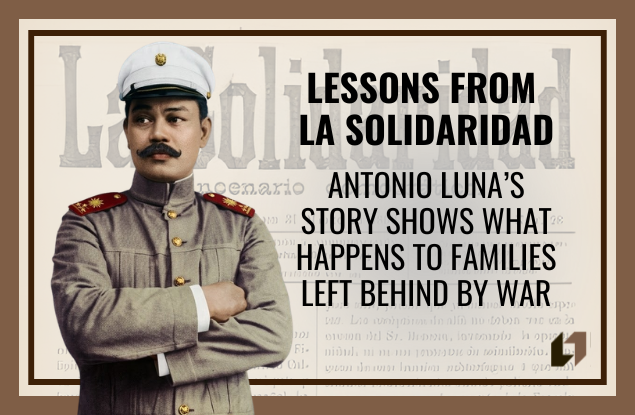
In May 1891, an essay titled “Orphans” appeared in the reformist newspaper La Solidaridad. Written under the pseudonym Taga-Ilog—widely attributed by historians to Antonio Luna—the piece stands out from many of the social satires published during the Propaganda Movement.
Unlike the essays that mocked vanity or social hypocrisy, this story carries a darker and more emotional tone.
At its center is a quiet visit to a struggling family in Madrid. The narrator arrives expecting an ordinary social call but instead finds himself confronted with the harsh realities of poverty and loss.
The woman he visits is a widow.
Her husband had been a soldier who died in battle in Jolo while fighting Moro rebels. Although he died serving the Spanish crown and was praised for his bravery, the recognition did little to protect the family he left behind.
His widow and children were left to survive on their own.
A Household That Has Fallen Apart
The narrator describes entering what was once a respectable household but has now deteriorated into hardship. Furniture lies scattered, the apartment feels cramped and neglected, and the mother struggles to manage several young children.
The most painful moment occurs when a sick child begins crying from hunger.
The narrator hears the boy whisper weakly:
“Bread… Mama… give me bread.”
The mother responds with quiet tenderness:
“I am going to get it, dear child.”
But the heartbreaking truth is that she has no bread to give.
The boy is thin and frail, barely able to move. His hunger has drained him of strength, leaving him weak and trembling on the floor.
Despite her suffering, the mother still tries to preserve dignity in front of her visitor. She comforts the child gently and asks the narrator to give him a kiss.
It is a moment of quiet compassion amid overwhelming poverty.
When Hunger Replaces Order
Soon the rest of the children appear.
There are many of them—six or seven young boys and girls who fill the small apartment with noise and restless movement. Their hunger becomes immediately visible when the narrator offers them candies.
The children rush forward all at once.
They climb over him, shout, fight, and struggle just to grab a small piece of food. The narrator describes the chaotic scene as if a swarm had suddenly descended upon him.
The comparison is vivid. The children resemble “little devils fighting over honey.”
Yet the story does not mock them. Instead, it shows how poverty can destroy the structure and innocence of childhood. Hunger turns even playful children into desperate competitors for survival.
The Forgotten Family of a Hero
The most tragic detail in the story is the father himself.
He had been a brave soldier who died fighting for Spain. His death was treated as an honorable sacrifice. But after the praise faded, his family was left in poverty.
The government celebrated his heroism, yet offered little protection to those who depended on him.
Through this story, the narrator raises an uncomfortable question: what kind of society praises sacrifice while abandoning the families of those who made it?
A Haunting Ending
As the visit comes to an end, the sick child falls asleep in his mother’s arms.
The narrator writes quietly that the boy “fell asleep deeply… akin to death.”
Then he adds a haunting uncertainty: who knows if he actually died?
The story ends without a clear answer.
But the implication is painfully clear. The child may not survive.
A Lesson That Still Matters Today
Although the essay was written in 1891, the question it raises remains deeply relevant.
Across the world today, families still depend on the income of a single breadwinner. When that person dies unexpectedly, the consequences can be devastating if no financial protection exists.
The tragedy Luna described reminds us that heroism and sacrifice alone do not guarantee security for those left behind. Families need systems of support—both social and financial—to protect them from falling into hardship.
In modern terms, that protection often comes through financial planning tools such as savings, insurance, and long-term preparation.
The Financial Lesson Behind the Story
The deeper message of “Orphans” is not only about war or poverty.
It is about responsibility.
A society that honors sacrifice must also protect the families who bear its cost. At the same time, individuals must recognize the importance of preparing for the unexpected.
More than a century ago, Antonio Luna told the story of a soldier’s forgotten family to reveal the human cost of neglect.
His story still carries a quiet but powerful lesson today: when the breadwinner disappears, the future of a family depends on the protection that was built before the tragedy happened.

