

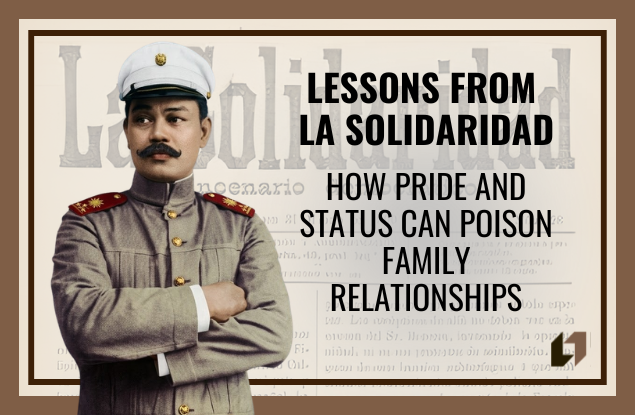
On November 15, 1891, an essay titled “A Sketch” appeared in the reformist newspaper La Solidaridad. The piece was written under the pen name Taga-Ilog, widely attributed to Filipino intellectual and future revolutionary general Antonio Luna.
Unlike many of Luna’s essays, which directly criticized politics or colonial policy, this one takes the form of a short psychological story. Yet beneath its domestic setting lies a sharp commentary on human vanity, social ambition, and the emotional damage that pride can cause inside families.
More than a century later, the behavior Luna described still feels surprisingly recognizable.
A Story About Pride and Aging
The story revolves around a woman named Soledad and her daughter Maria. At the beginning of the narrative, Luna describes how Soledad begins to notice the first signs of aging. Wrinkles appear, gray hairs emerge, and the admiration she once enjoyed in society slowly fades.
For Soledad, the loss is not merely physical. It is psychological.
In her younger years she had been admired for her beauty, elegance, and fashionable appearance. Compliments about her clothing, jewelry, and refinement reinforced a sense of pride that gradually became central to her identity.
But as time passes, the admiration she once received begins to disappear.
Instead of accepting this change calmly, Soledad becomes increasingly bitter. Luna portrays her transformation as both emotional and moral: the pride that once fueled her social confidence slowly turns into envy and resentment.
When Vanity Turns Into Jealousy
The person who unknowingly triggers Soledad’s bitterness is her own daughter.
Maria is young, talented, and widely admired. She plays the piano beautifully and receives praise from teachers and friends. Wherever she goes, people notice her ability and charm.
Instead of feeling proud of her daughter’s success, Soledad reacts with jealousy.
One moment in the story captures this tension clearly. After performing a piece on the piano, Maria asks her mother whether she liked the music. Hoping for approval, she waits anxiously for a kind word.
Soledad replies coldly:
“You play worse than before.”
The remark wounds Maria deeply. She continues trying to please her mother, but the encouragement she hopes for never arrives.
Luna uses this painful interaction to reveal how pride can distort even the most natural human bond.
Emotional Revenge Inside the Family
As the story unfolds, Luna reveals the darker motive behind Soledad’s cruelty.
She believes that her husband once loved Maria more than he loved her. Whether this perception is accurate or not is less important than the emotional consequence it produces. Soledad allows this insecurity to grow into resentment.
Instead of confronting her feelings, she takes quiet revenge against her daughter.
She criticizes Maria constantly, humiliates her in small ways, and withholds affection. Luna describes how wounded pride gradually transforms Soledad into someone unrecognizable:
a “disgusting creature.”
The transformation is not sudden. It is the slow result of vanity, jealousy, and bitterness—emotions that gradually overpower compassion.
A Critique of Social Vanity
Although the story focuses on a single family, Luna’s message reaches beyond the household. Writers of the Propaganda Movement often used domestic narratives to criticize the moral values of colonial society.
In this sense, Soledad represents a broader social type: a person deeply concerned with status, admiration, and appearances.
Her sense of identity depends on being admired by others. When that admiration fades, she cannot accept the change gracefully. Instead, she turns her frustration toward the people closest to her.
Maria, by contrast, represents sincerity and innocence. Her desire is simple: she wants her mother’s approval. Yet even this modest hope becomes impossible once pride takes control of Soledad’s heart.
The Lesson Behind the Story
Luna summarizes the moral conflict in one striking phrase: the “victory of the flesh over the spirit.”
For him, pride and vanity represent the “flesh”—the selfish impulses that seek admiration, status, and recognition. Compassion, humility, and love belong to the “spirit.”
When pride dominates, the spirit loses.
The tragedy of the story is not merely that Soledad becomes unhappy. It is that her pride destroys the most fundamental relationship in her life.
Why Luna’s Story Still Feels Relevant
Although “A Sketch” was written in 1891, the psychological pattern Luna described remains familiar today.
Modern society places enormous emphasis on image, recognition, and social approval. In different ways—through career success, social media attention, or public admiration—people often tie their sense of identity to how others perceive them.
When that recognition fades or shifts to someone else, jealousy can easily appear.
In some cases, competition even emerges inside families, between parents and children or among siblings whose achievements attract attention.
Luna understood that pride can quietly transform admiration into resentment.
A Timeless Warning
Through the simple story of Soledad and Maria, Antonio Luna delivered a warning that still resonates today.
Vanity may seem harmless when it first appears. But when admiration becomes the foundation of a person’s identity, the loss of that admiration can produce bitterness and cruelty.
In Luna’s story, pride slowly replaces love.
And when pride takes control, even the closest relationships can become casualties.

