

Close Menu

    Subscribe to Updates

    Get the latest creative news from FooBar about art, design and business.

    What's Hot

    What Andrea Torres Learned About Money Before Success Arrived  

    July 1, 2026

    Marcelo H. del Pilar’s 1889 Question That Still Haunts Philippine Politics

    July 1, 2026

    How Pride and Status Can Poison Family Relationships

    July 1, 2026
    Facebook X (Twitter) Instagram
    Facebook X (Twitter) LinkedIn
    Financial AdviserFinancial Adviser
    • Home
    • Success
      • Leadership & Growth
      • Entrepreneurship
      • Business Strategy
      • Inspiring Stories
    • Money
      • Investing
      • Personal Finance
      • Wealth Building
      • Financial Planning
    • Work
      • Career Development
      • Workplace Culture
      • Productivity & Efficiency
      • Management & Performance
    • Life
      • Relationships & Family
      • Health & Wellness
      • Mindfulness & Balance
      • Personal Growth
    • Inspiration
      • Vision & Purpose
      • Overcoming Adversity
      • Motivational Stories
      • Mindset & Motivation
    • Opinion
    Financial AdviserFinancial Adviser
    Home»Opinion»Marcelo H. del Pilar’s 1889 Question That Still Haunts Philippine Politics
    Opinion

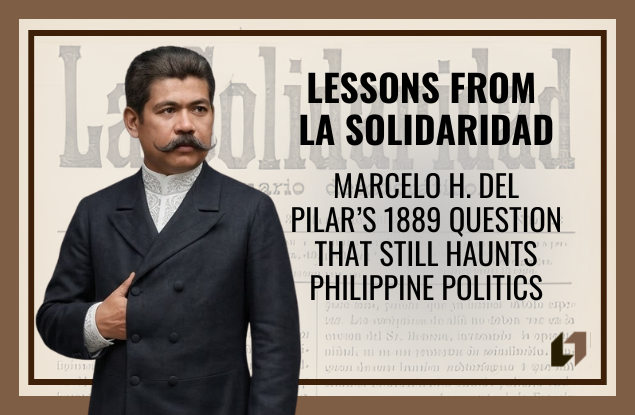
    Marcelo H. del Pilar’s 1889 Question That Still Haunts Philippine Politics

    FinancialAdviser.phJuly 1, 20263 Mins Read
    Share Facebook Twitter LinkedIn Email Copy Link
    Share
    Facebook Twitter LinkedIn Email Copy Link

    On September 30, 1889, Filipino reformist Marcelo H. del Pilar raised a question that would challenge the logic of colonial rule.

    Writing in the reformist newspaper La Solidaridad, Del Pilar addressed the issue of assimilation—the idea that the Philippines should be treated as an integral part of Spain.

    For many Filipino reformists, assimilation meant something very concrete:

    if the Philippines belonged to Spain, then Filipinos should enjoy the same rights as Spanish citizens.

    But colonial authorities did not see it that way.

    Del Pilar pointed out a striking contradiction.

    A Filipino who moved to Spain could enjoy political rights guaranteed by the Spanish Constitution. But that same Filipino would lose those rights simply by living in the Philippines.

    As he explained:

    “The Filipino who transfers his residence to the Peninsula, Cuba, or Puerto Rico enjoys such rights, in spite of his alleged primitive state.”

    Yet the opposite was also true.

    “The Spaniard, Cuban, or Puerto Rican who is born with these rights loses them inevitably… solely by living in the Philippines.”

    In other words, the issue was not citizenship—it was geography.

    In the Philippines, Del Pilar argued,

    “the place and not the citizenship determines the exercise or the restriction of rights.”

    The Question of Representation

    Del Pilar then raised another question that would become central to the reform movement.

    If Filipinos were part of the Spanish nation, why were they denied representation in the Spanish parliament?

    He wrote:

    “What reason is there for not having the Philippines represented in the Spanish parliament?”

    For Del Pilar, the answer revealed a deeper problem: colonial authorities treated Filipinos as subjects to be governed, rather than citizens to be represented.

    Yet he insisted that Filipinos were not passive or ignorant.

    “The loyal people who know that they are not a flock of sheep, that they are not slaves… if they should have duties, they also should have rights.”

    This statement captured the core demand of the Propaganda Movement.

    Filipinos were willing to fulfill their obligations as citizens—but they also expected the rights that came with those obligations.

    A Growing Political Awareness

    Del Pilar also noted that many Filipinos were already using legal and constitutional means to demand reform.

    “In the Philippines there is a growing desire for a better life… with attention to their needs expressed through legal means.”

    Reformists had formally presented their demands to the Spanish government.

    These included representation, equality before the law, and the protection of civil rights.

    Yet despite these petitions, colonial authorities often dismissed Filipino demands as unrealistic or radical.

    Del Pilar rejected that view.

    He argued that these reforms were not revolutionary at all.

    They were simply rights already recognized by Spain’s own constitution.

    Why Del Pilar’s Argument Still Matters

    More than a century later, Del Pilar’s essay remains a powerful reflection on the meaning of political equality.

    At its core, his argument was about consistency.

    If a nation claims that all its citizens are equal, then those rights must apply everywhere—not only in certain places.

    His critique also highlights a broader principle that remains relevant today:

    rights should not depend on geography, privilege, or political convenience.

    They must be grounded in the rule of law.

    In 1889, Del Pilar believed that the future of the Philippines depended on whether these principles would be recognized.

    More than a hundred years later, his words still echo in modern discussions about governance, representation, and accountability.


    Loading

    Share. Facebook Twitter LinkedIn Email Copy Link
    Previous ArticleHow Pride and Status Can Poison Family Relationships
    Next Article What Andrea Torres Learned About Money Before Success Arrived  

    Related Posts

    Opinion

    How Pride and Status Can Poison Family Relationships

    July 1, 2026
    Opinion

    Is AbaCore Becoming a Land Bank Instead of a Developer?

    June 30, 2026
    Opinion

    Roxas Has Billions to Deploy. Should Shareholders Expect Bigger Dividends?

    June 29, 2026
    Add A Comment

    Comments are closed.

    ATRAM AI Banner Ad
    Stay In Touch
    • Facebook
    • Twitter
    • LinkedIn

    Subscribe to Updates

      Get the latest updates from Financial Adviser about financial literacy and business acumen. Subscribe to our mailing list!

      By checking this, you agree to our Data Privacy Consent/Agreement and accept our use of such cookies.
      I agree to the Terms and Conditions

      Facebook X (Twitter) LinkedIn RSS

      Home

      Sucess

      • Leadership & Growth
      • Entrepreneurship
      • Business Strategy
      • Inspiring Stories

      Money

      • Investing
      • Personal Finance
      • Wealth Building
      • Financial Planning

      Work

      • Career Development
      • Workplace Culture
      • Productivity & Efficiency
      • Leadership & Management

      Life

      • Relationships & Family
      • Health & Wellness
      • Mindfullness & Balance
      • Personal Growth

      Inspiration

      • Vision & Purpose
      • Overcoming Adversity
      • Motivational Stories
      • Mindset & Motivation

      Contact Us

      Subscribe to Updates

        Get the latest updates from Financial Adviser about financial literacy and business acumen. Subscribe to our mailing list!

        By checking this, you agree to our Data Privacy Consent/Agreement and accept our use of such cookies.
        I agree to the Terms and Conditions

        Copyright © 2026 Financial Adviser. All rights reserved.

        • Privacy Policy

        Type above and press Enter to search. Press Esc to cancel.

        FINANCIALADVISER.PH USES COOKIES TO ENSURE YOU GET THE BEST EXPERIENCE WHILE BROWSING THE SITE.

        By continued use, you agree to our Data Privacy Consent/Agreement and accept our use of such cookies. For further information, click the link Data Privacy Consent/Agreement.