

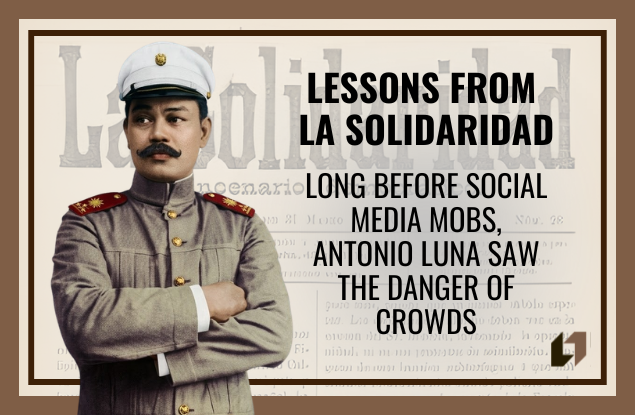
On October 15, 1891, an essay titled “Remains” appeared in the reformist newspaper La Solidaridad. The article was written under the pen name Taga-Ilog, a pseudonym widely attributed to Filipino intellectual and future revolutionary general Antonio Luna.
At first glance, the essay seems to describe a curious public spectacle in Madrid: an advertised fight between animals staged inside an arena. Notices announcing the event attract a large crowd eager for entertainment. Spectators gather expecting a brutal contest, a clash that will satisfy their appetite for excitement.
But Luna is not really writing about a sporting event. Beneath the surface, the essay becomes a reflection on something far more troubling—the dangerous psychology of crowds.
A Crowd Searching for Violence
Luna begins by observing how quickly people are drawn to spectacles of violence. Public announcements of the event bring thousands of spectators eager to witness destruction. According to Luna, this attraction to violent entertainment has deep historical roots. Even societies that consider themselves civilized have often been fascinated by scenes of bloodshed.
He writes that many spectators attend such events because they seek the thrill of destruction:
“Revolutions and wars are and will be the delight of many men… [people] seek diversion in small battles against bulls and beasts.”
In this sense, the arena becomes a substitute battlefield—a place where spectators can indulge violent instincts without risking their own lives.
When Civilization Reveals Its Primitive Side
Yet the spectacle does not unfold as expected. When the animals are brought into the arena, they refuse to attack each other. The crowd waits impatiently for violence that never arrives.
At first the audience grows restless. Soon frustration spreads throughout the arena.
For Luna, this moment reveals something profound about human nature. Beneath the surface of civilization, he suggests, primitive impulses remain ready to emerge.
“Barbarism has not completely disappeared… at the slightest provocation it emerges like a spark.”
The reaction of the crowd soon proves his point.
When the Crowd Becomes the Spectacle
Frustrated by the absence of bloodshed, the crowd suddenly becomes the spectacle itself. Spectators rush into the arena, transforming from observers into participants.
Chaos erupts.
Luna describes the scene with brutal clarity:
“It was the Madrid mob… looking for the performer in order to pummel him.”
Instead of watching violence, the crowd creates it. People seize the terrified animal and begin attacking it with knives.
The frenzy becomes grotesque.
“Knives of different dimensions were raised and plunged… laughter and cries of joy were heard… everybody wanted to smear himself with the blood.”
What had been advertised as entertainment quickly turns into what Luna calls “complete savagery.” Even when several people are injured in the chaos, the frenzy continues.
A Question About Civilization
At the end of the essay, Luna poses a simple but devastating question:
“What can such inhuman display contribute to society?”
It is more than a moral reflection. It is a question about civilization itself.
If a society claims to be cultured and modern yet still celebrates cruelty and violence as entertainment, Luna suggests, what does that reveal about its true character?
Why Luna’s Warning Still Matters Today
Although “Remains” was published in La Solidaridad on October 15, 1891, the behavior Luna described remains recognizable today.
Modern society may no longer gather in arenas to watch animals fight in the same way, but fascination with violence has hardly disappeared. Spectacles of aggression appear in new forms—sensational media coverage, extreme entertainment, viral outrage, and online mobs that collectively attack individuals.
The psychological transformation Luna observed—the moment when individuals lose restraint within a crowd—remains a recurring pattern throughout history.
Once emotions spread through a group, judgment can quickly disappear.
The Fragility of Civilization
Luna’s essay ultimately reminds us that civilization is more fragile than we often assume. Education, laws, and institutions may restrain human impulses, but those impulses never disappear completely.
Under the right conditions—anger, excitement, anonymity, or mob mentality—primitive instincts can quickly re-emerge.
More than a century ago, Antonio Luna watched how a crowd in Madrid transformed from spectators into participants in violence.
His observation still feels uncomfortably familiar today.
Sometimes the distance between civilization and chaos is thinner than we think.

