

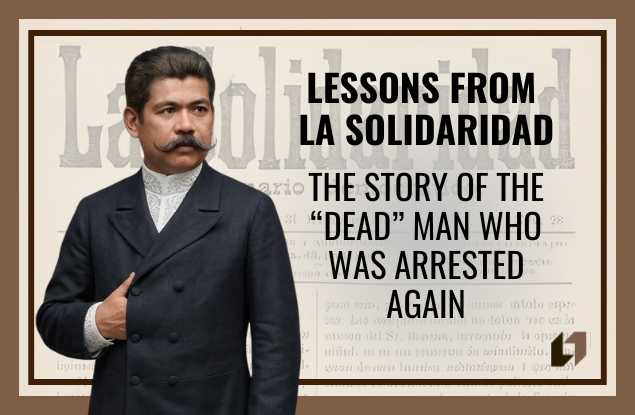
In February 1890, readers of La Solidaridad encountered one of the most unusual stories printed in the reformist paper. The article, titled “Resurrection of a Chinese,” was published under the editorial leadership of Marcelo H. del Pilar.
At first glance, the story appears almost unbelievable. It tells of a Chinese prisoner who, according to official records, had already died and been buried—only to be arrested again later, very much alive.
But behind the bizarre narrative was a deeper critique of the colonial system in the Philippines. Through irony and satire, the article revealed how bureaucracy, authority, and unquestioned institutions could produce absurd outcomes.
The article begins by explaining that the incident was so strange that it deserved to be recorded.
“Owing to its novelty, I shall give you an account of the resurrection, somewhat of a scandal, of a citizen of the Celestial Empire.”
The story centers on a Chinese prisoner who was being transported under government custody.
According to the report, the governor of Nueva Vizcaya had received orders from Manila to deliver the prisoner to the colonial authorities. The prisoner was escorted through the province of Nueva Ecija on the way to the capital.
But during the journey, a message was sent back to the provincial government. The prisoner, it said, had fallen ill in a town along the route.
Soon afterward, another message arrived.
The Chinese prisoner had died.
The article recounts how the authorities were informed of his death:
“Later another notice was received of the death of the Chinese in the same town and it was this information which was sent to the government that was sending him.”
The matter appeared settled. The man had died while under custody.
More importantly, the death was documented. A certificate of burial had been issued and signed by the parish priest.
As far as the official records were concerned, the prisoner no longer existed.
The Unexpected Problem
Some time passed. Then an astonishing development occurred.
In Nueva Vizcaya, the same Chinese man was arrested again.
The article describes the absurdity of the situation. If the official records stated that he had died and been buried, how could he now be alive?
The authorities therefore began an investigation.
But when officials in Nueva Ecija examined the records, they discovered something that complicated the matter.
There was indeed a burial certificate confirming the death of the Chinese prisoner.
And it had been signed by the parish priest.
When Records Become Untouchable
At this point the investigation ran into a serious problem.
Church records during the Spanish colonial period were treated as virtually unquestionable. The article describes the difficulty faced by the authorities:
“The prosecution found insurmountable obstacles in the infallibility of the parish record.”
The implication was clear. If a burial certificate signed by a priest existed, it was almost impossible to declare it false.
The article then delivers one of its most memorable and sarcastic lines:
“The curate is a friar; the friar is impeccable and rather than declare the falsity of the certificate, it is preferable to declare the false existence of the Chinese, or to make things right, to believe in his resurrection.”
In other words, it seemed easier for the system to accept the impossible—that the man had somehow come back from the dead—than to admit that an official record might be wrong.
What the Investigation Revealed
The article hints that the inquiry uncovered deeper problems.
It describes the investigation as exposing corruption and irregularities:
“They instituted a timely investigation which netted a nest of toads and snakes.”
Yet despite the discovery of wrongdoing, the investigation struggled to proceed. The authority of the friar and the sanctity of the parish records made it difficult to challenge the official narrative.
The story ends without a definitive resolution. The author remarks that it was still uncertain which explanation would prevail:
“I do not know which of these solutions will prevail.”
But he also notes that some friars were already boasting about the incident as proof of their power.
“Some friars are taking advantage of the incident to brag about their invulnerable power.”
Why This Story Still Feels Familiar Today
Although the story took place more than a century ago, its lessons remain surprisingly relevant.
First, it shows the danger of institutions becoming too powerful to question. When authorities are treated as infallible, mistakes cannot easily be corrected.
Second, it highlights how bureaucratic systems sometimes prioritize protecting reputations over discovering the truth.
The article’s irony—that officials might prefer to believe in a resurrection rather than admit a mistake—captures a problem that still appears in modern institutions.
Third, it reminds us that transparency and accountability are essential in governance. Records, documents, and official statements should always be open to verification.
Without that principle, even the most obvious truths can become difficult to establish.

