

AI Upskilling Has a Teacher Problem
Financial markets reward preparation. That is why governments and businesses are investing heavily in AI skills. The assumption is straightforward: workers who understand AI will be more productive and more competitive.
But there is a major constraint that receives far less attention.Teachers.
I recently spoke to Jing Castaneda about this. Every proposal to reskill workers depends on someone capable of teaching those skills. Yet discussions about AI workforce readiness rarely focus on educator readiness. Where is the upskilling of the upskillers?
This question matters because human capital remains one of the most important drivers of economic growth. A country can invest in technology infrastructure, software platforms, and innovation programs. But without capable educators, those investments generate limited returns.
Knowledge does not spread itself. People teach people. Today, many institutions are experimenting with AI education. Some universities and training organizations are moving aggressively. Others remain cautious or resistant. This uneven progress creates a fragmented learning environment. Workers in some sectors gain access to modern training. Others do not. Over time, these gaps become productivity gaps.
The solution begins with recognizing that AI education is not one thing. There are two distinct tracks.
The first is specialist education. These programs produce AI researchers, engineers, and advanced technical professionals. They are essential for innovation and technological leadership.
The second is AI literacy. This track serves the broader workforce. Most employees do not need to design AI systems. They need to understand how to use AI tools effectively, evaluate outputs critically, and incorporate AI into daily workflows.
This literacy should become widely available. The economic value of broad AI literacy may ultimately exceed the value of specialist training alone because it affects millions of workers rather than thousands. However, both tracks depend on qualified instructors.
That is why teacher development should be viewed as a strategic investment rather than an educational expense. When policymakers discuss workforce competitiveness, teacher capability should be part of the conversation. When organizations discuss reskilling budgets, instructor development should be included. When governments design national AI strategies, educator training should be a core pillar.
The goal should be practical rather than rhetorical.
- How many educators require training?
- What competencies should be standardized?
- How frequently should training be updated?
- What incentives encourage adoption?
These questions are less exciting than predictions about artificial general intelligence.
They are also far more actionable. History shows that economic transitions favor societies that invest in education early. The AI transition will be no different.
The workforce of the future will depend on teachers who understand the technology well enough to explain it, evaluate it, and integrate it into learning.
Before we can fully reskill workers, we must first upskill the people responsible for reskilling them. That may be the highest-return investment in the entire AI economy.
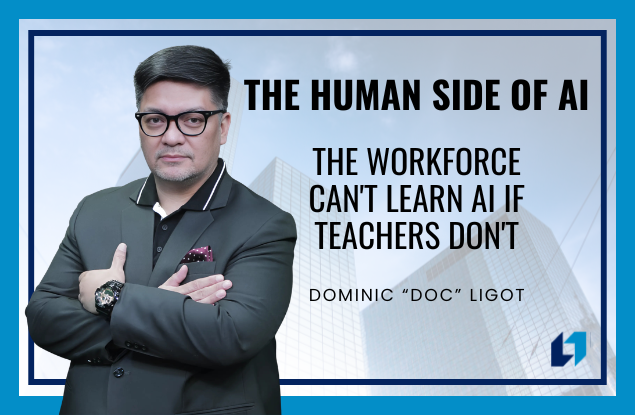
Dominic “Doc” Ligot is one of the leading voices in AI in the Philippines. Doc has been extensively cited in local and global media outlets including The Economist, Channel News Asia, South China Morning Post, Washington Post, and Agence France Presse. His award-winning work has been recognized and published by prestigious organizations such as NASA, Data.org, Digital Public Goods Alliance, the Group on Earth Observations (GEO), the United Nations Development Programme (UNDP), the World Health Organization (WHO), and UNICEF.
If you need guidance or training in maximizing AI for your career or business, reach out to Doc via https://docligot.com.

