

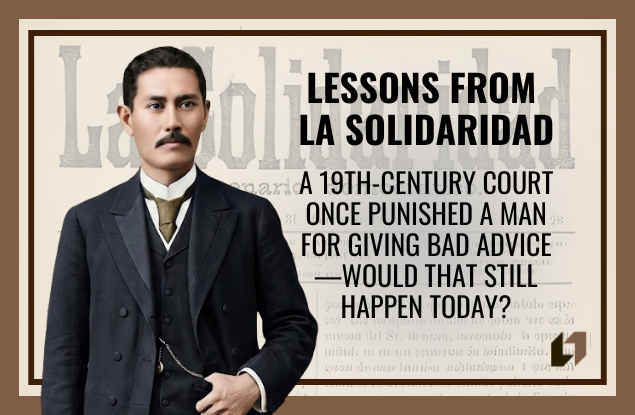
In the late 19th century, a short international news note published in the reformist newspaper La Solidaridad described a curious legal case from England.
At the time, the paper was edited by Filipino journalist Graciano López Jaena, who often included unusual court stories and social anecdotes from Europe to illustrate broader lessons for readers.
This particular story involved an unexpected legal outcome: a man was ordered by a court to pay damages simply for giving advice.
The case raises an interesting question today—why would a court rule that way then, and why would such a ruling likely be rare today?
The Story Behind the Court Decision
According to the report, two wealthy young men were close friends who consulted each other on nearly every decision.
One day, they met a young woman while walking through the suburbs of a large city. One of the young men quickly fell in love and decided he wanted to marry her.
Before finalizing the decision, he asked his friend for advice.
The friend tried to dissuade him from marriage, praising the “blessings of freedom” and offering arguments against the idea of settling down.
Eventually, the young man followed his friend’s advice and decided to remain a bachelor.
When the woman learned what had happened, she took an unusual step: she filed a lawsuit—not against the former fiancé, but against the friend whose advice had persuaded him to abandon the marriage.
The court ruled in her favor.
The friend was ordered to pay 800 pounds in damages, a significant sum at the time.
According to the report, the woman later used the money to open a millinery shop, turning the compensation into a small business.
Why the Court May Have Ruled That Way
At first glance, the ruling may seem strange today. Why would a court punish someone for giving advice?
But legal historians note that during the 19th century, courts in Europe and Britain sometimes recognized claims related to “interference with marriage” or broken engagement.
Marriage was considered not only a personal relationship but also a social and economic arrangement. A broken engagement could damage a person’s reputation and financial prospects, especially for women who depended on marriage for economic security.
If a third party deliberately interfered in that arrangement, courts could treat it as a form of harm.
Seen in that historical context, the ruling makes more sense. The court may have believed the friend’s actions directly caused the woman’s loss.
Why Such a Case Would Be Unlikely Today
Modern legal systems generally take a different view.
Today, most courts emphasize individual responsibility and freedom of choice. A person who decides not to marry someone is typically seen as exercising a personal right.
Even if a friend offers advice that influences the decision, it would be difficult to prove that the adviser should be legally responsible for the outcome.
In many countries, lawsuits based on broken engagements or romantic interference have largely disappeared from modern law.
Society has also changed in other ways. Economic independence, particularly for women, has reduced the financial consequences of a failed engagement.
In the 19th century, losing a marriage opportunity could have serious economic implications. Today, individuals generally have more independent career options and legal protections.
The Moral the Newspaper Wanted to Highlight
The brief note in La Solidaridad ended with a line that captured the editor’s intended lesson:
“The culprit should profit from experience or he would be likely to indulge in the same habit of giving advice which proves costly to the adviser.”
The message was partly humorous but also instructive.
Advice—especially advice that affects major life decisions—can carry consequences.
A Lesson That Still Matters
Even if courts today are unlikely to punish someone for giving bad personal advice, the broader principle remains relevant.
People frequently influence one another’s decisions—about careers, investments, relationships, and business opportunities. Those recommendations can shape outcomes in ways that are not always predictable.
In finance and professional fields, advisers are often required to follow strict ethical and legal standards precisely because their guidance can have real consequences.
The 19th-century story reminds readers that while the law may change over time, the responsibility that comes with influencing someone else’s decisions has always been recognized.
Sometimes, the most expensive advice is the advice that seemed harmless when it was given.

