

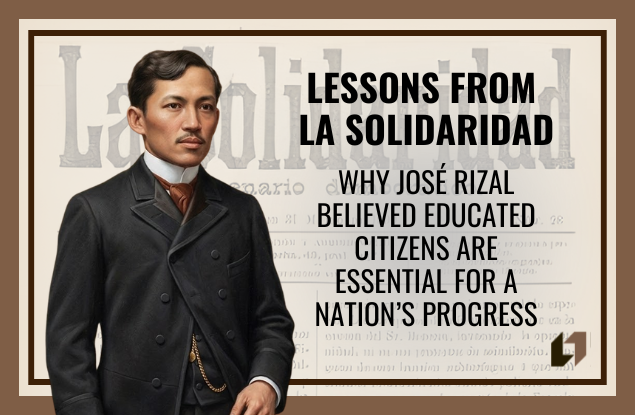
Long before financial literacy, civic education, and informed citizenship became widely discussed ideas, Filipino reformist José Rizal was already writing about the importance of education in shaping a nation’s future.
In an article published on May 31, 1889 in the reformist newspaper La Solidaridad, Rizal examined the growing tensions between reform-minded Filipinos and the colonial authorities governing the Philippines. Beneath the political arguments of the essay lies a deeper idea: societies progress when citizens become educated, informed, and aware of their rights.
Rizal observed that a new generation of Filipinos was emerging—individuals who were beginning to question abuses and think critically about their country’s future.
“The educated Filipinos, the liberals who increase their number every day… have dedicated themselves to the welfare of our country.”
This sentence reflects a transformation that was beginning to unfold during Rizal’s time. Increasing numbers of Filipinos were gaining access to education both locally and abroad. Exposure to new ideas about governance, economics, and political rights was shaping a generation that believed reform and progress were possible.
For Rizal, education was not merely a tool for personal advancement. It was a force capable of transforming society itself.
An informed population, he believed, could recognize injustice and demand accountability from those in power.
But Rizal also understood that ignorance made societies vulnerable to manipulation. Systems of abuse often survived because people lacked the knowledge or confidence to challenge them.
In one striking passage, Rizal pointed out how societies sometimes reflect the examples set by their leaders.
“The nation that they wish to call a ‘child’ has had bad teachers and has learned bad examples.”
The remark carried a powerful implication. When those in authority act without integrity or responsibility, the effects spread throughout society. Institutions weaken, public trust erodes, and the moral standards of governance decline.
Education, therefore, was essential not only for intellectual growth but also for building a healthier political and economic environment.
Rizal also observed how reform-minded Filipinos were increasingly dedicating themselves to improving their country despite opposition from colonial authorities.
He wrote that these individuals were not motivated by selfish interests but by a desire to serve the public good.
“They have dedicated themselves to the welfare of our country.”
For Rizal, the rise of educated citizens was both a source of hope and a source of tension. As people became more aware of injustice, they naturally began to question the systems that sustained it.
Rizal warned that suppressing this intellectual awakening would only deepen social problems.
“This demoralization cannot be corrected by sealing the lips of those who accuse.”
In other words, silencing criticism or discouraging debate does not resolve the underlying issues within society. Progress requires open discussion, accountability, and the willingness to confront uncomfortable truths.
More than a century later, Rizal’s insight still resonates.
Modern economists often speak about human capital—the collective knowledge, skills, and capabilities of a population—as one of the most important drivers of economic growth.
Countries that invest heavily in education, research, and intellectual development tend to build stronger economies and more innovative societies.
Rizal recognized this relationship long before modern economic theory formalized it.
He understood that education empowers individuals to participate meaningfully in public life. It allows citizens to evaluate policies, understand economic conditions, and hold institutions accountable.
Today, the meaning of education continues to evolve.
Beyond traditional schooling, societies now emphasize financial literacy, digital skills, and civic awareness as essential tools for navigating complex economic systems. Individuals who understand markets, governance, and public finance are better equipped to make informed decisions about their futures.
In many ways, Rizal anticipated this idea when he described the growing number of educated Filipinos who were beginning to dedicate themselves to the welfare of the country.
Education, he believed, was not simply about knowledge—it was about responsibility.
Without an informed citizenry, societies risk remaining trapped in cycles of weak leadership and poor governance. But with knowledge comes the capacity to build stronger institutions, more transparent governments, and more resilient economies.
More than 130 years later, Rizal’s message remains clear: the future of a nation ultimately depends on the knowledge, awareness, and engagement of its people.

