

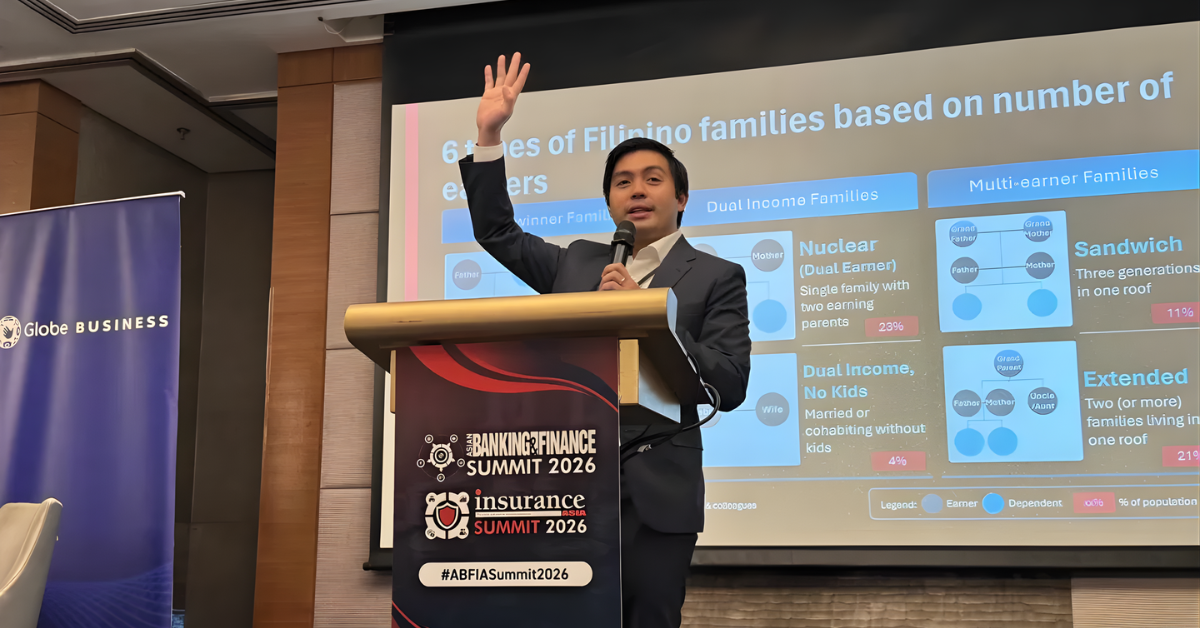
Financial inclusion, consumer protection, and the evolving needs of Filipino families were among the key themes discussed at the Asian Banking & Finance and Insurance Asia Summit – Manila, held on 10 March 2026.
Industry leaders and experts highlighted how financial institutions must rethink the way they design products and services to better serve vulnerable groups and the changing financial behavior of Filipino households.
Protecting Vulnerable Customers Builds Trust
Speaking at the summit, Karen Jill Espineli, Chief Compliance Officer and General Counsel at AXA Philippines, emphasized that insurers have a major opportunity to strengthen public trust by improving how they identify and support vulnerable customers.
Espineli noted that a large segment of the Philippine population may fall into vulnerable categories.
The country has about 11 million senior citizens, 2.6 million persons with disabilities (PWDs), and 17.8 million people living in poverty. At the same time, around 28.7 million Filipinos have only basic financial literacy.
“These are individuals whose personal situation makes them more likely to experience harm at any stage of the customer journey,” she said.
Although the Philippine insurance sector does not yet have a single formal definition of vulnerable customers, Espineli said insurers can draw guidance from practices used in other markets. In jurisdictions such as Hong Kong, regulators require financial institutions to consider vulnerable groups when designing and promoting financial products.
Local legislation also offers guidance. Espineli pointed to the Financial Products and Services Consumer Protection Act, which includes provisions that insurers can use when developing safeguards for vulnerable customers.
The Bangko Sentral ng Pilipinas (BSP) identifies vulnerable sectors as groups such as the poor, women, children, persons with disabilities, indigenous peoples, overseas Filipinos and their families, and the elderly, as well as individuals facing financial instability such as irregular income.
At the same time, the rapid digitalisation of financial services presents new challenges.
“If you are a senior citizen, how can you keep up with AI?” Espineli said, noting that complex digital platforms and increasingly sophisticated financial products may expose vulnerable customers to unsuitable offerings.
She urged insurers to define vulnerability within their organizations, train employees to recognize vulnerable situations, test financial products with vulnerable groups, and strengthen internal safeguards.
Ensuring proper protection, she added, does more than comply with regulations—it helps insurers build trust with the public and advance financial inclusion.
“We want to make sure that when elderly customers, PWDs, women, and farmers interact with us, they know they are protected,” she said.
Financial Products Must Reflect How Families Actually Spend
Another key theme at the summit was the need for financial institutions to rethink product design to better reflect how Filipino families manage money.
Lance Katigbak, Principal at Boston Consulting Group (BCG), said financial services often focus too heavily on income earners rather than the people who actually manage household spending.
For example, most financial products designed for Overseas Filipino Workers (OFWs) focus on remittances and the sending of money abroad. However, few financial solutions are designed for the families who receive and manage those funds.
“Decision-making is a collective process,” Katigbak said. “Most decisions are made by multiple members. How often are our products designed to account for something like that?”
Family financial dynamics also evolve over time. In families with children, younger members gradually become involved in financial decisions. In extended families, elders and middle generations often share responsibility for managing finances.
BCG’s research also revealed the financial priorities of Filipino households. In a June 2025 survey of 1,515 families, the top concern was financial security in the face of medical emergencies.
About 70% of respondents said being financially prepared for health-related shocks was their top priority.
However, the study also revealed a worrying gap in financial resilience. Around 64% of Filipino families said they would struggle to cover a ₱10,000 hospital bill.
Beyond healthcare, Filipino households also expressed strong interest in building larger savings funds (68%) and improving daily nutrition and food quality (60%).
Katigbak also encouraged banks and financial institutions to communicate in language that resonates with everyday Filipinos.
Instead of relying solely on technical financial terms, institutions should incorporate commonly used expressions such as “abono” and “paluwag” when discussing financial concepts.
Designing Financial Services for Real Lives
The discussions at the Asian Banking & Finance and Insurance Asia Summit – Manila highlighted a common message: financial institutions must design products and policies that reflect the realities of Filipino lives.
Whether through better protection for vulnerable customers or by creating products that match how families actually make financial decisions, industry leaders agree that a more inclusive approach will ultimately strengthen both customer trust and long-term industry growth.
As the financial services sector continues to evolve, the challenge for insurers and banks will be to ensure that innovation does not leave behind the very communities that financial inclusion aims to serve.

