

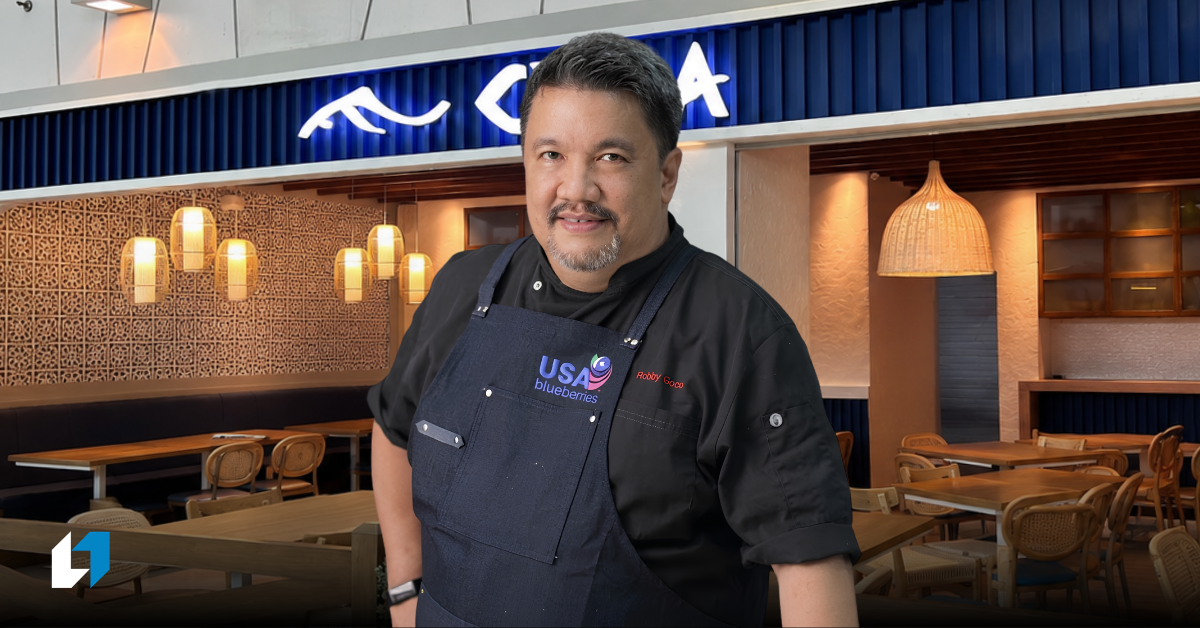
For many Filipinos, the Goco name has long been associated with law and public service.
Chef Robby Goco grew up in a family deeply rooted in that tradition. His father, Raul Goco, was one of the country’s most respected lawyers, serving as Solicitor General of the Philippines during the administration of President Fidel Ramos before later becoming Philippine ambassador to Canada.
Given that background, many naturally expected the younger Goco to follow the same professional path.
But when the time came to decide on his career, he had a very different answer.
“Then when it was time to choose a career path, my father asked me, ‘What do you plan to do?’” Goco recalls.
“I said, ‘I’m comfortable being in the hospitality industry—restaurants, being a chef, being in hotels.’”
His father was surprised.
“He said, ‘That’s not our line, di ba? You’re supposed to be a lawyer.’”
But Goco had already made up his mind.
“I said, ‘No, this is what I want to do.’”
While his father initially questioned the decision, his mother became one of his strongest supporters.
“My mom was very supportive,” he says.
Instead of dismissing the idea, she encouraged him to treat the decision seriously by researching culinary schools abroad.
“So sabi niya, ‘Okay, research where you want to go.’ We researched Switzerland, the United States, everything.”
Choosing an unconventional path
In the early 1990s, becoming a professional chef was far less common than it is today. The Philippine restaurant industry was still developing, and the profession did not yet have the visibility it enjoys now.
“During that time, this was back in ’92, wala pa masyadong chefs,” Goco says.
After researching various programs, he eventually chose one of the leading culinary schools in the United States.
“I did the research, and finally I said, ‘I want to go to the California Culinary Academy.’”
The decision meant leaving the Philippines to pursue culinary training abroad.
“So I went and pursued my dream,” he says.
After completing his studies, Goco stayed in the United States for several years, gaining experience and building his career in the hospitality industry.
“Then I stayed in the US for quite some time,” he says.
The importance of building skills outside the family legacy
Goco’s journey reflects a pattern seen among many successful entrepreneurs and business leaders: developing professional skills independently before eventually building something of their own.
Coming from a family known for law and government service, he could have easily followed a conventional path. Instead, he chose to pursue a completely different field and trained in it seriously.
This decision allowed him to build expertise, confidence, and industry knowledge before eventually starting ventures in the Philippines.
For second-generation entrepreneurs or professionals from prominent families, this step is often critical. Experience gained outside the family environment provides perspective and credibility that cannot easily be developed within a familiar network.
A conversation that changed his perspective
At one point, Goco had grown comfortable living and working in the United States. But a conversation with his mother would eventually reshape how he thought about his career.
“Eventually, I became very comfortable in the US,” he recalls. “Then I called home, and my mom said, ‘Why don’t you come back to the Philippines?’”
Her reasoning was simple but powerful.
“If you stay in the US, you’ll be living from salary to salary,” she told him. “But here in the Philippines, you can create jobs.”
She believed his talent could have a larger impact at home.
“With whatever you’re doing, your talent, you can create something, create livelihood, create jobs. A lot of people are going to rely on you.”
That advice reframed the way he thought about success.
Instead of simply pursuing a career abroad, he began to see the possibility of building businesses that could generate opportunities for others.
Building a legacy of his own
Many Filipino professionals face a similar crossroads: whether to pursue stability abroad or return home to build something new.
For Goco, the decision to eventually come back to the Philippines would shape the rest of his career. In the years that followed, he would establish restaurants and help introduce new dining concepts to the local market—including the Greek restaurant brand Cyma, which later became one of the country’s most recognizable restaurant concepts.
Looking back, his story highlights an important lesson about career paths.
Family legacy can provide inspiration, but it does not necessarily define one’s direction.
In Goco’s case, choosing the kitchen instead of the courtroom did not mean abandoning his family’s tradition of leadership—it simply meant building a legacy in a different field.

