

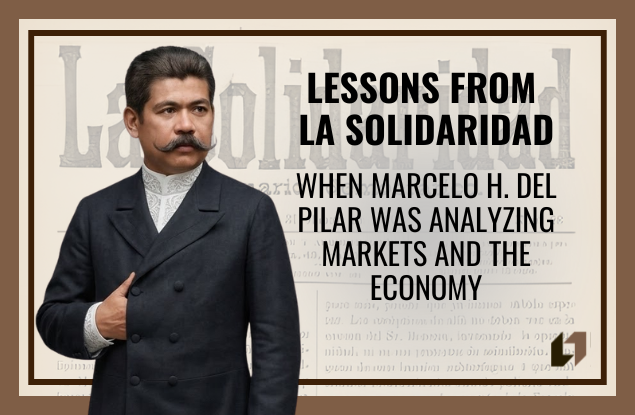
More than a century before modern financial media began analyzing currency crises, stock market volatility, and government debt, Filipino reformist writer Marcelo H. del Pilar was already doing something remarkably similar.
In late 1891, del Pilar published a series of commentary columns in the reformist newspaper La Solidaridad that read strikingly like modern economic analysis. Two of these pieces—“News of the Last Two Weeks,” published on October 31, 1891, and “News of the Fortnight,” published on November 15, 1891—examined the financial and political turmoil unfolding in Spain at the time.
While del Pilar was best known as a political reformist advocating change in the Philippines, these columns reveal another side of his writing. He was closely observing markets, monetary policy, and government finances, connecting economic instability with political decisions. In many ways, he was doing what today’s financial columnists and economic analysts do: explaining how government actions shape financial markets and investor confidence.
A Financial Crisis Unfolding
In the October 31, 1891 column, del Pilar described a deteriorating economic situation in Spain. The government had attempted to stabilize the financial system by expanding paper currency issued by the Bank of Spain, a move intended to ease financial pressure. Instead, the policy weakened confidence in the country’s monetary system.
Del Pilar pointed to the reaction in financial markets as evidence. Government securities that once traded around 500 pesetas had fallen sharply to about 413, and within days dropped another 33 points, sending waves of panic through investors.
Today such developments would be described as the combined effect of monetary expansion and collapsing investor confidence. Although del Pilar wrote decades before modern macroeconomic theory took shape, his description captured the same relationship economists still discuss today: when confidence in a country’s currency weakens, financial markets react quickly.
He also noted that Spain’s currency was losing value in foreign exchange markets. Bills of exchange were declining steadily, signaling falling international confidence in the Spanish financial system. In modern terms, he was describing the early stages of a currency depreciation problem.
Trade Problems and Economic Consequences
Del Pilar also examined the impact of political decisions on international trade. Spain had been negotiating with France regarding tariffs on Spanish wine exports, but delays and poor negotiations allowed France to impose policies that effectively closed its market to Spanish producers.
The result was a major blow to one of Spain’s key export industries.
Del Pilar responded with biting satire. If Spanish wine could no longer be sold abroad, he suggested, it might at least become cheaper for Spaniards to drink at home. In that case, drunkards might raise their glasses and shout, “Hurrah for the administration!”
Behind the humor was a serious point: trade policy mistakes eventually appear in economic data and market behavior.
A Second Column: Political Instability and Financial Stress
Two weeks later, in “News of the Fortnight,” published on November 15, 1891, del Pilar returned to the same theme. Spain’s political system, he argued, was consumed by internal rivalries between factions of Conservatives and Liberals. Ministers were resigning, factions were competing for influence, and the government appeared unable to address the country’s growing financial difficulties.
This political instability, del Pilar suggested, was closely connected to the economic turmoil already visible in financial markets.
He pointed to another troubling indicator: the declining value of Bank of Spain shares. The stock had fallen significantly within a short period, reflecting investors’ growing doubts about the country’s financial stability.
Del Pilar also raised concerns about the central bank itself. Official balance sheets appeared to show that the Bank of Spain had issued paper currency beyond the legal limits allowed by law, while gold and silver reserves were shrinking. In modern financial language, this would raise questions about central bank credibility and monetary discipline.
Debt, Empire, and Government Spending
Another issue del Pilar highlighted was the heavy financial burden of Spain’s colonial empire. Military campaigns in places such as Cuba and the Philippines required enormous expenditures, and the government continued to finance these costs by borrowing.
The state was issuing loan certificates and accumulating debt even as economic conditions deteriorated.
For del Pilar, the connection was clear. A government struggling with fiscal discipline, unstable currency policies, and political division could not expect markets to remain confident.
More than a century later, economists would describe similar dynamics when discussing deficit spending, debt sustainability, and investor confidence in sovereign finances.
When Politics Shapes Markets
Taken together, del Pilar’s two columns presented a consistent argument: financial markets often reveal the deeper consequences of political decisions.
When governments overspend, weaken their currency, or fail to manage trade policy effectively, those problems eventually appear in falling asset prices, currency depreciation, and declining investor confidence.
This relationship between politics and markets remains one of the central insights of modern financial analysis.
Del Pilar may not have used contemporary economic terminology, but he clearly understood the underlying principle.
A Surprisingly Modern Lesson
What makes these columns remarkable today is how familiar their themes still feel.
Del Pilar was writing about currency depreciation, stock market declines, government borrowing, trade policy failures, and political instability affecting markets—topics that continue to dominate financial headlines more than a century later.
Seen from this perspective, his columns in La Solidaridad were not merely political commentary. They were early examples of economic analysis aimed at explaining how financial systems respond to policy decisions.
Markets evolve, technologies change, and financial instruments become more complex. But the relationship between political leadership, economic policy, and investor confidence remains largely the same.
More than 130 years ago, Marcelo H. del Pilar was already observing that connection.
And in many ways, he was doing something that still defines modern financial journalism today: using economic evidence to reveal the deeper consequences of political decisions.

