

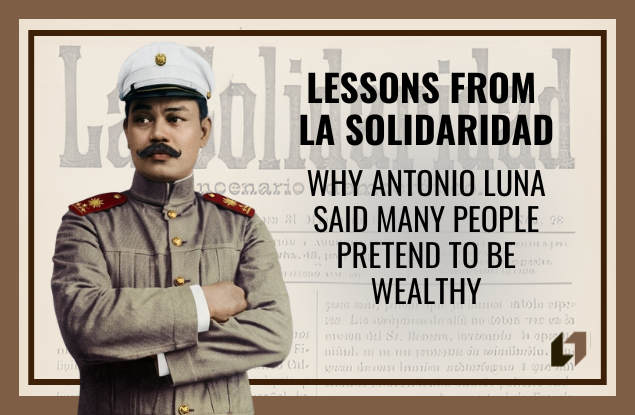
In 1891, Filipino intellectual Antonio Luna noticed something curious while watching travelers at a railway station in Madrid.
Many of them proudly announced that they were spending the summer in fashionable seaside resorts such as San Sebastián, Biarritz, or Santander. The declarations sounded confident and glamorous, as though the destinations themselves carried social prestige.
But Luna suspected that something else was happening.
Writing under the pen name Taga-Ilog in La Solidaridad, he observed that some travelers seemed more interested in saying where they were going than actually enjoying the trip.
With quiet irony, Luna captured the scene with a single telling phrase:
“I shall spend summer in Biarritz.”
The statement itself, Luna implied, functioned almost like a badge of status.
It was less about the journey and more about the social signal it sent.
When Travel Becomes a Status Signal
The scene Luna described unfolds at a crowded railway station at the beginning of summer.
Families gather to say goodbye. Friends wave from the platform. Travelers prepare to leave Madrid for the coast.
At first, the atmosphere appears festive. People speak enthusiastically about escaping the city’s heat and enjoying the sea breeze. But Luna begins to notice that these conversations are not only about relaxation.
They are also about reputation.
As Luna observed with dry humor, many people seemed eager to make sure others heard their travel plans.
“One hears everywhere the phrase: ‘I shall spend the summer in Biarritz,’ or ‘We are going to San Sebastián.’”
The statement itself becomes the point.
The destination becomes a symbol.
In the social world Luna describes, leaving Madrid for the summer quietly signals prosperity and refinement. Those who travel appear fashionable and successful, while those who remain behind risk appearing less fortunate.
Remaining in the city, Luna suggests, could signal that one simply did not have the means to leave.
The Truth Behind the Stories
What makes Luna’s observation especially amusing is the truth he later reveals.
Many of the same individuals who boast about glamorous destinations are not actually traveling very far.
Instead of the celebrated resorts they mention in conversation, some spend the summer in small nearby villages such as Pozuelo, Pinto, or Valdemoro—modest towns located only a short distance from Madrid.
The reality is far less impressive than the story.
Luna points out the contradiction with subtle mockery.
People announce journeys to famous resorts, yet end up vacationing in ordinary places close to home.
The statement becomes more important than the destination.
The story matters more than the truth.
A Social Performance
By quietly observing a railway station, Luna turns an ordinary moment into a commentary on social behavior.
The travelers become actors in a subtle performance where reputation and appearance take center stage.
Travel, in this context, functions almost like a public declaration of status.
Luna suggests that the desire to appear prosperous can sometimes outweigh the desire for genuine enjoyment.
The vacation becomes less about rest and more about recognition.
Why Luna’s Observation Still Feels Familiar
More than a century later, the behavior Luna described remains easy to recognize.
The railway station has simply been replaced by modern platforms—social media feeds, travel photos, and curated online lifestyles.
Instead of announcing trips to Biarritz in conversation, people today often display their vacations through carefully selected images of luxury resorts and exotic destinations.
The technology has changed, but the motivation remains strikingly similar.
People still feel pressure to demonstrate that they belong to a certain lifestyle.
The Lesson from 1891
Luna’s essay quietly reveals how easily financial decisions can be influenced by social expectations.
People sometimes spend money not because they truly need something, but because they want others to believe they are successful.
More than a century ago, Antonio Luna already saw through this social performance.
He understood that appearances often mask reality.
His observation still rings true today: the desire to look wealthy can sometimes become stronger than the desire to build real wealth.

