

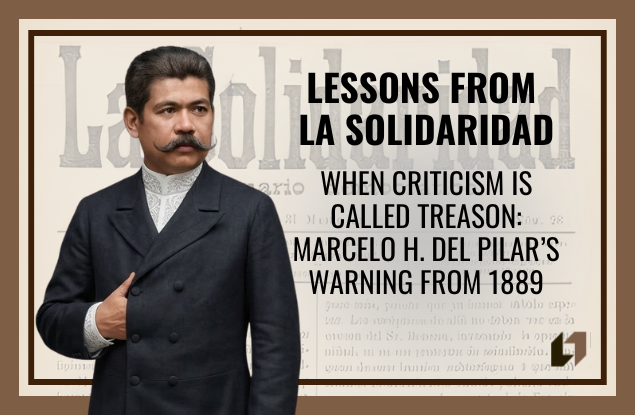
In the late nineteenth century, the battle for reform in the Philippines was not fought only in politics or revolution. It was also fought through essays and arguments in the pages of La Solidaridad, where Filipino reformists tried to expose the abuses of colonial rule and argue for change.
One of the most perceptive voices in that movement was Marcelo H. del Pilar, who sometimes wrote under the pseudonym “M. Makiling.” In an essay published on August 15, 1889, Del Pilar described a tactic that authorities frequently used against reformers: accusing them of threatening the integrity of Spain itself.
At first glance, the accusation sounded serious. But Del Pilar argued that it was often used not to defend the state but to silence critics.
“The friar, Mr. Editor, is a terrible enemy,” he wrote. “When he meets with somebody in town who opposes his caprices and wishes, he immediately makes use of the oft-repeated statement that national integrity is endangered by such a person.”
In other words, anyone who challenged the authority of the friars could quickly be portrayed as dangerous to the government.
Del Pilar observed that the accusation worked because it created fear among colonial officials.
“In this way he frightens the government into making a similar charge.”
Once a critic was labeled in this way, the consequences could be severe. Reformers could be branded filibusteros—a word that suggested rebellion against Spain. The label did not require proof. Suspicion alone was enough to damage a person’s reputation or livelihood.
Del Pilar believed the practice destroyed not only individuals but also families and communities.
“He works blindly,” Del Pilar wrote of the friars, “killing the happiness of every citizen, of the family and of the home.”
The problem, he argued, was widespread. Many Filipinos had experienced the same treatment.
“This is the common experience of many in Philippine towns.”
What made the situation even more troubling was that officials in Madrid sometimes believed they were promoting reforms in the Philippines. Del Pilar himself praised the Minister of the Colonies, Manuel Becerra, for introducing measures intended to promote progress and improve the welfare of the country.
Yet Del Pilar warned that such reforms would accomplish little unless the deeper problem—the power of the friars—was addressed.
“I fear, however, that his measures would be dead letters,” he wrote, “if the influence of the opposition group is not eliminated in everything that tends to propagate culture and to promote progress in this Archipelago.”
To illustrate the problem, Del Pilar described a revealing example involving language policy. Spain had issued a royal decree encouraging the use of Spanish in the Philippines. In theory, the measure was meant to promote integration and education.
In practice, however, many friars resisted it.
According to Del Pilar, some priests deliberately avoided using Spanish when dealing with Filipinos, even in towns where Spanish had already been commonly used in church ceremonies such as baptisms and marriages.
Instead, they insisted on using local languages—even when the participants were educated Filipinos who understood Spanish.
The reason, Del Pilar implied, was control. Language was power. If Filipinos learned Spanish, they could read laws, understand government policies, and communicate directly with colonial officials.
Keeping that barrier in place preserved the friars’ influence.
Ironically, Filipinos who tried to speak or write Spanish sometimes became targets of suspicion themselves.
“If the native were to talk in Spanish or write in Spanish,” Del Pilar wrote, “he was placed in the diabolical list of the friars as a filibustero or anti-Spaniard.”
The contradiction was striking. Those who adopted Spanish language and culture were accused of betraying Spain.
For Del Pilar, this revealed the deeper flaw of the colonial system. Progress in the Philippines would remain impossible as long as this structure of power remained intact.
He made his position clear in the closing lines of the essay.
“We are children of Spain and we desire her glory and honor and the welfare of all Spaniards,” he wrote. Yet the prosperity of the Philippines, he warned, “will never be achieved as long as the pernicious influence of the friar reigns.”
More than a century later, Del Pilar’s insight remains strikingly relevant.
Throughout history, powerful institutions have often used similar tactics. When criticism becomes uncomfortable, critics may be labeled as enemies of the state, traitors, or destabilizers. The accusation shifts attention away from the issue itself and focuses instead on the person raising it.
Once the label is applied, debate becomes difficult. Fear replaces discussion.
Del Pilar understood that this strategy weakened societies rather than strengthening them. A nation that cannot tolerate criticism loses the opportunity to correct its own mistakes.
For the reformists of La Solidaridad, loyalty to a country did not mean silence. It meant the courage to speak honestly about the problems that prevented it from progressing.
True patriotism, they believed, required reform.
The lesson Del Pilar left behind in 1889 is therefore not only a historical observation. It is a reminder that healthy societies depend on open discussion and the freedom to question authority.
When criticism is treated as treason, progress becomes impossible.

