

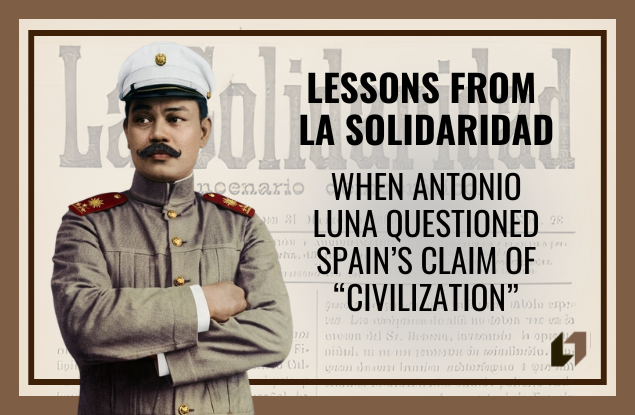
In 1889, Filipino intellectual and scientist Antonio Luna published a short but striking essay in the reformist newspaper La Solidaridad. Writing under the pen name Taga-Ilog, Luna described a seemingly ordinary outing outside Madrid.
At first glance, the article reads like a travel observation. But beneath the narrative lies a deeper critique of colonial arrogance and the claim often repeated by Spanish officials that Spain was bringing “civilization” to the Philippines.
By carefully describing what he saw in Spain itself, Luna quietly turned that argument upside down.
Remembering the Beauty of the Philippines
The essay begins with Luna reflecting on the beauty of the Philippine countryside. Living in Europe, he longed for landscapes that reminded him of home.
He described the Philippines with poetic admiration:
“The cane fields, coconut groves, mango groves and the balitis shade the ground; the intoxicating perfume of the fruits and flowers of our orchards and gardens.”
For Luna, the natural scenery of the islands possessed a richness that was difficult to capture even with art.
“Extensive plots of green; running rivulets meandering through enchanting banks covered with green tapestries; a clear sky of infinite blue.”
He even suggested that the beauty of the Philippines exceeded what poetry or painting could fully describe:
“That sublime and marvelous spectacle of a country so beautiful that the heart is filled with diverse thoughts which neither the song of the poet nor the brushes of the painter can describe.”
At a time when colonial writers often portrayed the Philippines as primitive or uncultured, Luna’s description was a quiet reminder of the country’s natural richness.
A Very Different Landscape in Spain
Seeking a similar experience in Spain, Luna traveled outside Madrid to enjoy the countryside. But what he found was far from what he had imagined.
Instead of lush fields and shaded groves, he encountered something much less inspiring.
He described the landscape bluntly:
“A confused pile of stones… without order or harmony.”
The surrounding area appeared barren and lifeless.
“Arid fields, devoid of vegetation, desert hills… a rivulet meandering over rocks and stones.”
The contrast with the tropical landscapes of the Philippines could not have been clearer.
Inside the Tavern
Luna then entered a merendero, a small tavern where people gathered to eat, drink, and socialize.
What he witnessed there surprised him even more.
“The noise of the dishes, the clinking of glasses and cups are drowned by the loud voice of that vulgar crowd.”
Instead of refined conversation or quiet leisure, the atmosphere was chaotic.
“Women laughed loudly, shouted oaths, terrible blasphemies; screams were heard every moment.”
Arguments erupted among the guests, sometimes escalating dangerously.
“Colorless light sharp arguments ensue, at times knives and blades.”
For Luna, the entire scene contradicted the image of European refinement that colonial authorities often projected.
The Dance Floor
Soon the tavern transformed into a dance floor. Music from a mechanical piano began playing and the crowd prepared to dance.
“The crowd stamped their feet, chairs were removed, men and women picked their partners and soon everybody was ready for the dance.”
But what followed disturbed Luna even more.
“Charm in manners, the basic element of decency, disappeared completely.”
He described dancers pressing closely together in movements he considered indecent.
“Those bodies glued together at the waist under that lascivious movement consisting of the swaying of hips.”
To Luna, the scene represented a complete abandonment of modesty.
“That was immorality of the highest order; decency thrown overboard.”
The Policemen’s Answer
Shocked by what he had seen, Luna stepped outside and approached two policemen standing nearby.
He expected that the authorities would intervene to restore order.
Instead, the officers simply shrugged.
When Luna asked why they allowed the disorder to continue, they answered casually:
“Ah, man—that is nothing. They are enjoying themselves.”
The response was so striking that Luna used it as the title of his essay.
Luna’s Hidden Argument
At first glance, Luna’s article appears to be nothing more than a humorous account of a night in Madrid.
But readers of La Solidaridad understood the deeper message.
Spain justified its colonial rule over the Philippines partly by claiming that it was bringing civilization and moral order to a supposedly inferior people.
Yet Luna had just described scenes of disorder, drunkenness, and indecency in the capital of Spain itself.
His implication was clear:
civilization was not the exclusive property of Europe.
Through satire and observation, Luna challenged the colonial myth that Europeans were inherently more refined or morally superior.
Why the Essay Still Feels Familiar Today
More than a century later, the scenes Luna described feel surprisingly recognizable.
In cities around the world today—Madrid, Manila, Tokyo, London, or New York—nightlife districts are filled with crowded bars, loud music, drinking, dancing, and arguments.
The behavior Luna witnessed in 1889 is hardly unique to any one society.
What disturbed Luna was not the existence of such behavior, but the double standard used to judge different cultures.
When Europeans behaved this way, it was dismissed casually as entertainment.
As the policeman said:
“They are enjoying themselves.”
But when similar behavior occurred in colonized societies, it was often cited as proof of backwardness.
The Lesson From Luna’s Observation
Through a simple evening observation in Madrid, Antonio Luna delivered a subtle but powerful message to Filipino readers.
Colonial rule had encouraged many Filipinos to believe that Europe represented the height of civilization and moral order.
Luna’s experience suggested otherwise.
Every society contains both refinement and disorder. No culture holds a monopoly on virtue or civilization.
By quietly exposing that contradiction, Luna reminded his readers of something important:
civilization is not determined by empire, geography, or race—but by the values people actually practice in everyday life.
And sometimes, the easiest way to challenge a myth is simply to observe reality.

