

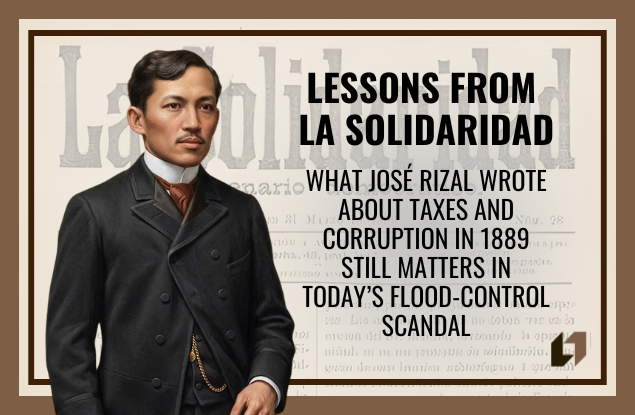
More than a century ago, Filipino reformist José Rizal wrote about taxes, corruption, and government accountability in an article published in the reformist newspaper La Solidaridad.
The essay, written in May 1889 while Rizal was part of the Filipino reform movement in Europe, examined how Spanish colonial authorities governed the Philippines and how public funds collected from taxpayers were used. Rizal addressed the article primarily to Spanish readers and policymakers, hoping to expose the abuses of the colonial system and push for reforms in the administration of the islands.
Although Rizal was responding to the political conditions of his own time, many of the questions he raised remain strikingly relevant today.
At the center of his argument was a simple but powerful principle: if citizens are required to pay taxes, those resources must ultimately serve the people.
Taxes exist to support public services, infrastructure, education, and institutions that strengthen society. They represent a social contract between the state and its citizens—an agreement that public money will be used for the common good.
But when those resources are misused, diverted, or captured by private interests, that relationship between citizens and government begins to break down.
Rizal’s Argument About Public Money
Rizal believed that taxation should benefit the community that provides those resources. If people are required to pay taxes while receiving little in return, the system becomes unjust.
He raised this concern directly in his article:
“Why should the people who pay their taxes be obliged to work gratuitously? Why pay at all if they are not permitted to live for their families?”
During the colonial period, Filipino communities were often required to provide forced labor for public works while still paying various taxes. To Rizal, this situation violated the basic purpose of taxation.
He pushed the question even further:
“Must they pay to be enslaved? Does the taxpayer’s money serve to hire petty tyrants and not to satisfy the needs of the community?”
Rizal’s criticism went beyond the issue of taxes themselves. His deeper concern was how public funds were being used.
If tax revenues were diverted to support corrupt officials, abusive administrators, or inefficient systems, the people who paid those taxes would see little benefit from their sacrifices.
In modern economic language, Rizal was describing what economists today call misallocation of public resources.
Corruption and the Damage It Causes
Rizal also warned that corruption and political manipulation often distort the proper functioning of government.
He described how personal rivalries and ambition could influence political decisions:
“In this political war all means, good or bad, are employed—bribes, gifts, lies, accusations, tattling.”
His description captures a political environment where competition for power encourages unethical behavior.
Rizal believed this kind of culture could spread throughout society.
He warned that when leaders behave dishonestly, institutions begin to deteriorate and the public eventually learns the same habits.
“The nation that they wish to call a ‘child’ has had bad teachers and has learned bad examples.”
In other words, corruption at the top can gradually shape the behavior of the entire system.
A Warning About Abuse of Power
Rizal understood that poor governance can eventually threaten social stability.
If people believe that the system is unfair or abusive, resentment can slowly build.
He wrote:
“Treat the people well, teach them the sweetness of peace so that they can love it and maintain it.”
Stable societies depend on trust between citizens and their government.
But Rizal warned that continued abuse could have serious consequences:
“In the Philippines today there is still no filibusterismo, but there will be for sure and it would be terrible if the abuses continue.”
This was not merely a political warning. It was a reminder that injustice and corruption can eventually provoke deep social unrest.
Why Rizal’s Message Still Matters Today
More than 130 years later, Rizal’s observations remain relevant.
In recent years, investigations in the Philippines have raised serious questions about the management of public infrastructure funds, particularly involving flood-control projects intended to protect communities from disasters.
Allegations have surfaced involving projects that were overpriced, poorly constructed, incomplete, or possibly never built at all despite receiving large amounts of public funding.
For taxpayers, the issue is not simply political controversy.
It is about accountability.
Citizens contribute taxes with the expectation that those funds will improve infrastructure, protect communities, and strengthen public services. When those funds are misused, the consequences are felt directly by ordinary people.
In a country frequently affected by floods and typhoons, the failure of flood-control infrastructure can mean destroyed homes, lost livelihoods, and damaged communities.
The Economic Cost of Corruption
Modern economists often emphasize that corruption has serious economic consequences.
When public funds are misused:
- infrastructure projects become inefficient or poorly built
- public services deteriorate
- investor confidence weakens
- economic development slows.
Rizal understood this long before modern economic theory formalized these ideas.
His criticism of colonial governance was essentially a warning about how corruption can weaken institutions and undermine public trust.
A Lesson That Still Applies
The Philippines today is very different from the colonial society Rizal criticized in 1889.
Yet the principle he defended remains unchanged.
Taxes represent a contract between the state and its citizens. People contribute resources with the expectation that those resources will improve society.
When governments use public funds responsibly, societies can build strong institutions, attract investment, and sustain economic growth.
But when public money is misused, the consequences extend far beyond financial losses.
More than a century ago, Rizal recognized a truth that still shapes debates about governance today:
public money must ultimately serve the people who provide it.
And when it does not, citizens have every right to ask why.

