

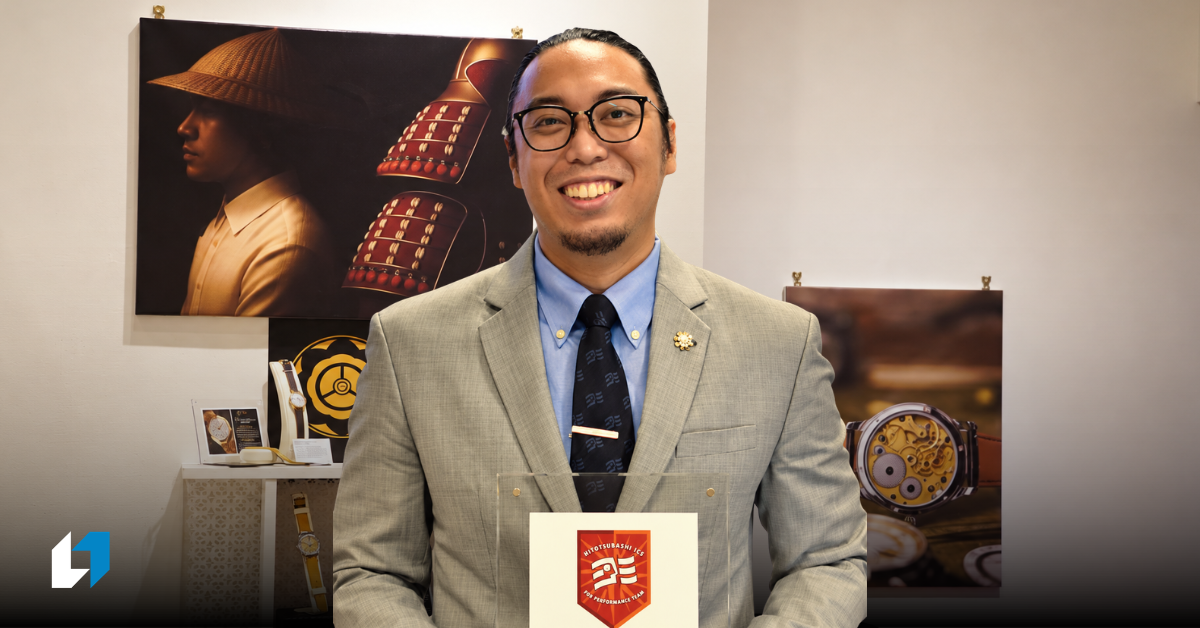
For many entrepreneurs, success is often measured by growth—more sales, more customers, more expansion. But for Francisco Moreno Jr., founder of Ibarra Watches and Moreno Watch Studio Tokyo, one of the most important lessons in building a lasting brand came not from scaling a business, but from learning how to slow down.
That lesson emerged during his time in Japan.
In 2022, Moreno moved to Tokyo to pursue an MBA at Hitotsubashi University. While the academic experience was valuable, the deeper impact came from something outside the classroom: the culture of craftsmanship he encountered among Japanese artisans.
What he discovered reshaped the way he thinks about both watchmaking and entrepreneurship.
A different understanding of craft
Japan has a long tradition of craftsmanship guided by the philosophy of shokunin, often translated simply as “artisan.” But Moreno quickly realized that the meaning runs deeper than the English translation suggests.
“Shokunin is sometimes translated simply as artisan, but the word carries something heavier — a lifetime of service to the work itself, with no completion point and no room for ego,” Moreno says.
In Japan, mastery is not treated as a destination. It is a lifelong commitment.
Through his professional relationships in Tokyo’s watchmaking community, Moreno met craftspeople who had spent decades refining a single discipline. Many of them worked quietly, without public recognition or commercial ambition.
What impressed him most was their humility.
“What moved me most in the craftsmen I met in Japan was how they were expressing their mastery modestly, and how much they were living it completely,” he says.
For Moreno, the experience offered a different way of thinking about achievement.
Competing with your past self
In many industries, businesses measure success by outperforming competitors. The shokunin mindset approaches the question differently.
“The shokunin mindset does not compete outward; it competes inward,” Moreno explains.
Instead of asking how to beat rivals, craftsmen focus on improving their own work.
“The craftsman’s only true opponent is yesterday’s version of himself,” he says.
For entrepreneurs used to chasing market share and rapid expansion, that philosophy can feel counterintuitive. But Moreno believes it offers a more sustainable way to build a brand.
By focusing on continuous improvement rather than constant comparison, businesses can develop deeper expertise and stronger identity.
Craftsmanship in an age of mass production
The lesson became particularly meaningful in an era when many products are designed for efficiency rather than longevity.
Modern manufacturing often prioritizes scale. The faster something can be produced, the more profitable it becomes. But craftsmanship follows a different logic.
“Craftsmanship is the truest form of luxury I know,” Moreno says. “Because it contains something that cannot be replicated at scale: the maker’s time, attention, and life.”
When a craftsman invests personal effort into an object, Moreno believes something intangible is transferred to the final product.
“When more of a human being goes into an object, something intangible transfers,” he says.
For watchmaking—a field where mechanical precision and aesthetic beauty must coexist—that philosophy feels especially relevant.
Two paths: business and craft
Moreno’s work now operates across two complementary worlds.
Through Ibarra Watches, he develops timepieces that can be produced and distributed to a wider market. These watches combine classic design with modern components and accessible serviceability.
But in Tokyo, Moreno also works independently through Moreno Watch Studio, where the focus shifts from scale to craftsmanship.
His independent projects allow him to explore watchmaking as a personal craft, producing pieces that involve more direct hand-finishing and artistic experimentation.
“My independent work at Moreno Watch Studio in Tokyo is where I pursue craftsmanship in its spirit — working with my hands, finishing by hand, doing it patiently without rules or expectations from others,” he says.
The experience allows Moreno to balance two different forms of creation: entrepreneurship and artistry.
Learning from Japanese discipline
Japan’s influence on Moreno extends beyond technical skill. The country also changed how he thinks about the relationship between work and purpose.
During his time there, he encountered craftsmen who devoted their entire lives to perfecting a single discipline.
Many of them pursued mastery quietly, without public recognition or commercial ambition.
That level of dedication left a strong impression.
“The rigour of that, and the absence of ego within it, recalibrated everything I thought I knew about what it means to make something well,” Moreno says.
The experience reinforced a belief that excellence often emerges from patience rather than speed.
Lessons for entrepreneurs
For Moreno, the philosophy of shokunin offers lessons that extend far beyond watchmaking.
In business, entrepreneurs often feel pressure to move quickly—to launch new products, enter new markets, or chase the next opportunity.
But craftsmanship encourages a different mindset: build carefully, improve constantly, and measure success by the quality of the work itself.
Perspective, Moreno believes, is the most valuable lesson.
“Awareness of external conditions matters — but how you internalize them, and what they demand of you personally, is what defines what you build,” he says.
That philosophy applies not only to artisans but also to founders trying to build something meaningful over the long term.
Building something that lasts
The influence of Japan continues to shape Moreno’s work today.
Several of his watch designs reflect the patience and intentionality he developed during his time in Tokyo. Projects such as the Kaminari and Hatsushizuku at Moreno Watch Studio represent his attempt to translate the shokunin mindset into watchmaking.
Japan has also recognized his work formally. Moreno says he has been recognized there as an artist—an acknowledgment he describes as both humbling and motivating.
“This makes me grateful to Japan also, that they are allowing me to continue honing my craft here,” he says.
For Moreno, the journey of mastery remains ongoing.
In the world of craftsmanship, there is no finish line—only the next opportunity to do the work a little better than before.

