

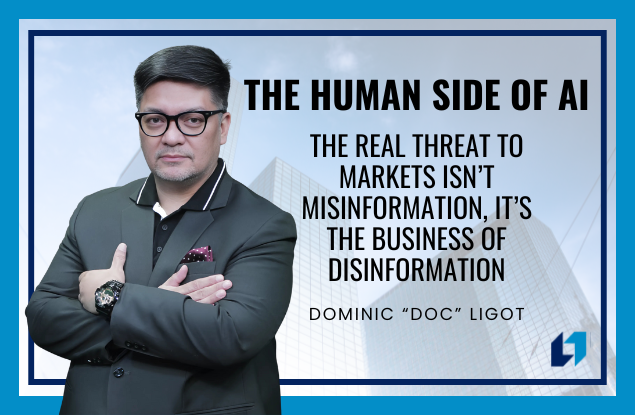
In the financial world, risk is often defined as what you don’t see coming. And when it comes to the digital environment Filipinos now operate in, one of the most underestimated risks is not ordinary misinformation, it’s organized, industrial-scale disinformation.
As I recently emphasized in the House Committee on Public Information, the danger no longer comes from random netizens posting half-truths. The real threat is the rise of engineered influence operations, PR firms masquerading as grassroots opinion, coordinated troll networks, AI-generated narratives, and paid actors hired to manipulate public perception.
For financial advisers, this is not merely a political problem. This is a market stability problem.
Organized disinformation preys on human psychology and hijacks the algorithms that shape sentiment, sentiment that directly affects investments, consumer behavior, regulatory direction, and, ultimately, the financial decisions our clients make. A rumor amplified by paid networks can spark a run on a stock, fuel panic over economic outlooks, or distort public understanding of real financial risk.
And here’s the uncomfortable truth: Filipinos unknowingly become amplifiers. A well-crafted falsehood, engineered by professionals, boosted by AI, wrapped in emotional cues, can feel organic, urgent, and share-worthy. The result is a feedback loop where fabricated narratives spread faster than facts.
Our point is crucial: our laws already deal with libel and slander. What they do not address are conspiracies to mass-produce and mass-distribute falsehoods, the industrial-level coordination that turns deception into a scalable business.
For advisers, this should be a wake-up call.
Your clients’ worldview is increasingly shaped by forces designed not to inform, but to manipulate. Their financial confidence, their fears, their investment decisions, all can be nudged by orchestrated campaigns operating in the shadows.
That’s why financial advisers must now see information literacy as part of their advisory mandate. We must become filters, educators, and advocates for evidence-based decision-making. We cannot advise clients effectively if they are consuming polluted information streams.
A more resilient financial ecosystem requires more than good policy, it requires professionals who can guide clients through a landscape where truth is no longer the default.
The disinformation industry is evolving fast. Our advisory practices must evolve faster.
The next time a client panics over a headline or shares a viral claim that “everyone is talking about,” don’t just correct it. Explain why such narratives spread, and who profits when they do.
Because in today’s environment, guarding wealth also means guarding the truth.
Dominic “Doc” Ligot is one of the leading voices in AI in the Philippines. Doc has been extensively cited in local and global media outlets including The Economist, South China Morning Post, Washington Post, and Agence France Presse. His award-winning work has been recognized and published by prestigious organizations such as NASA, Data.org, Digital Public Goods Alliance, the Group on Earth Observations (GEO), the United Nations Development Programme (UNDP), the World Health Organization (WHO), and UNICEF.
If you need guidance or training in maximizing AI for your career or business, reach out to Doc via https://docligot.com.

