

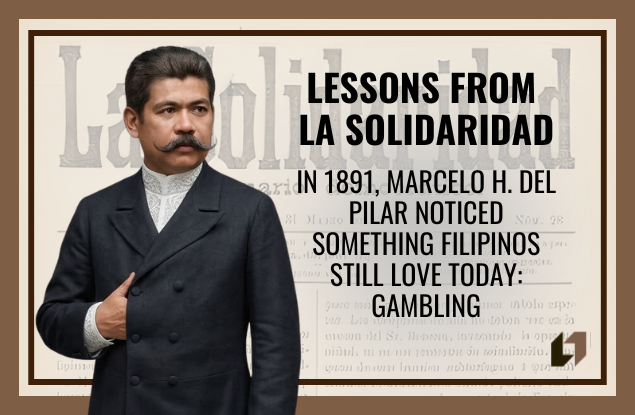
In March 1891, Filipino reformist Marcelo H. del Pilar published an essay titled “The Dawn of Redemption” in the reformist newspaper La Solidaridad.
The article focused primarily on colonial policy and the need for reforms in the Philippines. Yet within the essay, del Pilar inserted a small but revealing economic observation about trade between Spain and its colony.
Examining import statistics, he noted that essential materials that supported economic development—such as wheat flour, iron products, and other industrial goods—came mainly from countries like China, England, Germany, and the United States.
Spain, the colonial power that governed the Philippines, appeared only marginally in this list.
But when del Pilar looked at another category of imports, the situation suddenly changed.
Spain dominated the export of playing cards used for gambling.
Del Pilar wrote with unmistakable irony:
“Spain contributes very little to our industrial life; but she has secured for herself the monopoly of sending us playing cards.”
According to the figures he cited, the Philippines imported 47,200 kilograms of playing cards from Spain, a volume far greater than that supplied by any other country.
The contrast was striking. While other nations provided goods that helped build industries, Spain’s most visible contribution to the colonial economy appeared in a very different form.
Del Pilar highlighted the irony with biting sarcasm:
“Thus the mother country, which gives us neither factories nor industries, takes care that we shall not lack cards with which to gamble.”
In other words, Spain had little presence in the trade of materials that strengthened economic productivity, yet it was firmly established in supplying products associated with gambling.
A Long-Standing Appetite for Gambling
Del Pilar’s statistics suggest that gambling was already deeply embedded in everyday life in the Philippines during the late nineteenth century. The heavy demand for playing cards indicated that games of chance were not merely occasional amusements but a widespread social activity.
The numbers he cited offered an indirect glimpse into the habits of colonial society.
By presenting the statistics in such a pointed way, del Pilar implied that the colonial system did little to encourage economic development while allowing other, less productive activities to flourish.
His commentary hinted at a broader question about priorities.
From Playing Cards to Digital Betting
The tools of gambling today look very different from the playing cards that del Pilar described in 1891.
Instead of decks imported from Spain, modern technology has created an entirely new landscape of betting opportunities. Online casinos, sports betting platforms, digital gaming apps, and mobile gambling systems now make participation in games of chance easier than ever.
With a smartphone and a digital wallet, individuals can place bets or join online games within seconds.
What once required a deck of cards and a table of players can now take place instantly on a screen.
Yet the attraction remains the same: the possibility of winning quickly through luck rather than sustained effort.
The Risk Behind the Culture of Chance
Del Pilar’s observation also raises a deeper economic issue. Activities based on chance and speculation can generate excitement and entertainment, but they rarely produce lasting wealth.
Whether in nineteenth-century card games or modern online betting platforms, the odds are generally structured in favor of the organizer rather than the participant.
For individuals, the danger lies in confusing the thrill of gambling with the process of building financial security. Short-term wins can feel rewarding, but long-term prosperity usually depends on patience, discipline, and productive investment.
A Lesson Hidden in an Old Statistic
The figure cited by del Pilar—47,200 kilograms of playing cards imported into the Philippines—may appear to be a small detail in colonial trade records.
But sometimes a small statistic reveals something larger about society.
More than a century ago, Filipinos were already drawn to games of chance. Today the tools have changed, moving from imported playing cards to digital betting platforms and mobile gaming apps. But the temptation remains the same: the appeal of quick rewards and the excitement of uncertainty.
Del Pilar’s observation reminds us that societies often reveal their habits through what they consume.
And occasionally, a single line in an old trade report can tell us more about human behavior than a long political speech.

